


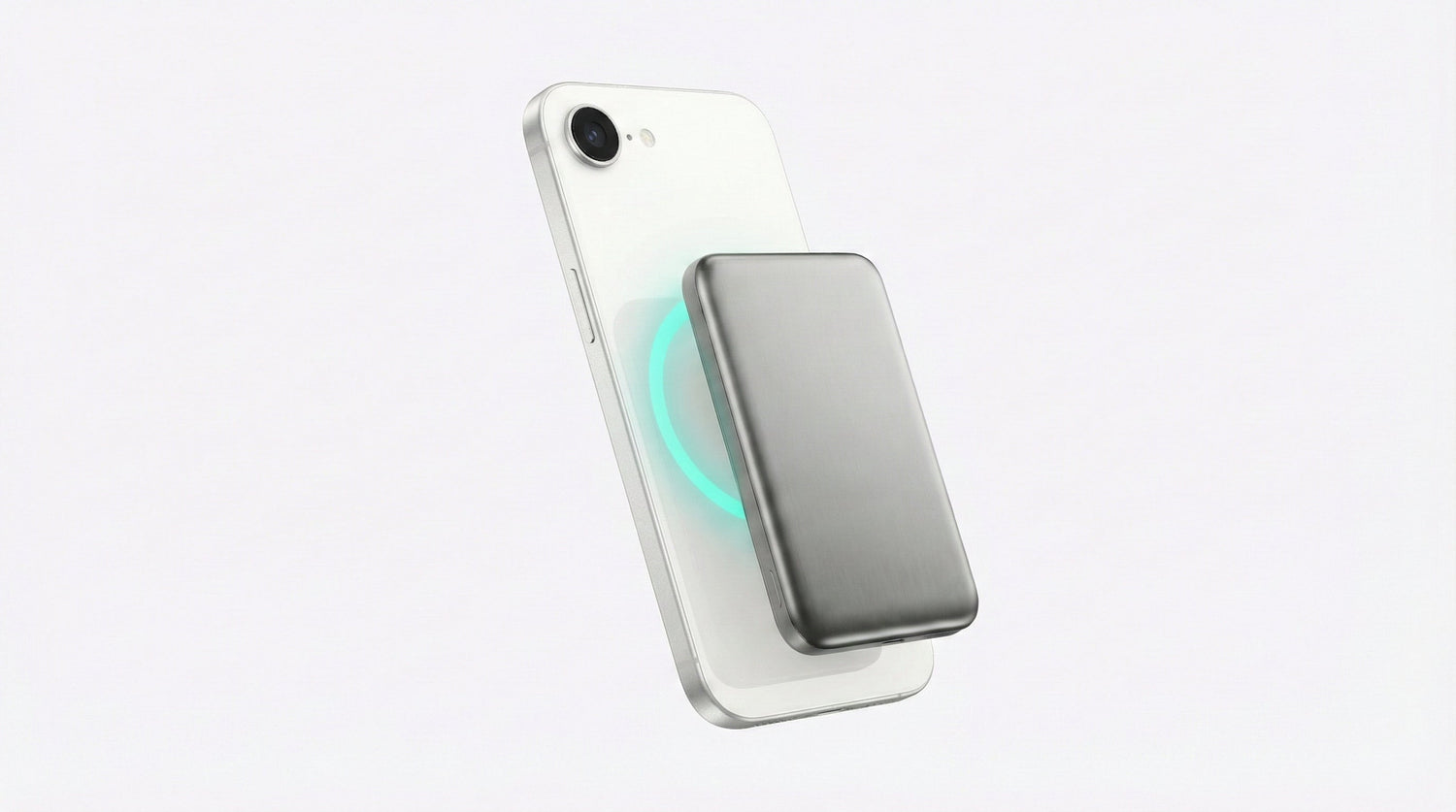
The iPhone 17e supports MagSafe and Qi2 wireless charging for the first time. It charges at up to 20W wired via USB-C (50% in 30 minutes) and 15W wirelessly via MagSafe or Qi2. This is a major upgrade from the iPhone 16e, which only supported slow 7.5W Qi charging with no magnetic alignment. The 17e also has a 4,005mAh battery, which means heavy users will want a power bank that takes full advantage of these new charging capabilities. BMX's SolidSafe power banks are a natural fit: they match the 17e's exact charging speeds (15W Qi2 wireless, 20W USB-C PD wired) and use semi-solid-state battery cells with a gel-like electrolyte instead of the free-flowing flammable liquid found in conventional lithium-ion, designed to improve thermal stability and greatly lower fire risk.
What Changed from the iPhone 16e: The Charging Upgrade That Matters
When Apple launched the iPhone 16e, the biggest complaint wasn't the camera or the chip. It was the charging. No MagSafe. No magnetic alignment. Just basic 7.5W Qi wireless charging, the same slow standard from 2017. Apple's reasoning was that "most people in the 16e's target audience exclusively charge with a cable." Users disagreed. Loudly.
The iPhone 17e fixes that. Here's what changed:
| Charging Feature | iPhone 16e | iPhone 17e |
|---|---|---|
| MagSafe | No | Yes (15W) |
| Qi2 wireless | No | Yes (15W) |
| Qi wireless | 7.5W (no magnets) | Backward compatible |
| Wired USB-C | 20W | 20W |
| 0 to 50% (wired) | ~30 min | ~30 min |
| Magnetic alignment | None | Full MagSafe ring |
| Battery | 4,005mAh | 4,005mAh |
| Port | USB-C | USB-C |
| Price | From $599 | From $599 |
The headline: wireless charging speed doubled from 7.5W to 15W, and magnetic snap-on alignment is finally here. That means MagSafe chargers, MagSafe wallets, and most importantly, magnetic power banks all work with the 17e for the first time. Every accessory in the MagSafe ecosystem just opened up to budget iPhone buyers.
4,005mAh: What That Actually Means for Your Day
The iPhone 17e keeps the same 4,005mAh battery as the 16e. Apple rates it at 26 hours of video playback, which sounds great on paper. The A19 chip is more power-efficient, which helps.
But in real-world heavy use, 4,005mAh is 4,005mAh. If you're streaming music on your commute, navigating with Maps, checking social media throughout the day, and taking photos, you're going to see the battery percentage drop into uncomfortable territory by late afternoon. That's not a knock on the phone. It's just physics: a smaller battery in a device you use constantly needs backup power.
The good news is that the 17e now charges fast enough, both wired and wireless, that topping up takes minutes instead of the slow crawl that 7.5W Qi offered on the 16e. And with MagSafe support, you can snap on a magnetic power bank and keep using the phone normally while it charges. That's the real upgrade.
iPhone 17e Charging Specs: Everything You Need to Know
| Spec | iPhone 17e |
|---|---|
| Battery capacity | 4,005mAh |
| Port | USB-C |
| Max wired charging | 20W (USB-C PD) |
| 0 to 50% wired | ~30 minutes (20W+ adapter) |
| MagSafe wireless | 15W (with 20W+ adapter) |
| Qi2 wireless | 15W (with 20W+ adapter) |
| Qi (legacy) wireless | 7.5W (backward compatible) |
| Qi2.2 (25W) | Not supported (17 / Pro / Pro Max only) |
| Adapter needed (wired) | 20W+ USB-C PD |
| Adapter needed (wireless) | 20W+ (for MagSafe/Qi2 charger) |
| USB data speed | USB 2 (480Mbps) |
| In the box | USB-C cable only (no adapter) |
Two things to note: Apple doesn't include a power adapter in the box, just a cable. And the 17e uses Qi2, not the newer Qi2.2 standard on the pricier models. That's actually fine. Qi2 at 15W is exactly the wireless speed the 17e supports, so a Qi2 charger or power bank will hit full speed without overpaying for a Qi2.2 charger you can't use.
Which Chargers Work with the iPhone 17e
Wired (USB-C)
Any USB-C Power Delivery adapter rated at 20W or higher will fast-charge the iPhone 17e at its maximum speed. If you already have a 20W adapter from an iPad, MacBook charger, or any third-party USB-C PD charger, you're set. No need to buy a new one.
Wireless (MagSafe / Qi2)
Any MagSafe charger or Qi2-certified charger paired with a 20W+ adapter will deliver the full 15W. If you're upgrading from a 16e, this is brand new territory. The magnetic alignment means the phone snaps into place on the charger or power bank perfectly every time, no more fiddling to find the sweet spot like with old Qi pads.
Older Qi chargers still work at 7.5W, but honestly, once you experience magnetic snap-on charging at double the speed, you won't go back.
The Case for a Power Bank with the iPhone 17e
Here's the situation: the iPhone 17e has a 4,005mAh battery, which is solid but not huge. Heavy users will hit 20-30% by late afternoon. The phone now supports magnetic wireless charging for the first time. And it doesn't come with a power adapter in the box.
A Qi2 magnetic power bank solves all of this. Snap it on, keep using your phone, and top up whenever you need to. No cable, no hunting for outlets, no interruption. The 17e's 15W Qi2 wireless and 20W USB-C PD wired speeds mean a good power bank can push meaningful charge into the phone in 20-30 minutes.
But here's what most people don't think about: that power bank is magnetically attached to your phone, pressed against the back of a device you hold to your face, carry in your pocket, and set on your nightstand. The battery chemistry inside it matters.
Most power banks use conventional lithium-ion cells packed with liquid electrolyte. That liquid is flammable. It's why power banks get recalled, why airlines restrict them, and why you occasionally see news stories about one catching fire. The risk is low, but it exists every time you use one.
How to Choose Your Next Power Bank
Lithium-ion power banks have been recalled by the millions for fire and burn hazards. The root cause is almost always the same: cells packed with free-flowing flammable liquid electrolyte that can vaporize and ignite when damaged. That's the technology inside nearly every power bank on the market right now.
Semi-solid-state is a newer approach. Instead of free-flowing liquid, the electrolyte is a gel. BMX's SolidSafe line uses semi-solid-state cells with only about 2.5% liquid content. The rest is a gel-like electrolyte that doesn't flow the same way conventional lithium-ion liquid does.
What does that mean in practice?
- Much lower fire risk by design. When a conventional lithium-ion cell is damaged, the liquid electrolyte can move, vaporize, and ignite. In SolidSafe cells, the gel stays put. It doesn't flow, which helps prevent damage from escalating into thermal runaway. SolidSafe cells have been drilled, cut, and punctured while fully charged with no fire and no thermal runaway. No battery is completely risk-free, but the way damage escalates is fundamentally different.
When your power bank snaps magnetically onto a phone that costs $599 and sits against your body all day, the battery chemistry inside it is the most important thing about the product you can't see.
Every SolidSafe power bank matches the iPhone 17e's exact charging speeds: 15W Qi2 wireless and 20W USB-C PD wired. Here's how the three models differ.

SolidSafe Air 5K — Slimmer Than Your iPhone 17e
CES 2026 Innovation Award Winner | Featured by Tech Radar, Android Police, Cult of Mac
The iPhone 17e is 7.8mm thick. The SolidSafe Air 5K is 6.8mm - a full millimeter thinner than the phone it's charging, and just 116g. It snaps onto the back of the 17e via Qi2 magnetic alignment and delivers 15W wireless, the phone's maximum wireless speed, or 20W wired via USB-C PD, the phone's maximum wired speed. Full speed, both ways.
Titanium enclosure built for the pocket. Inside: semi-solid-state cells with a gel-like electrolyte instead of the free-flowing flammable liquid found in conventional lithium-ion. That means much lower fire risk by design, right against the back of your new phone. This is the power bank for people who bought the 17e because they wanted something sleek and don't want to ruin it with a bulky battery pack.
$59.99 | Shop SolidSafe Air 5K →
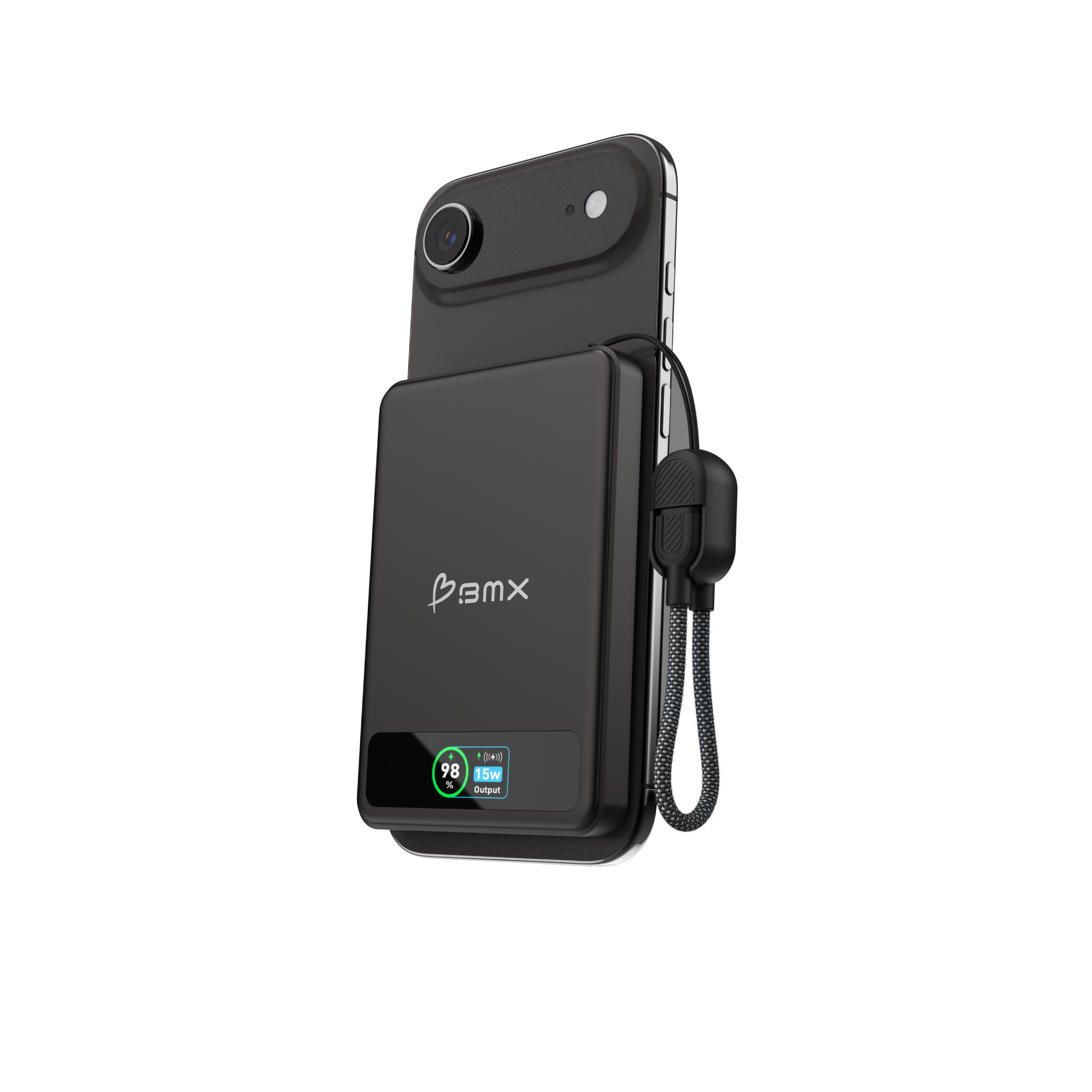
SolidSafe 5K — The Everyday Carry
Same 15W Qi2 wireless and 20W USB-C PD wired that match the 17e's full charging speed. The difference is the extras: a full-color LCD that shows exact wattage and battery percentage in real time so you always know what's happening, a built-in USB-C lanyard cable that wraps around the body as a lanyard so you never forget a cable, and pass-through charging so you can charge the power bank and your 17e at the same time from a single outlet.
Precision-milled aluminum unibody that doubles as a heat sink. Semi-solid-state cells with significantly less flammable liquid electrolyte than conventional lithium-ion. Two-year warranty. This is the one you throw in your bag every morning without thinking about it.
$59.99 | Shop SolidSafe 5K →
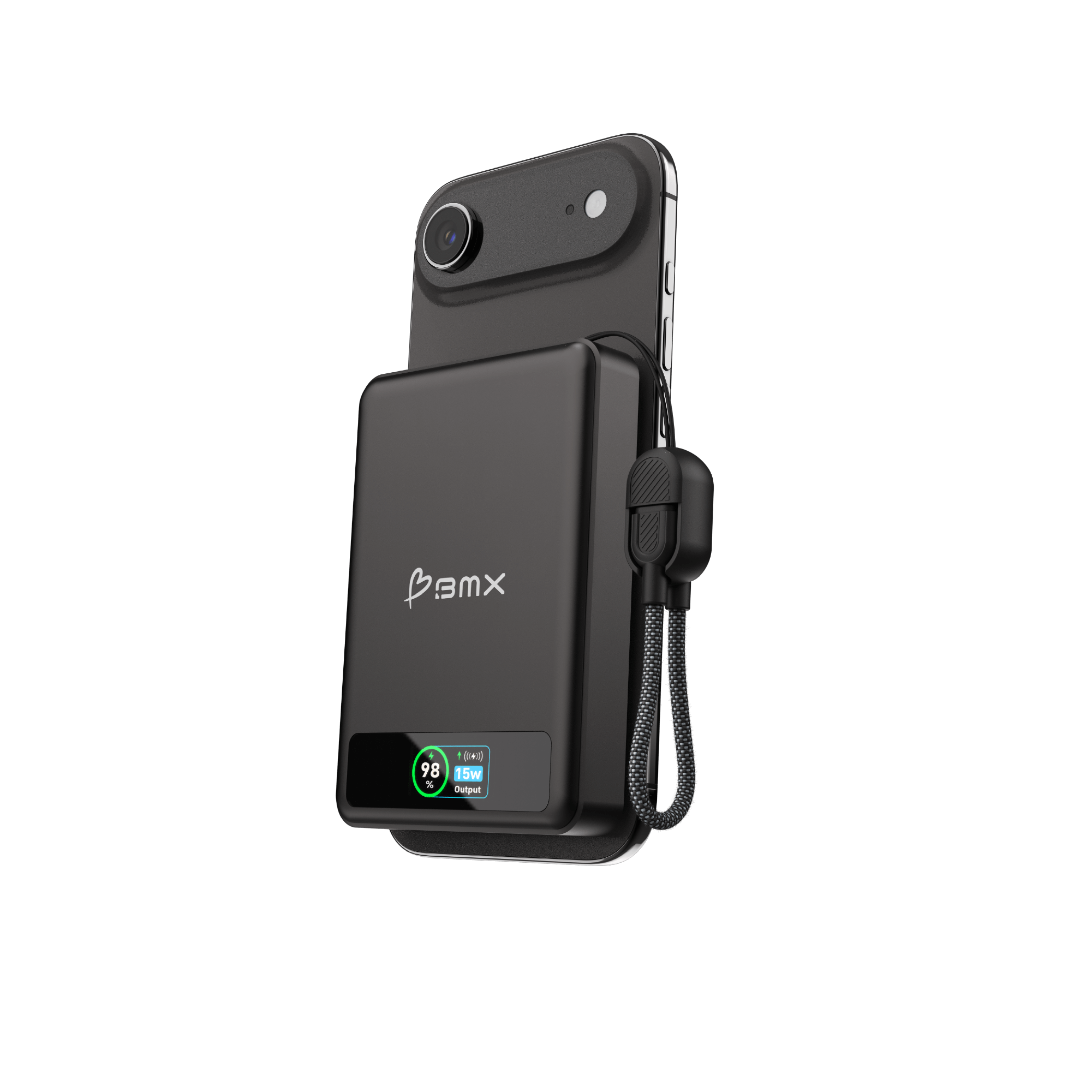
SolidSafe 10K — All-Day Power for Travel Days
When your 17e needs to last through a full travel day, a conference, a festival, or any day where outlets aren't an option. The SolidSafe 10K has double the capacity of the 5K with 30W output across dual USB-C ports plus 15W Qi2 wireless. Wirelessly charge your 17e while simultaneously wired-charging your AirPods and Apple Watch. Three devices from one power bank.
Same precision-milled aluminum chassis. Same full-color LCD. Same built-in cable. Same semi-solid-state cells with a gel-like electrolyte that greatly lowers fire risk by design. At 37Wh, it's well under the FAA's 100Wh carry-on limit. No questions at airport security.
$79.99 | Shop SolidSafe 10K →
SolidSafe + iPhone 17e: Full Compatibility
| Feature | SolidSafe Air 5K | SolidSafe 5K | SolidSafe 10K |
|---|---|---|---|
| Qi2 wireless output | 15W (17e max) | 15W (17e max) | 15W (17e max) |
| USB-C PD wired output | 20W (17e max) | 20W (17e max) | 30W dual USB-C |
| Charges 17e at full speed | Yes, both modes | Yes, both modes | Yes, both modes |
| Simultaneous devices | 2 | 2 | 3 |
| Battery chemistry | Semi-solid-state | Semi-solid-state | Semi-solid-state |
| Body | Titanium, 6.8mm | Aluminum unibody | Aluminum unibody |
| Built-in cable | No | Yes (USB-C) | Yes (USB-C) |
| Display | LED indicators | Full-color LCD | Full-color LCD |
| Airline carry-on | Yes (18.5Wh) | Yes (18.5Wh) | Yes (37Wh) |
| Price | $59.99 | $59.99 | $79.99 |
How the iPhone 17e Compares to the Rest of the iPhone 17 Lineup
If you're deciding between the 17e and other iPhone 17 models, here's how charging compares:
| Spec | iPhone 17e | iPhone 17 | iPhone 17 Pro | iPhone 17 Pro Max |
|---|---|---|---|---|
| Battery | 4,005mAh | 3,692mAh | 4,252mAh | 5,088mAh |
| Wired charging | 20W | 40W | 40W | 40W |
| 0 to 50% | ~30 min | ~20 min | ~20 min | ~20 min |
| Wireless | 15W (Qi2) | 25W (Qi2.2) | 25W (Qi2.2) | 25W (Qi2.2) |
| MagSafe | 15W | 25W | 25W | 25W |
| Price | From $599 | From $799 | From $1,099 | From $1,199 |
The 17e charges at about half the wired speed of the standard 17 and Pro models. That's the tradeoff for $200-$600 less. For most people, 20W wired and 15W wireless is plenty fast. Where you'll feel the difference is on the 4,005mAh battery during heavy use days, which is exactly why a good power bank makes sense as a day-one accessory.
3 Things Worth Knowing About iPhone 17e Charging
MagSafe cases work. MagSafe and Qi2 charge through most cases. Thick wallet cases or cases with metal plates can interfere. If wireless charging feels slow, try without the case first.
Optimized Battery Charging is on by default. iOS learns your routine and sometimes pauses at 80% to protect long-term battery health. It can look like your charger stopped. It's doing you a favor. You can turn it off in Settings > Battery > Battery Health & Charging, but Apple recommends leaving it on.
The 17e uses Qi2, not Qi2.2. The iPhone 17 and Pro models support the newer Qi2.2 standard at 25W. The 17e supports Qi2 at 15W. That means you don't need to buy a Qi2.2 charger for the 17e. A standard Qi2 charger or power bank delivers full speed and usually costs less.
Frequently Asked Questions
Does the iPhone 17e have MagSafe?
Yes. The iPhone 17e supports MagSafe wireless charging up to 15W and Qi2 wireless charging up to 15W. This is a major upgrade from the iPhone 16e, which only supported basic 7.5W Qi wireless charging with no magnetic alignment. The 17e is the first budget iPhone to include MagSafe.
How fast does the iPhone 17e charge?
The iPhone 17e charges at up to 20W wired via USB-C (50% in about 30 minutes with a 20W+ adapter) and up to 15W wirelessly via MagSafe or Qi2. The 16e only supported 7.5W wireless, so the 17e's wireless charging is twice as fast.
What changed between iPhone 16e and 17e charging?
The iPhone 16e had no MagSafe and only supported 7.5W Qi wireless charging with no magnetic alignment. The iPhone 17e adds MagSafe and Qi2 at 15W, doubling wireless speed and adding magnetic snap-on alignment for chargers and power banks. Wired charging remains 20W USB-C on both models.
What is the best power bank for iPhone 17e?
Look for a power bank with Qi2 wireless at 15W (matching the 17e's max wireless speed) and USB-C PD at 20W (matching its max wired speed). The BMX SolidSafe Air 5K ($59.99) is 6.8mm thin with a titanium body and semi-solid-state cells for reduced fire risk. The SolidSafe 5K ($59.99) adds a built-in cable and full-color LCD. The SolidSafe 10K ($79.99) doubles the capacity with 30W combined output for multi-device charging. All three are Qi2 certified and MagSafe compatible.
Does the iPhone 17e support Qi2?
Yes. The iPhone 17e supports Qi2 wireless charging at up to 15W with magnetic alignment. It does not support Qi2.2 (the 25W standard on the iPhone 17 and Pro models). Any Qi2-certified charger or power bank will work at full 15W speed.
Do I need a new charger for the iPhone 17e?
For wired charging, any USB-C adapter rated at 20W or higher will fast-charge the iPhone 17e at full speed. For wireless, you'll need a MagSafe or Qi2 charger. The 17e supports MagSafe for the first time, so this is new territory for anyone upgrading from the 16e. Any existing MagSafe or Qi2 charger will work.
How big is the iPhone 17e battery?
The iPhone 17e has a 4,005mAh battery, roughly the same as the iPhone 16e. Apple rates it at up to 26 hours of video playback. In real-world heavy use with streaming, navigation, and social media, most users will need a top-up by late afternoon or evening.


Leave a comment
This site is protected by hCaptcha and the hCaptcha Privacy Policy and Terms of Service apply.