




Last updated: March 2026
You can still bring a power bank on a plane in your carry-on - any unit under 100 watt-hours (roughly 27,000mAh) is allowed without special approval. But more than 20 airlines now ban using them mid-flight, and the rules on storage, charging, and even which power banks clear security have changed fast.
Most of this started after a lithium-ion power bank fire destroyed an Air Busan A321 in January 2025. Within 12 months, airlines across Asia, Europe, and Australia rewrote their policies. Some ban in-flight use entirely. Others restrict overhead bin storage. China now requires government certification to carry one on a domestic flight at all. If you travel with a portable charger, the rules you followed six months ago may already be wrong. Here is the full 2026 breakdown.
Important
Power banks are still allowed on planes in carry-on luggage. The new bans target in-flight USE - charging devices with a power bank during the flight - and overhead bin storage. Checked baggage remains completely banned for all power banks worldwide.
Why Power Banks Keep Catching Fire on Planes
The Air Busan fire was not an isolated event. According to data from UL Standards & Engagement, power bank incidents on passenger flights increased 42% between 2024 and 2025. Power banks accounted for 30% of all thermal runaway incidents on flights - more than any other single device category, including vapes (28%). The FAA logged 620 lithium battery incidents on aircraft between 2006 and 2025.
The underlying problem is chemistry. Every conventional lithium-ion battery contains a flammable liquid electrolyte between the positive and negative electrodes. When a cell is damaged, overheated, or short-circuits internally, that liquid breaks down, flows, and feeds a chain reaction called thermal runaway. In a confined overhead bin at 35,000 feet, the results are catastrophic.
Banning in-flight use reduces the chances of a power bank overheating while actively charging a device. But the battery chemistry inside remains the same whether the power bank is on or off. A cell with a manufacturing defect or internal damage can short-circuit in your bag regardless of whether you press the power button. The power banks being recalled and causing incidents are not defective outliers. They use the same battery chemistry as nearly every portable charger on the market.
That is why the fundamental issue is the chemistry, not the behavior.
What Semi-Solid-State Batteries Change About Fire Risk
If the liquid electrolyte is what fuels thermal runaway, the most direct way to reduce fire risk is to reduce the liquid. That is the idea behind semi-solid-state battery technology.
BMX's SolidSafe power banks use semi-solid-state cells with an oxide electrolyte containing approximately 2.5% liquid content - compared to 25%+ in conventional lithium-ion. In a standard cell, the liquid electrolyte flows freely and feeds the chain reaction. In a semi-solid-state cell, there is not enough liquid to catch and not enough to spread. The reaction fizzles out instead of cascading.
In internal testing, BMX SolidSafe cells were drilled through while fully charged - with no fire and no thermal runaway. Standard lithium-ion ignites immediately in the same test:

BMX SolidSafe cell drill test: punctured while fully charged with no fire, no thermal runaway.
This does not make any battery risk-free, but it meaningfully lowers the risk profile at the chemistry level - which is what regulators and airlines are ultimately concerned about. Current airline rules do not yet differentiate by battery chemistry. They are based purely on watt-hour ratings. But the chemistry is the variable that actually determines whether a damaged cell starts a fire or does not.
Carry-On Rules and Watt-Hour Limits
While in-flight use rules are changing fast, the core carry-on regulations remain consistent across most international aviation authorities (FAA, EASA, IATA). These are based on watt-hour (Wh) capacity, not milliamp-hours (mAh).
| Watt-Hour Rating | Approximate mAh (at 3.7V) | Carry-On Status |
|---|---|---|
| Under 100Wh | Under ~27,000mAh | Allowed without airline approval |
| 100Wh - 160Wh | ~27,000 - 43,000mAh | Requires airline approval (max 2 units) |
| Over 160Wh | Over ~43,000mAh | Prohibited on all passenger aircraft |
| Any capacity | Any | Never allowed in checked baggage |
What this means for most travelers: A standard 5,000mAh power bank sits around 18-19Wh. A 10,000mAh power bank is roughly 37Wh. Both are well under the 100Wh threshold and do not require any airline approval to carry on. The vast majority of consumer power banks fall in this range.
The Wh formula is simple: multiply the mAh by the nominal voltage (usually 3.7V for lithium cells), then divide by 1,000. For example: 10,000mAh x 3.7V / 1,000 = 37Wh. Your power bank's Wh rating is often printed on the label, but if only mAh is listed, this formula gives you the answer.
Note: "TSA compliant" means a power bank falls within FAA/TSA watt-hour limits for carry-on. There is no TSA certification or approval program for power banks. Any power bank under 100Wh is compliant by default.
Every Airline Power Bank Ban and Restriction in 2026
The list below covers confirmed airline and country-level restrictions as of March 2026. Rules vary by carrier. Always check your specific airline's policy before flying, as new announcements continue.
| Airline / Country | In-Flight Use | Overhead Bin | Effective Date |
|---|---|---|---|
| Lufthansa Group | Banned (medical devices exempt) | Banned | Jan 15, 2026 |
| Includes: SWISS, Austrian, Eurowings, Brussels Airlines, Discover, Edelweiss, Air Dolomiti, ITA Airways | |||
| Korean Air | Banned | Banned | Jan 26, 2026 |
| Emirates | Banned | Restricted | Oct 2025 |
| Cathay Pacific | Banned | Restricted | Oct 2025 |
| Singapore Airlines | Banned | Restricted | 2025 |
| Qantas / Jetstar / Virgin Australia | Banned | Banned | Dec 15, 2025 |
| Japan (all carriers) | Banned | Banned | Apr 2026 |
| India (DGCA directive) | Banned | Restricted | 2025 |
| China (CAAC) | Restricted | Restricted | Jun 28, 2025 |
| China requires 3C (CCC) certification on all power banks carried on domestic flights. Uncertified power banks are confiscated at security. | |||
| Thai Airways, China Airlines | Banned | Restricted | 2025-2026 |
2026 IATA global rule change
The IATA Dangerous Goods Regulations 67th Edition, effective January 1, 2026, now prohibits charging power banks from in-seat USB ports on any flight worldwide. This applies even on airlines that still allow in-flight power bank use. You can no longer plug your power bank into the seat to recharge it.
China's 3C Certification Rule: The Strictest Power Bank Regulation in the World
China's Civil Aviation Administration (CAAC) introduced the most aggressive power bank regulation of any country. Since June 28, 2025, all portable power banks carried on domestic Chinese flights must have China Compulsory Certification (CCC, also called 3C). Power banks without the certification mark are confiscated at airport security. No exceptions.
CCC is not just a lab test. It includes factory audits, production line inspections, and ongoing compliance checks. Most international power bank brands have not gone through this process. If you fly domestically in China with a non-certified power bank, it will be taken from you at the gate.
BMX's SolidSafe Air 5K carries CCC certification - one of the only semi-solid-state power banks to hold this credential. For frequent China travelers, this is not a feature. It is a requirement.
How to Fly With a Power Bank in 2026: Checklist
Before every flight, confirm these seven things:
- Check the Wh rating - must be under 100Wh to carry on without airline approval. Look for the label on the back of the power bank.
- Pack it in your carry-on - power banks are banned from checked baggage on every airline worldwide. No exceptions.
- Keep it out of the overhead bin - store in seat pocket, under the seat, or on your person. Most airlines with new rules require this.
- Do not charge devices mid-flight on airlines that ban in-flight use. Check your specific carrier before boarding.
- Do not charge the power bank from the seat USB port - banned globally under IATA DGR 67th Edition, effective January 1, 2026.
- Maximum 2 power banks per passenger on most carriers. Some airlines limit to 2 units regardless of capacity.
- China flights: check for CCC (3C) certification - uncertified power banks are confiscated at security for domestic Chinese flights since June 2025.
Pro tip
Charge your phone fully before boarding. With in-flight power bank use banned on many carriers, your phone battery at the gate is what you are working with until you land. If your flight allows power bank use, charge during the cruise phase only - not during taxi, takeoff, or landing.
BMX SolidSafe Power Banks: Airline Compliance at a Glance
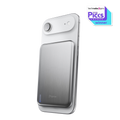
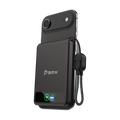
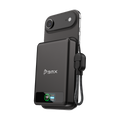
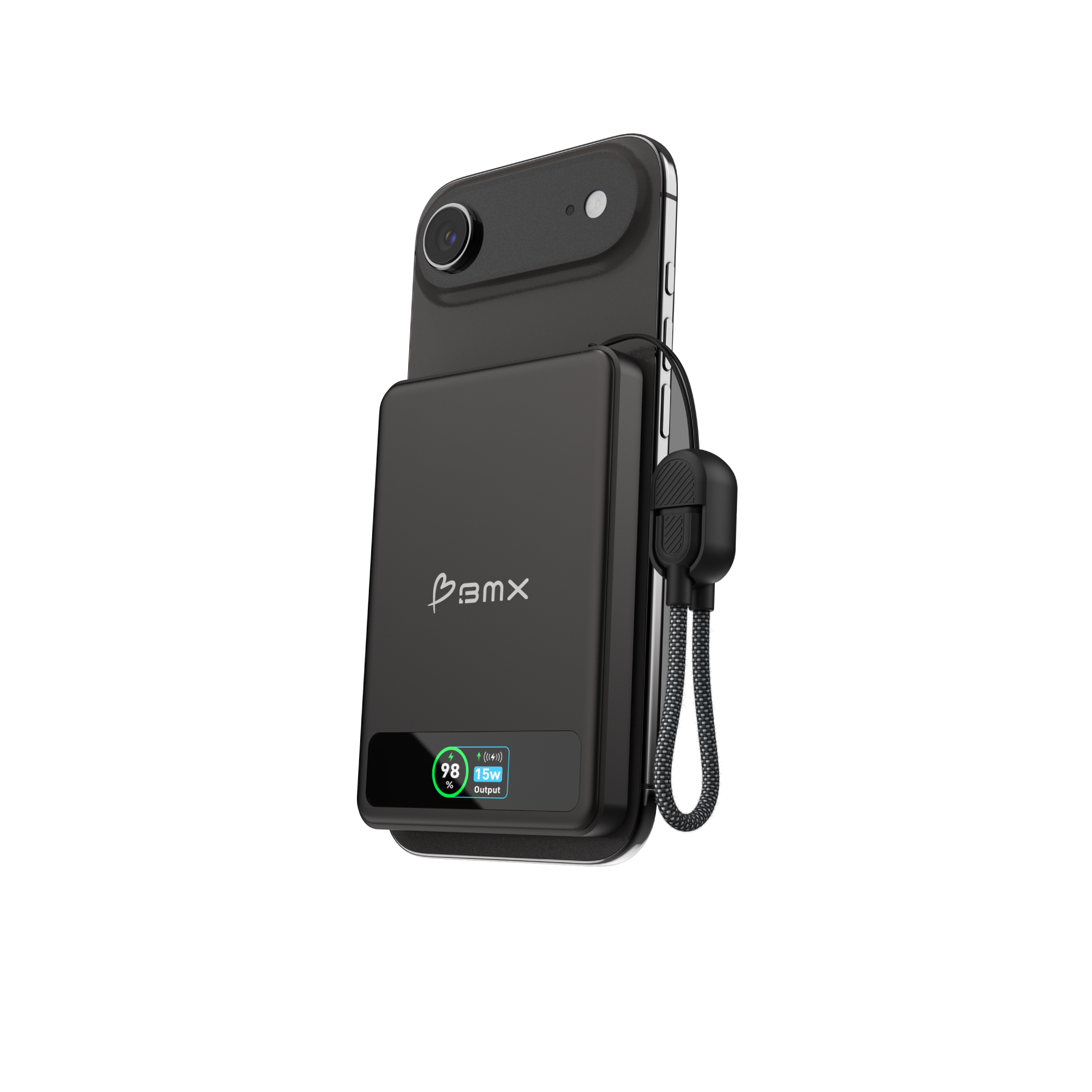
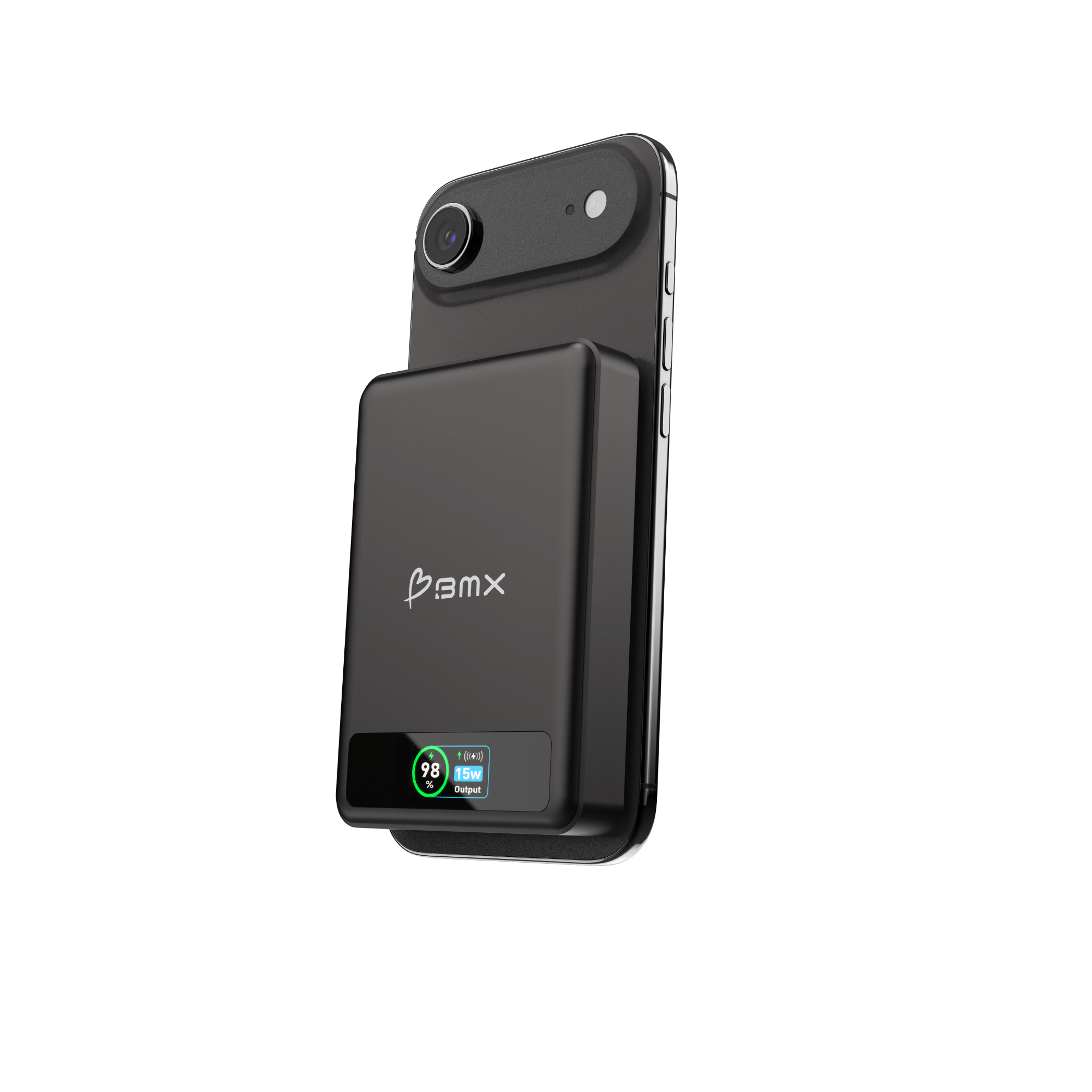
All three BMX SolidSafe power banks fall well under the 100Wh carry-on threshold. The Air 5K also carries CCC certification for China travel. Here is how they compare on the specs that matter for air travel.
| Spec | SolidSafe Air 5K | SolidSafe 5K | SolidSafe 10K |
|---|---|---|---|
| Capacity | 5,000mAh | 5,000mAh | 10,000mAh |
| Watt-Hours | ~18.5Wh | ~18.5Wh | ~37Wh |
| Under 100Wh (carry-on) | Yes | Yes | Yes |
| Battery Chemistry | Semi-solid-state (oxide) | Semi-solid-state (oxide) | Semi-solid-state (oxide) |
| CCC (3C) Certified | Yes | No | No |
| Wireless Charging | Qi2 15W | Qi2 15W | Qi2 15W |
| Price | $59.99 | $59.99 | $79.99 |

Frequently Asked Questions
Can I bring a power bank on a plane in 2026?
Yes. Power banks under 100Wh (roughly 27,000mAh) are allowed in carry-on luggage on virtually all airlines worldwide. They are never allowed in checked baggage. However, many airlines now restrict or ban using them to charge devices during the flight.
Which airlines have banned power banks on flights?
As of March 2026, more than 20 airlines ban in-flight power bank use, including Lufthansa Group (8 airlines), Korean Air, Emirates, Cathay Pacific, Singapore Airlines, Qantas, Jetstar, Virgin Australia, and all major Japanese carriers (effective April 2026). India's DGCA has also issued a blanket directive banning in-flight use and charging.
Can I put my power bank in the overhead bin?
Most airlines with updated 2025-2026 rules now prohibit overhead bin storage for power banks. Keep your power bank in the seat pocket, under the seat in front of you, or on your person. This rule exists because a thermal event in an overhead bin is harder for crew to detect and respond to.
What is the maximum Wh for a power bank on a plane?
Under 100Wh requires no special approval. Between 100-160Wh requires airline approval and is limited to 2 units per passenger. Over 160Wh is prohibited on all passenger aircraft. To calculate Wh from mAh: multiply mAh by 3.7, then divide by 1,000. A 10,000mAh power bank is approximately 37Wh.
Can I charge my power bank from the airplane USB port?
No. The IATA Dangerous Goods Regulations 67th Edition, effective January 1, 2026, prohibits charging power banks from in-seat USB ports on all flights globally. You can still charge devices like phones and tablets directly from the seat port, but plugging in a power bank to recharge it is no longer permitted.
Do I need 3C certification to bring a power bank on a flight in China?
Yes, for domestic Chinese flights. Since June 28, 2025, the CAAC requires all portable power banks carried on domestic flights to have CCC (3C) certification. Uncertified power banks are confiscated at airport security. BMX's SolidSafe Air 5K carries CCC certification. International flights into China may have different requirements - check with your airline.
Are semi-solid-state power banks safer to fly with?
Semi-solid-state cells like those in BMX's SolidSafe line contain significantly less flammable liquid electrolyte than conventional lithium-ion - approximately 2.5% versus 25%+ in standard cells. This reduces the fuel available for thermal runaway, the chain reaction behind battery fires. No battery is risk-free, but the risk profile is meaningfully lower. Current airline rules are based on watt-hour ratings and do not yet differentiate by chemistry.
Why are power banks banned from checked luggage?
Because a lithium battery fire in the cargo hold is undetectable by crew and inaccessible during flight. Carry-on placement ensures any thermal event can be identified and managed immediately using onboard fire suppression equipment. This is a universal rule across all airlines and aviation authorities.
SolidSafe Power Banks
Fly With Less to Worry About
Semi-solid-state cells with ~2.5% liquid electrolyte. TSA compliant. CCC certified (Air 5K). Engineered to reduce the fire risk that triggered 20+ airline bans.
See SolidSafe Power Banks


Leave a comment
This site is protected by hCaptcha and the hCaptcha Privacy Policy and Terms of Service apply.