





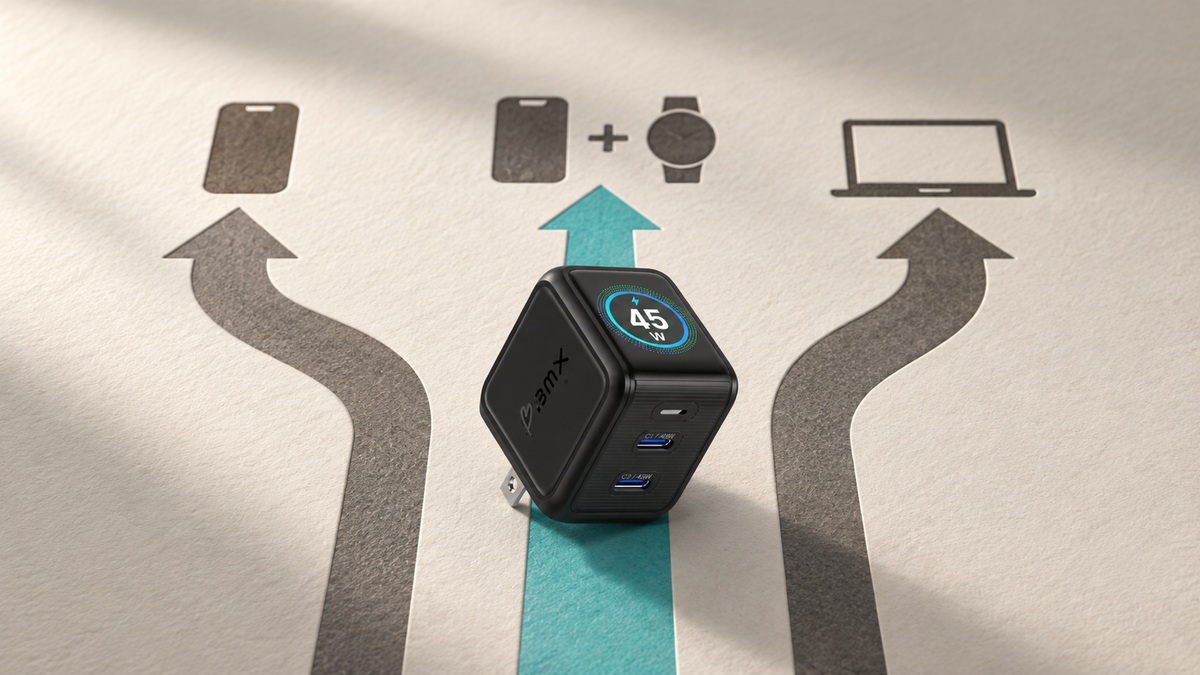
Yes, 20W is fast charging for many phones. It is not the universal answer anymore.
The right charger depends on your exact phone and the charging protocol it supports. A larger wattage number is only extra capacity until the phone can actually request it. Higher wattage becomes most useful when the same charger also powers your watch, tablet, or laptop.
Start with the phone, not the charger's biggest number
| Charger tier | What it means for a phone | When it earns its place |
|---|---|---|
| 5W | Slow by current standards | Overnight charging when speed does not matter |
| 20W | A real fast-charge baseline for many phones | One phone, especially when its published result calls for 20W or higher |
| 30W | More headroom, but only supported phones use it | Pixel 11 and Pixel 11 Pro with PPS, and other phones that publish a 30W-class result |
| 45W | Not automatically faster than 20W or 30W | Select Galaxy and Pixel models with the required protocol, or a phone plus another USB-C device |
| 65W to 140W | Usually laptop and multi-device territory | One charger replacing separate phone, tablet, watch, and laptop chargers |
Match the charging protocol before you compare wattage
Wattage tells you how much power a charger can supply. It does not tell you whether the charger and phone speak the same fast-charging language.
iPhone: Apple says an iPhone 17e or iPhone Air can reach its published 50 percent result with a 20W adapter or higher. The iPhone 17, iPhone 17 Pro, and iPhone 17 Pro Max move that published condition to 40W or higher. For iPhone 18 Pro, Apple specifies a 60W-capable or higher adapter with Adjustable Voltage Supply, or AVS, for its fastest published wired result. That does not mean the phone continuously draws 60W. It means the full benchmark depends on both wattage and AVS. See Apple's fast-charge guidance and the iPhone 18 Pro specifications.
Google Pixel: Google's current guidance says a compatible PPS adapter rated for 30W or more is required for the published maximum wired speed on applicable Pixel models. Pixel 11 and Pixel 11 Pro are documented up to 30W, while Pixel 11 Pro XL is documented up to 45W. A 45W label without PPS does not prove either result. See Google's Pixel charging guidance.
Samsung Galaxy: Samsung documents 25W and 45W charging tiers, with exact support varying by Galaxy model. The phone, compatible charger, protocol, and cable all matter. Buying 45W solely because the number is larger does not make every Galaxy charge at 45W. See Samsung's current charger guidance.
Let the phone request the power it can use
A charger's rating is a ceiling, not a command. USB Power Delivery allows a connected device to request only the power it needs. A 100W USB-C charger does not force 100W into a phone. The phone and charger negotiate a supported power level first.
That is why a higher-rated USB-C PD charger can be useful even when the phone uses only part of its capacity. The unused capacity can serve a second device, or it can let the same charger move from phone duty to laptop duty. For the mechanism in more detail, read how USB-C Power Delivery negotiates charging.
Choose more wattage when one charger needs to run more devices
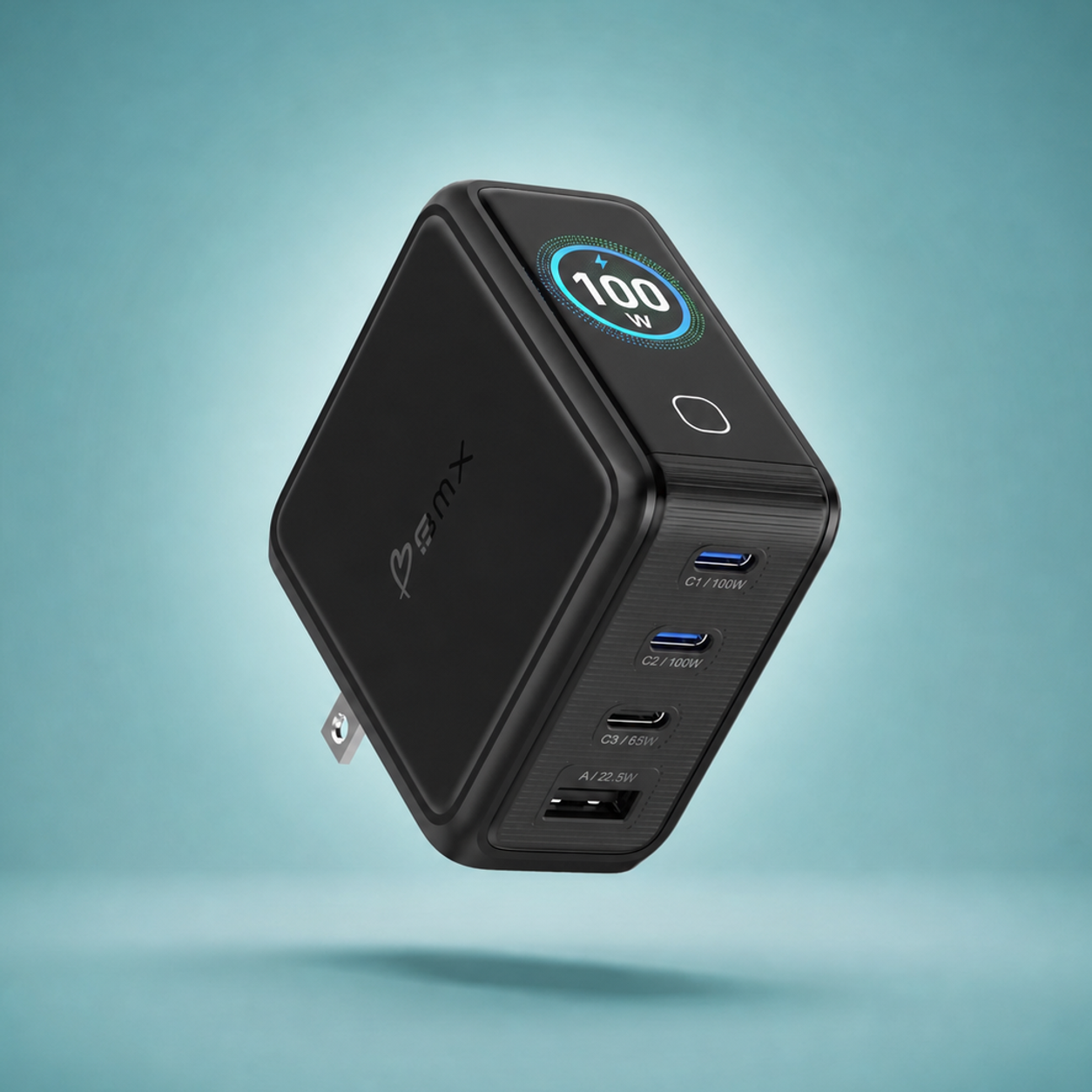
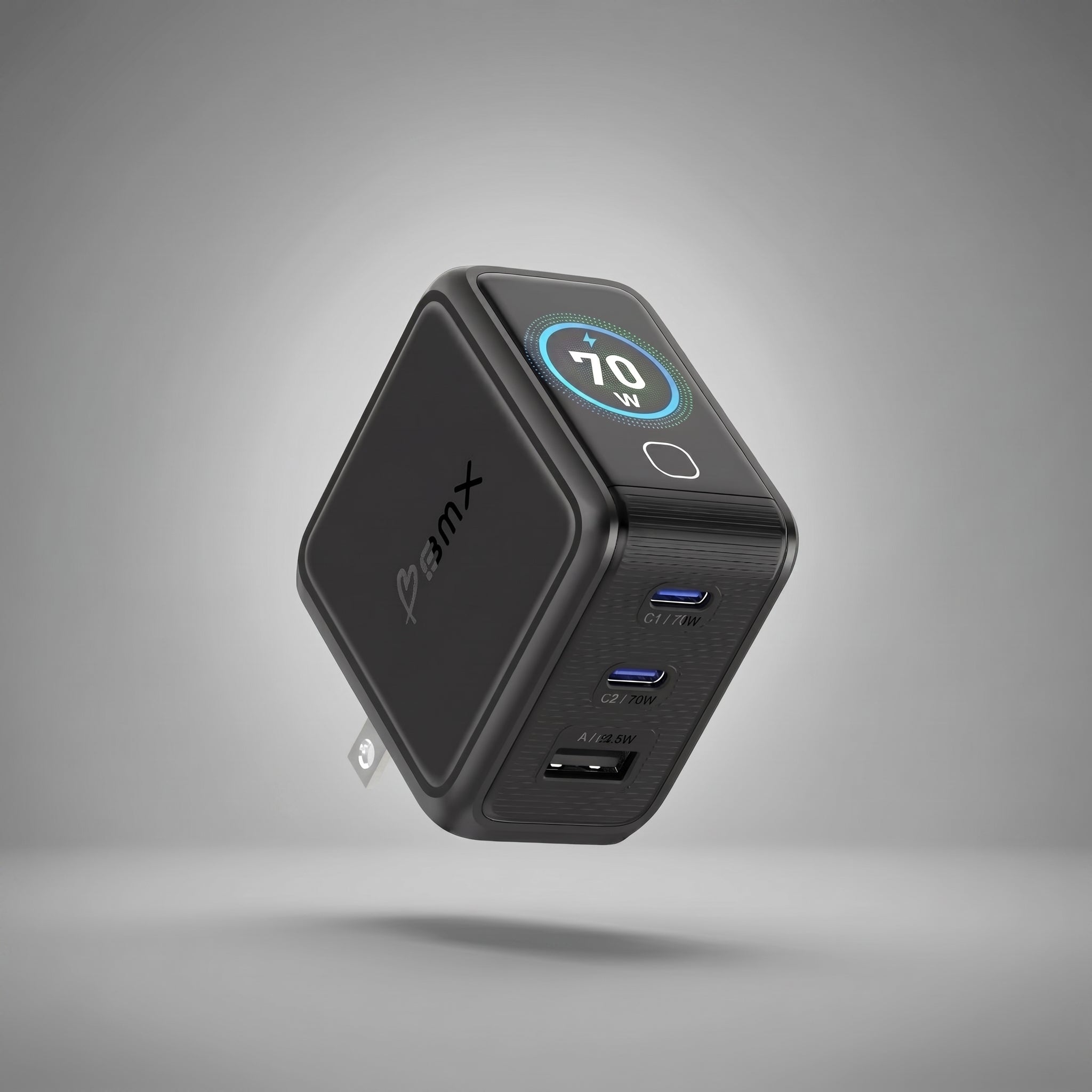
This is the honest bridge to the BMX GaNSta line. A phone alone rarely needs a 70W, 100W, or 140W charger. Those larger models earn their place when you want one outlet to handle the phone and the rest of your device stack.
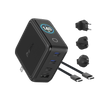
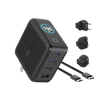
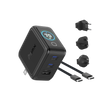
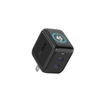
Every GaNSta LCD model shows the charger's live output by port, so shared power is visible. The display does not diagnose your phone, measure power inside its battery, or guarantee its maximum benchmark. It shows the charger's reported output, which helps you see when another device, a cable, or the phone's own charging curve changes the result.
| Your charging setup | GaNSta fit | What it actually supplies |
|---|---|---|
| Phone alone, or phone plus Apple Watch puck; the phone's fastest benchmark still depends on protocol support | GaNSta 45W, $39.99 | Up to 45W on one USB-C port, or 20W + 20W across both |
| MacBook Air plus phone, or three travel devices | GaNSta 70W, $59.99 | 45W + 20W when its two USB-C ports are the occupied ports; two USB-C plus one USB-A |
| A USB-C laptop whose input fits a 100W path, plus phone and accessories | GaNSta 100W, $79.99 | Up to 100W alone, or 70W + 30W when the two primary USB-C ports are occupied |
| 16-inch MacBook Pro on a 140W path with a 140W-or-higher rated USB-C cable, or a four-device travel setup | GaNSta 140W, $89.99 | Up to 140W on one primary USB-C port, or 65W + 45W when both primary USB-C ports are occupied |
The outputs above come from the current BMX model specifications linked in the table. GaNSta 45W, 70W, and 100W are documented as USB PD 3.0. GaNSta 140W adds PD 3.1 EPR for its 140W laptop path. Those facts do not independently prove Apple AVS or PPS support, so BMX does not claim every GaNSta model reproduces every phone maker's fastest published result.
Phone charger wattage FAQs
Is 20W fast charging?
Yes, in the context of many phone makers' published charging results. Twenty watts remains enough for Apple's published iPhone 17e and iPhone Air result. Newer premium phones may publish faster results that require more wattage and a specific protocol.
Is a 30W charger faster than a 20W charger?
Only when the phone can request more than 20W and the charger supports the required protocol. If the phone tops out at 20W, a 20W and 30W charger with the same required protocol and an appropriate cable should produce a similar result. The 30W charger simply has unused headroom.
Can a 45W, 70W, or 100W charger damage a phone?
A standards-compliant USB-C PD charger does not force its full rating into the phone. The connected device negotiates and takes the power it requires. Use a standards-compliant charger and a cable rated for the charging path.
Does iPhone 18 Pro need a 60W charger?
Apple specifies a 60W-capable or higher adapter with AVS for the iPhone 18 Pro's fastest published wired result. That condition does not prove the phone draws 60W continuously, and a charger labeled 60W is not enough by itself if AVS is missing.
Why does a phone charge more slowly when another device is plugged in?
Multi-port chargers share a fixed total output. Adding another device can trigger a different power split. For example, GaNSta 45W changes from up to 45W on one port to 20W + 20W across two ports.
Disclosure: This article links to BMX chargers. BMX manufactures GaNSta products. Device-specific charging results depend on the phone, charger protocol, cable, battery state, temperature, software, and the number of connected devices.


Leave a comment
This site is protected by hCaptcha and the hCaptcha Privacy Policy and Terms of Service apply.