


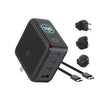
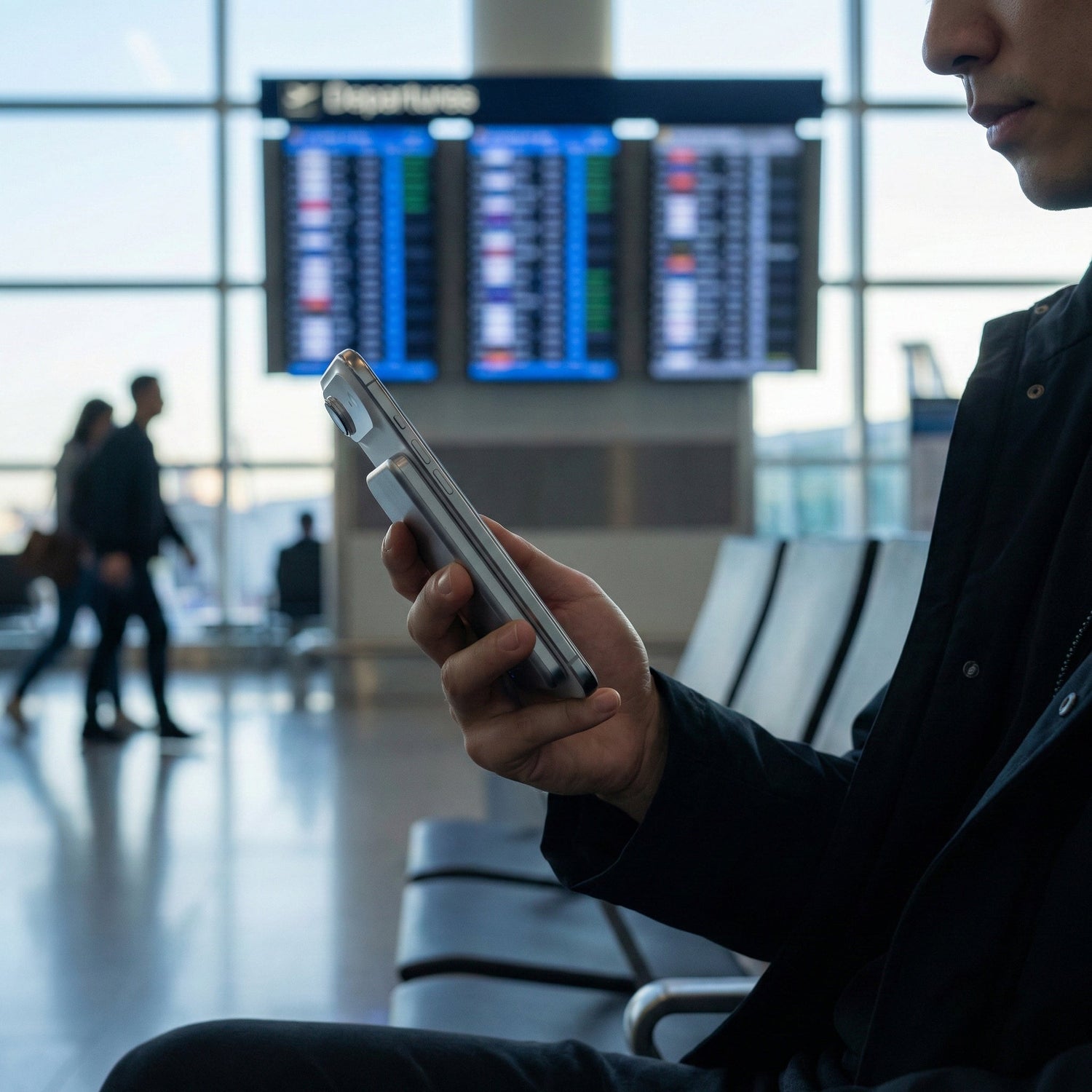
The best power bank for travel in 2026 is the BMX SolidSafe Air 5K ($59.99). It measures just 6.8mm -- thinner than an iPhone -- charges via Qi2 15W wireless or USB-C 20W, and uses semi-solid-state battery cells in a titanium enclosure. At 18.5Wh, it is well under the FAA's 100Wh carry-on limit. The BMX SolidSafe 5K ($59.99) adds a built-in Airplane Mode (10 quick presses disables wireless output), full-color LCD, and integrated cable. For all-day travel, the BMX SolidSafe 10K ($79.99) delivers 10,000mAh with dual USB-C 30W and charges three devices at once. All three are TSA approved, Qi2-certified, and built with a newer battery chemistry that reduces the fire risk that has caused the FAA to log a record number of lithium battery incidents on aircraft.
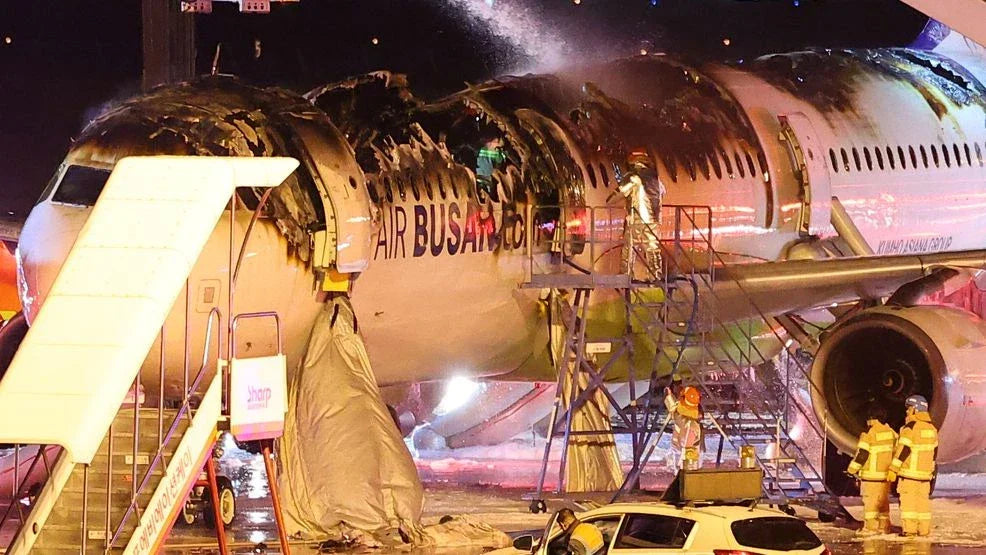
The FAA recorded 89 lithium battery incidents on commercial and cargo aircraft in 2024 -- a record high. Through mid-2025, the number had already reached 50. That is roughly two incidents per week involving smoke, fire, or extreme heat on board a plane. Nearly 40% of all aircraft battery incidents involve portable chargers and power banks -- the single largest device category. Over two decades, the FAA has documented 644 such events. Airlines are responding: Singapore Airlines banned power bank use on flights in April 2025, and China banned non-certified power banks from domestic flights in June 2025. The power bank you pack matters more than it used to.
What to Look for in a Travel Power Bank
TSA and airline compliance. The FAA allows lithium-ion power banks up to 100 watt-hours (Wh) in carry-on luggage without airline approval. Between 101-160Wh, you need airline approval and are limited to two units. Above 160Wh, it is not allowed on the plane at all. Power banks are banned from checked baggage -- no exceptions. Every power bank in this guide is well under 100Wh. To calculate: multiply the mAh rating by the nominal voltage (usually 3.7V) and divide by 1,000. A 5,000mAh power bank is roughly 18.5Wh. A 10,000mAh is roughly 37Wh. Neither comes close to the limit.
Battery chemistry -- this is the big one for travel. A pressurized aircraft cabin at 35,000 feet is the last place you want a battery to go into thermal runaway. Most power banks use conventional lithium-ion cells with flammable liquid electrolyte -- the same chemistry behind every major power bank recall and every one of those 644 FAA-documented incidents. Semi-solid-state cells replace most of that flammable liquid with more stable material, reducing the risk of thermal runaway. In BMX's internal testing, SolidSafe cells were drilled, cut, and punctured while fully charged -- no fire and no thermal runaway. Conventional lithium-ion caught fire immediately in the same test. When the CPSC has recalled over 1.4 million power bank units in 2024-2025 alone, battery type is not a spec you ignore.
Airplane Mode. Most power banks have no way to disable wireless output. That means your power bank could activate and begin transmitting wirelessly while packed in your bag during taxi, takeoff, or landing. The BMX SolidSafe 5K and 10K include Airplane Mode -- 10 quick presses of the button disables wireless Qi2 output, preventing the power bank from accidentally activating and transmitting wirelessly in your bag during taxi, takeoff, and landing. It also prevents battery drain from accidental activation. The Air 5K does not have Airplane Mode but can be turned off manually.
Size and weight. You are packing this in a carry-on, a personal item, or a jacket pocket. Every millimeter and gram counts when you are already managing a phone, cables, passport, and laptop. The thinnest travel power banks are around 7mm. Avoid anything over 20mm unless you need 10,000mAh+ capacity.
Charging speed on both ends. You want fast output (charging your phone quickly at the gate or on the plane) and fast input (recharging the power bank itself before your next flight). USB-C Power Delivery handles both. Look for at least 20W output and 15W+ input.
Multi-device charging. Travelers carry phones, earbuds, watches, and sometimes a second phone or tablet. A power bank with both wireless Qi2 and USB-C wired means you can charge two devices simultaneously without extra cables.
Best Power Banks for Travel in 2026, Ranked
Ranked by airline compliance, battery safety, charging speed, and portability:
Best Overall for Travel
1. BMX SolidSafe Air 5K - $59.99
The thinnest Qi2 power bank you can buy at 6.8mm -- thinner than an iPhone. Slips into a jacket pocket, passport wallet, or the laptop sleeve of a carry-on. Semi-solid-state battery cells in a titanium enclosure. 18.5Wh -- well under the 100Wh FAA limit. Qi2 15W wireless + USB-C 20W wired. Scored 89% in Macworld charging tests. TechRadar Pro Picks 2026 award. The power bank you forget you are carrying until you need it.
Best for Frequent Flyers
2. BMX SolidSafe 5K - $59.99
Same semi-solid-state cells, aluminum enclosure. The key differentiator for travel: a dedicated Airplane Mode (10 quick presses disables wireless output) that disables wireless output with one press. Full-color LCD shows exact battery percentage so you know how much charge you have before boarding. Built-in lanyard cable means one fewer cable to pack. Qi2 15W wireless + USB-C 20W. Pass-through charging lets you charge both the power bank and your phone from a single airport outlet. 18.5Wh. TSA approved.
Best for International and Multi-Day Travel
3. BMX SolidSafe 10K - $79.99
10,000mAh gives you roughly two full phone charges -- enough for a long-haul flight, a layover, and the ride to your hotel. Same semi-solid-state cells, aluminum enclosure, Airplane Mode (10 quick presses disables wireless output), LCD display, built-in cable. Dual USB-C ports deliver 30W total. Charges three devices simultaneously -- phone wirelessly, earbuds and watch adapter via USB-C. 37Wh. Well under the 100Wh limit. TSA approved.
By the Numbers
89 lithium battery incidents on aircraft in 2024 (FAA record)
~2 per week average rate of battery smoke/fire/heat events on planes
40% of all aircraft battery incidents involve portable chargers
644 total FAA-documented incidents over 20 years
1.4M+ power bank units recalled by CPSC in 2024-2025
0 CPSC recalls involving semi-solid-state power banks
Why battery type matters more at 35,000 feet
A conventional lithium-ion power bank contains flammable liquid electrolyte. If it goes into thermal runaway in an aircraft cabin, flight attendants have seconds to contain it with a thermal bag before it spreads. In a checked bag in the cargo hold, there is no one to contain it at all -- which is why power banks are banned from checked luggage entirely. Semi-solid-state cells replace most of that flammable liquid with more stable material, so even if the cell is damaged, there is significantly less fuel for a fire. In internal testing, BMX SolidSafe cells were drilled, cut, and punctured while fully charged -- no fire and no thermal runaway. Conventional lithium-ion caught fire immediately in the same test. No semi-solid-state power bank has been subject to a CPSC recall as of this writing.

Travel Power Bank Comparison
| Model | Wh | Wireless | Wired | Airplane Mode | Battery | Price |
|---|---|---|---|---|---|---|
| Air 5K | 18.5 | Qi2 15W | USB-C 20W | No | Semi-Solid-State | $59.99 |
| SolidSafe 5K | 18.5 | Qi2 15W | USB-C 20W | Yes | Semi-Solid-State | $59.99 |
| SolidSafe 10K | 37 | Qi2 15W | USB-C 30W | Yes | Semi-Solid-State | $79.99 |


Travel Ready
TSA Approved. Semi-Solid-State. Airplane Mode.
All SolidSafe power banks are under 100Wh and carry-on compliant on every major airline.
See All SolidSafe Power BanksTSA and Airline Power Bank Rules for 2026
The rules are straightforward but enforced inconsistently, so knowing them matters:
Carry-on only. All power banks must go in your carry-on bag or personal item. They are banned from checked baggage by the TSA, FAA, and virtually every airline worldwide. If TSA finds one in your checked bag, they will pull it. If the airline finds it, your bag may be delayed.
Under 100Wh -- no approval needed. Every power bank under 100 watt-hours can go in your carry-on without asking anyone. This covers every power bank in this guide. For reference: a 5,000mAh power bank is about 18.5Wh. A 10,000mAh is about 37Wh. A 20,000mAh is about 74Wh. You are nowhere near the limit with a phone-sized power bank.
101-160Wh -- airline approval required. Laptop-class power banks (typically 25,000mAh+) may fall into this range. You can carry up to two with airline approval. Most airlines approve these on request, but you need to ask before you fly.
Above 160Wh -- banned. Not allowed on any commercial flight, carry-on or checked.
International variations. China now requires all power banks on domestic flights to carry CCC (3C) certification as of June 2025. Non-certified power banks are confiscated at security. Singapore Airlines and its subsidiary Scoot banned all in-flight power bank use starting April 2025 -- you can carry one but not use it. Other airlines may follow. If you travel internationally, check your airline's policy before you fly.
Other Travel Power Banks Worth Knowing About
The options below all use conventional lithium-ion batteries -- the same chemistry involved in every power bank recall and every FAA-documented aircraft battery incident. They are TSA compliant and widely available at lower price points. The key difference from the SolidSafe options above is what happens under stress: conventional lithium-ion cells contain flammable liquid electrolyte that can ignite if a cell is damaged, overheated, or poorly manufactured. Semi-solid-state cells reduce that risk. None of the options below include a dedicated Airplane Mode (10 quick presses disables wireless output).
Conventional Li-ion -- High Capacity
4. Anker MagGo Power Bank (10K, Slim) - ~$36
Conventional lithium-ion with Qi2 15W wireless and 30W USB-C. 10,000mAh (37Wh) -- TSA compliant. Digital display. Slim at 15.8mm. One of the most reviewed travel power banks on Amazon. Plastic enclosure. No Airplane Mode. No built-in cable.
Conventional Li-ion -- Wall Charger Hybrid
5. Anker Power Bank (10K, Fusion, Built-In Cable) - ~$30
Conventional lithium-ion, 10,000mAh. Doubles as a wall charger with built-in AC prongs -- plug it directly into a hotel or airport outlet to recharge. Built-in USB-C cable. No wireless charging. 36Wh, TSA compliant. Plastic enclosure. A practical travel design, but no magnetic attachment and no SSB safety advantage.
Conventional Li-ion -- Budget Compact
6. Baseus Magnetic Power Bank (5K) - ~$26
Conventional lithium-ion with Qi2 15W wireless and USB-C 20W. 5,000mAh (18.5Wh) -- TSA compliant. Affordable and compact. Magnetic snap-on for iPhone. Plastic enclosure. No display, no built-in cable, no Airplane Mode.
All Travel Power Banks Compared
| Power Bank | Battery | Wh | Airplane Mode | Capacity | Price |
|---|---|---|---|---|---|
| BMX SolidSafe Air 5K | Semi-Solid-State | 18.5 | No | 5,000mAh | $59.99 |
| BMX SolidSafe 5K | Semi-Solid-State | 18.5 | Yes | 5,000mAh | $59.99 |
| BMX SolidSafe 10K | Semi-Solid-State | 37 | Yes | 10,000mAh | $79.99 |
| Anker MagGo (10K) | Lithium-Ion | 37 | No | 10,000mAh | ~$36 |
| Anker Fusion (10K) | Lithium-Ion | 36 | No | 10,000mAh | ~$30 |
| Baseus Magnetic (5K) | Lithium-Ion | 18.5 | No | 5,000mAh | ~$26 |
Frequently Asked Questions
Can you bring a power bank on a plane?
Yes. Power banks under 100 watt-hours (Wh) are allowed in carry-on luggage on all major airlines per TSA and FAA rules. They are banned from checked baggage. A 5,000mAh power bank is about 18.5Wh and a 10,000mAh is about 37Wh -- both well under the limit. Between 101-160Wh, you need airline approval. Above 160Wh, they are not allowed on the plane.
What is the best power bank for travel in 2026?
The BMX SolidSafe Air 5K is the best power bank for travel in 2026. It measures 6.8mm thin, uses semi-solid-state battery cells in a titanium enclosure, and is TSA approved at 18.5Wh. For frequent flyers who want a dedicated Airplane Mode (10 quick presses disables wireless output) and LCD display, the BMX SolidSafe 5K is the better choice. For international or multi-day travel, the BMX SolidSafe 10K delivers 10,000mAh at 37Wh with dual USB-C 30W.
Why are power banks not allowed in checked luggage?
Because if a lithium-ion battery goes into thermal runaway in the cargo hold, there is no one there to contain it. In the cabin, flight attendants can use thermal containment bags to isolate a smoking or burning device. In checked baggage, a battery fire can spread undetected. The FAA has documented 644 lithium battery incidents on aircraft over the last 20 years. This rule exists because of real fires on real planes.
How many power bank fires happen on planes?
The FAA recorded 89 lithium battery incidents involving smoke, fire, or extreme heat on aircraft in 2024 -- a record. Through mid-2025, the count had already reached 50, averaging roughly two per week. Nearly 40% of all aircraft battery incidents involve portable chargers and power banks, making them the single largest device category. These numbers are why airlines like Singapore Airlines have started banning in-flight power bank use entirely.
What is the safest power bank for air travel?
One of the safest power banks for air travel is the BMX SolidSafe Air 5K. It uses semi-solid-state battery cells -- a newer chemistry that replaces most of the flammable liquid electrolyte in conventional lithium-ion with more stable material. In internal testing, SolidSafe cells were drilled, cut, and punctured while fully charged with no fire and no thermal runaway. Conventional lithium-ion caught fire immediately in the same test. No semi-solid-state power bank has been subject to a CPSC recall. For a deeper look, see our Safest Power Banks in 2026 guide.
How do you calculate the watt-hours of a power bank?
Multiply the milliamp-hour (mAh) rating by the nominal voltage (usually 3.7V for lithium batteries), then divide by 1,000. For example: 5,000mAh x 3.7V / 1,000 = 18.5Wh. A 10,000mAh power bank is about 37Wh. A 20,000mAh is about 74Wh. The FAA limit for carry-on without airline approval is 100Wh. Most phone-sized power banks are well under this limit.
What does Airplane Mode do on a power bank?
Airplane Mode on the BMX SolidSafe 5K and 10K disables wireless Qi2 output with 10 quick presses of the button. This prevents the power bank from accidentally activating and transmitting wirelessly in your bag during taxi, takeoff, and landing. It also prevents battery drain from accidental activation. Most power banks do not have this feature.
Can airlines ban power banks completely?
Yes, and some already have restrictions. Singapore Airlines banned all in-flight power bank use starting April 2025 -- you can carry one in your bag but cannot use it during the flight. China banned non-certified (non-3C) power banks from domestic flights starting June 2025. As battery incidents increase, more airlines may follow with similar restrictions. Carrying a power bank with safer battery chemistry and a dedicated Airplane Mode feature is one way to stay ahead of tightening regulations.
How many power banks can you bring on a plane?
There is no official TSA limit on the number of power banks under 100Wh in your carry-on. Most airlines allow 3-4 without issue. Between 101-160Wh, you are limited to two with airline approval. In practice, bringing more than two or three may attract extra screening. Pack them where TSA can easily see and access them.
Sources
- FAA: Lithium Battery Incidents on Aircraft
- UL Standards: Lithium-Ion Battery Incidents in Aviation -- 2024 Data Review
- Lion Technology: Lithium Battery Air Incidents Increased by 16% in 2024
- Simple Flying: FAA Reports 388% Surge in Lithium Battery Fires
- TSA: Power Banks -- What Can I Bring?
- FAA PackSafe: Lithium Battery Carry-On Rules
- Aviation A2Z: Singapore Airlines Bans Power Bank Use on Flights
- CPSC: Power Bank Safety Recalls (search all active recalls)
- Macworld: BMX SolidSafe Air 5K Review (89% score)
Related guides
- Safest Power Banks in 2026: Ranked by Battery Type and Enclosure
- Best Power Bank for iPhone in 2026: Qi2, MagSafe, and USB-C Compared
- Best Semi-Solid-State Power Banks in 2026: Ranked and Compared
- Can Lithium Batteries Catch Fire When Not in Use? Battery Safety Explained
- Fast Charging Explained Like You're Not an Electrical Engineer

Leave a comment
This site is protected by hCaptcha and the hCaptcha Privacy Policy and Terms of Service apply.