
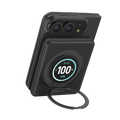
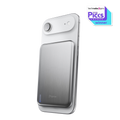
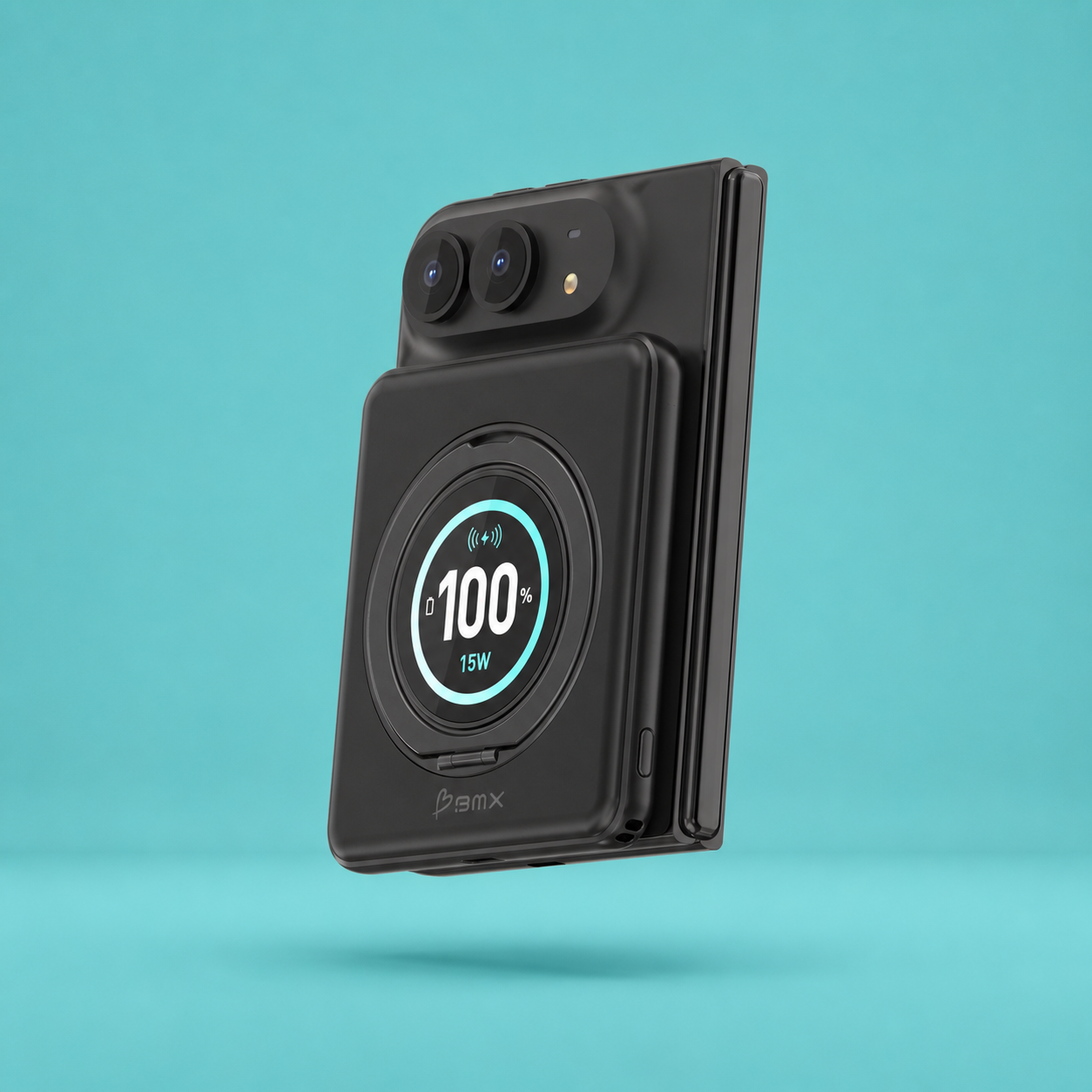




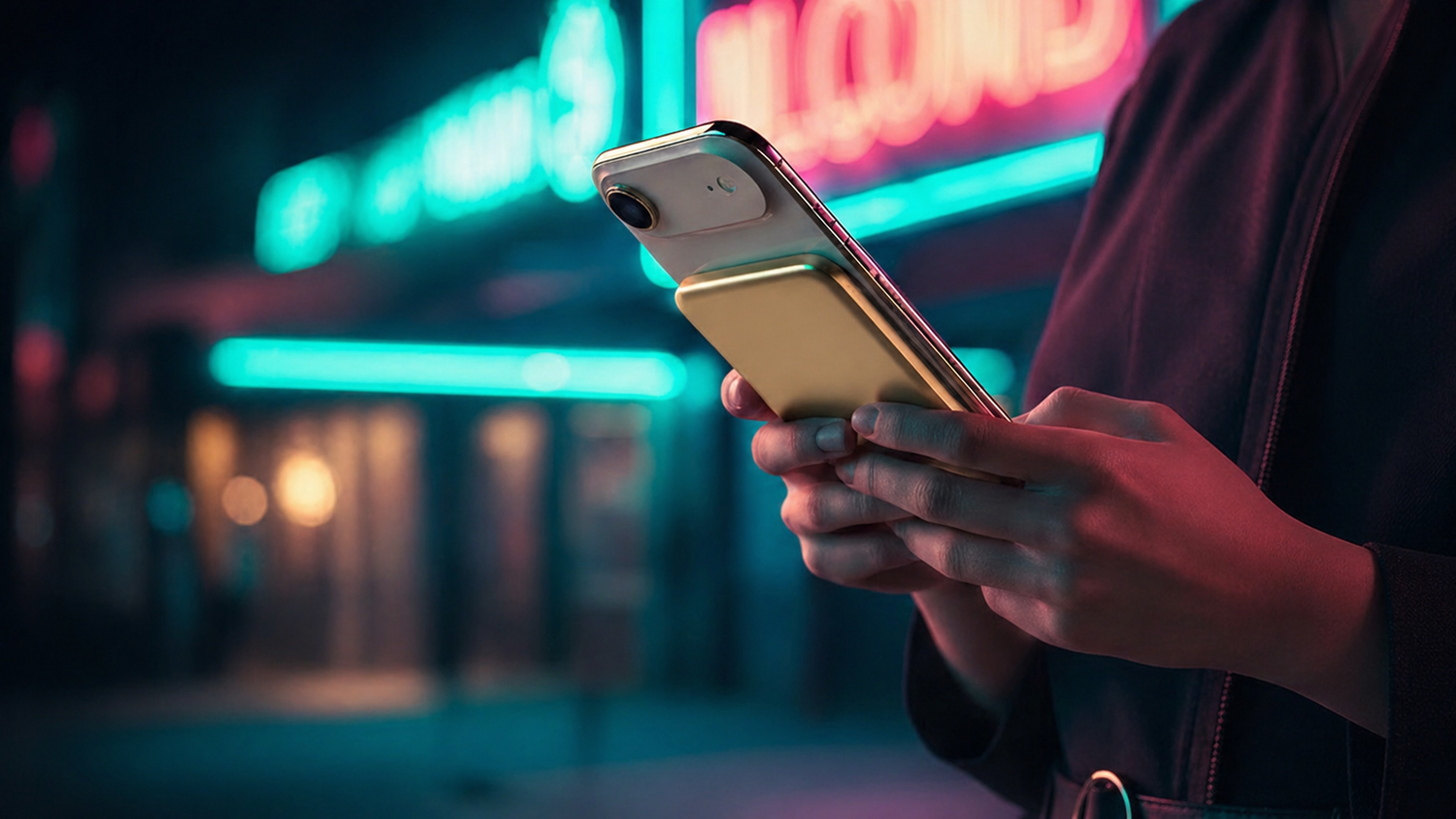
The BMX SolidSafe Air 5K is the best Qi2 power bank in 2026. It is 6.8mm thin, wrapped in titanium, and built with semi-solid-state battery cells that contain significantly less flammable liquid electrolyte than conventional lithium-ion. It is Qi2 certified, CCC certified, and works natively with iPhone, Google Pixel 10, and Samsung Galaxy S25.
Qi2 is the open wireless charging standard Apple co-developed with the Wireless Power Consortium. MagSafe is Apple's brand name for its Qi2 implementation. If a power bank is Qi2 certified, it delivers 15W magnetic wireless charging to any compatible phone, whether that phone is an iPhone, a Pixel 10, or a Galaxy S25. One standard, three phone families, identical experience.
Most "best Qi2 power bank" lists compare capacity, wattage, and price. None of them ask what is inside the battery, what the enclosure is made of, or whether the thing is built to last. This guide does. We rank on Qi2 certification, wireless speed (including newer Qi2.2 25W support), safety chemistry, materials, and real-world charging performance.
Quick Answer
The best Qi2 power bank in 2026 for most people is the BMX SolidSafe Air 5K: Qi2 certified, 6.8mm thin, titanium body, and built with semi-solid-state cells that contain significantly less liquid electrolyte than standard lithium-ion. For higher capacity, the SolidSafe 10K is the pick. If you need Qi2.2 25W wireless speed (the newer spec), the KUXIU S3 is the main alternative, though it uses a plastic body and lower testing transparency than BMX.
Key Takeaways
- Qi2 is the standard behind MagSafe: Qi2 is an open magnetic wireless charging standard at 15W. MagSafe is Apple's brand name for its Qi2 implementation. A Qi2 power bank works on iPhone, Pixel 10, and Galaxy S25 identically.
- Qi2.2 goes up to 25W: Qi2.2 (released 2025) is the faster version of Qi2, delivering up to 25W wireless on compatible phones. Only a small number of banks support it today.
- Semi-solid-state vs lithium-ion: Semi-solid-state cells contain significantly less flammable liquid, which reduces thermal runaway risk over years of charging.
- SolidSafe Air is the thinnest: 6.8mm, titanium body, semi-solid-state chemistry, Qi2 15W. No other Qi2 power bank combines those specs.
- Works on iPhone, Pixel, and Galaxy: Qi2 is not an Apple-only feature. Pixel 10 and Galaxy S25 support Qi2 15W magnetic charging natively.
What is Qi2 and Qi2.2?
Qi2 is the wireless charging standard managed by the Wireless Power Consortium (WPC), co-developed with Apple and released in 2023. It added two things to the older Qi standard: a ring of magnets (called the Magnetic Power Profile) for perfect alignment between phone and charger, and a consistent 15W charging speed. Before Qi2, wireless charging on Android was inconsistent and usually slower. Qi2 fixed that.
Qi2.2 is the 2025 update to the standard. It keeps the magnetic alignment and adds higher wireless wattage, up to 25W on compatible phones. Not every phone supports Qi2.2 yet, and not every Qi2 power bank is Qi2.2 capable. If you see a power bank advertised as "Qi2.2" or "MPP 25W," that is the faster version.
MagSafe is Apple's brand name for its Qi2 implementation on iPhone. When Apple says "MagSafe charger," the underlying spec is Qi2. That is why a Qi2 certified power bank charges an iPhone exactly the same way a MagSafe branded one does.
One more distinction: Qi2 "Certified" means the magnets are built into the phone itself. Qi2 "Ready" means the phone supports Qi2 wireless but needs a magnetic case or ring to get the physical snap. Both work with a Qi2 power bank. The difference is whether you need a case.
Which phones support Qi2?
Qi2 support splits into three camps: certified, ready, and not supported.
Qi2 Certified iPhones (magnets built in): iPhone 12, 13, 14, 15, 16, and 17 series. iPhone 17e. iPhone Air. Every iPhone from the 12 onward has the MagSafe magnet ring, and since MagSafe is Apple's Qi2 implementation, all of them work with a Qi2 power bank with full magnetic snap and 15W charging.
Qi2 Certified Android phones (magnets built in): Google Pixel 10, Pixel 10 Pro, Pixel 10 Pro XL. Samsung Galaxy S25, Galaxy S25+, Galaxy S25 Ultra. These phones have magnets built directly into the back, so a Qi2 power bank clicks on and charges at 15W exactly like it does on an iPhone. No case required.
Qi2 Ready Android phones (need a magnetic case or ring): Older Pixels (Pixel 9 series and earlier), older Galaxy phones (S24 and earlier), and most current Android phones support wireless charging but do not have magnets built in. A Qi2 power bank still works, but you need a magnetic case or a magnetic ring adapter (typically $5 to $15) to get the physical snap. Wireless charging still happens at Qi2 speeds.
The short version: if your phone is an iPhone 12 or newer, or a Pixel 10 or Galaxy S25, a Qi2 power bank snaps on natively. For older Android phones, add a magnetic case or ring and you are done.
Key takeaway
The BMX SolidSafe Air 5K is the only Qi2 power bank that is 6.8mm thin AND built with semi-solid-state cells in a titanium body. Every other Qi2 power bank at this price point either runs conventional lithium-ion or uses a plastic enclosure. It is Qi2 certified, CCC certified, and rated 4.5/5 by Macworld.
The BMX SolidSafe Air 5K is Qi2 certified, 6.8mm thin, and built with semi-solid-state cells instead of conventional lithium-ion. Titanium body, CCC certified, and rated 4.5/5 by Macworld. See the SolidSafe Air →
What should you look for in a Qi2 power bank?
Before comparing specific models, here are the specs that actually matter:
- Qi2 certified, not "Qi2 compatible." "Certified" means the product passed WPC testing for alignment, speed, and safety. "Compatible" is marketing language that means nothing. Look for the Qi2 logo and a certification number.
- Qi2 vs Qi2.2 (15W vs 25W wireless). Standard Qi2 charges at 15W wirelessly, which is enough to top up your phone during normal use. Qi2.2 pushes this to 25W, which matters if you charge from near-empty and want maximum wireless speed. If you usually charge from 30% to 80%, 15W is fine.
- Magnet strength. Weak magnets are the number one complaint across every magnetic power bank on the market. If the bank slides off your phone in your pocket, the feature that was supposed to add convenience becomes the source of a new problem.
- Battery chemistry. Semi-solid-state cells contain significantly less of the flammable liquid that causes battery fires. If you charge on your nightstand, carry one on flights, or just want the widest safety margin available, this is the spec that matters most.
- Capacity vs thickness trade-off. A 5,000mAh bank gives about one full phone charge. A 10,000mAh bank gives about two. Thinner banks are easier to carry but hold less power. Pick the capacity that matches how you actually use your phone.
- USB-C wired output. The best Qi2 power banks also include USB-C for faster wired charging when you need speed over convenience. 20W is the baseline. 30W is better.
- Airline compliance. Any power bank under 100Wh is allowed on flights in carry-on. Both 5,000mAh and 10,000mAh Qi2 banks are well under this limit, so all of these are airline safe.
Which Qi2 power bank is the best in 2026?
We ranked these based on Qi2 certification, wireless charging speed, battery safety, build quality, magnet strength, and real-world press reviews.
| Power Bank | Capacity | Battery Type | Thickness | Wireless | USB-C Out | Price |
|---|---|---|---|---|---|---|
| BMX SolidSafe Air | 5,000mAh | Semi-solid-state | 6.8mm | Qi2 15W | 20W | $59.99 |
| BMX SolidSafe 5K | 5,000mAh | Semi-solid-state | 12.5mm | Qi2 15W | 20W | $59.99 |
| BMX SolidSafe 10K | 10,000mAh | Semi-solid-state | 15.8mm | Qi2 15W | 30W | $79.99 |
| KUXIU S3 | 10,000mAh | Semi-solid-state | ~15mm | Qi2.2 25W | 35W | ~$69 |
| Anker MagGo Slim 5K | 5,000mAh | Lithium-ion | 8.6mm | Qi2 15W | 20W | ~$55 |
| Baseus PicoGo 10K | 10,000mAh | Lithium-ion | 14.7mm | Qi2 15W | 27W | ~$36 |
Best Qi2 Power Bank: BMX SolidSafe Air 5K
The SolidSafe Air is 6.8mm thin. That is thinner than most phone cases. It is Qi2 certified at 15W, built with a titanium enclosure, and uses semi-solid-state battery cells that contain significantly less liquid electrolyte than conventional lithium-ion. Semi-solid-state chemistry is what makes this thinness possible. Less volatile material inside means a wider safety margin at extreme slim dimensions. The combination of thin, safe, and Qi2 certified is the entire point of this product.
Macworld gave it 4.5 out of 5 stars and 89%, calling it "the thinnest magnetic wireless power bank full stop." Cult of Mac awarded it 5 out of 5, writing: "Super-slim MagSafe power bank is the best I've ever used." ZDNET said: "Yes, this is a very safe power bank." Techlicious called it "the ultra-thin charger that won't set your pants on fire." It won TechRadar's Pro Picks 2026 award.
The Air charges wirelessly at 15W via Qi2 and 20W via USB-C. It charges two devices simultaneously. LED dot indicators show battery level at a glance. The titanium body resists scratches and bending. NotebookCheck confirmed "it did not bend when sat on in a back pants pocket during testing." It also carries CCC certification (China Compulsory Certification), one of the strictest battery safety standards in the world, which includes factory audits, not just lab testing. If you fly to China, this is one of the few power banks that will not get confiscated at security.
The trade-offs: no LCD display (LED dots only), no built-in cable, and 5,000mAh is one full phone charge. If you want more information or a built-in cable, look at the SolidSafe 5K below. If you want the thinnest, most premium Qi2 power bank available, this is it.
Best Qi2 Power Bank with Display: BMX SolidSafe 5K
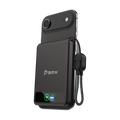
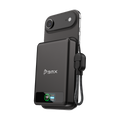
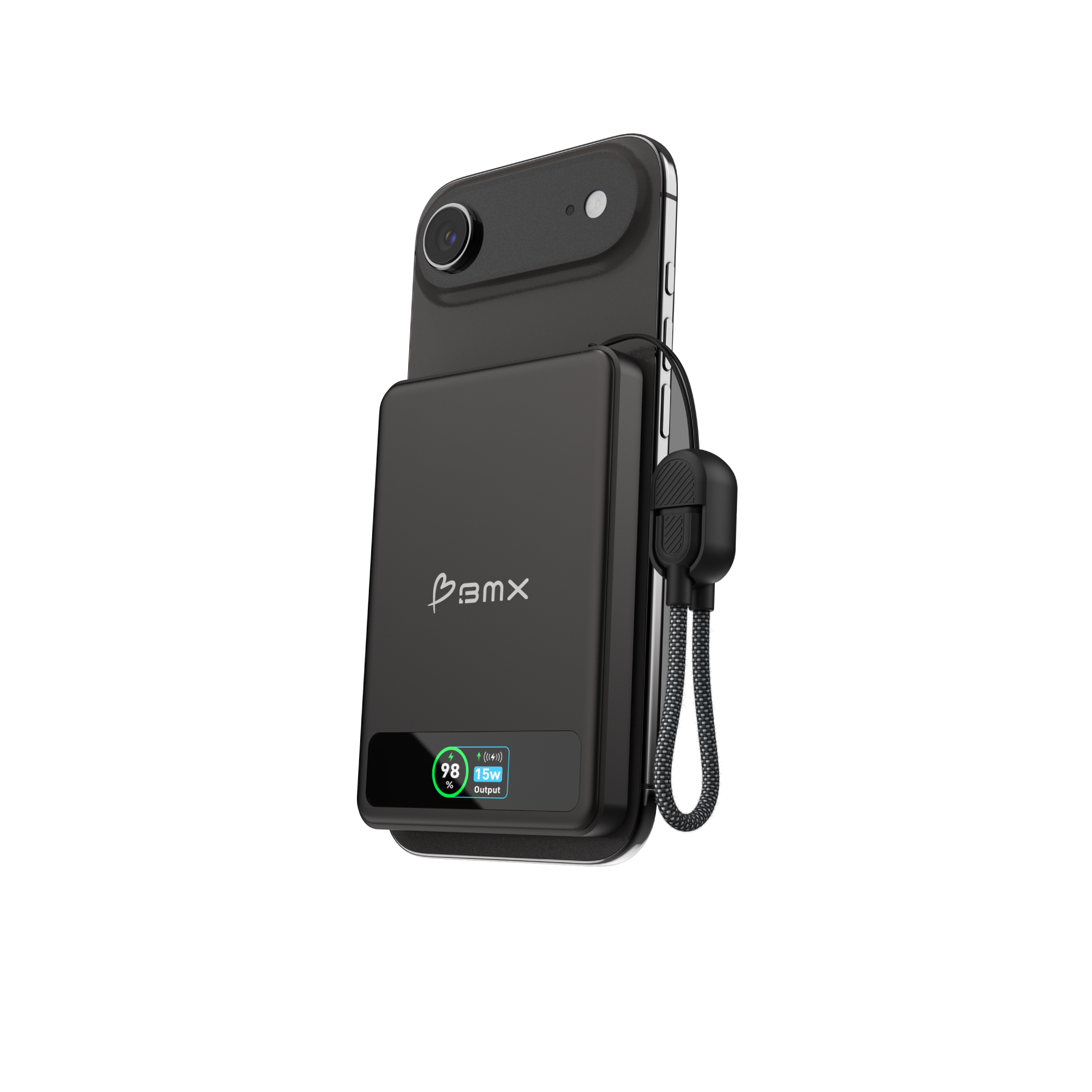
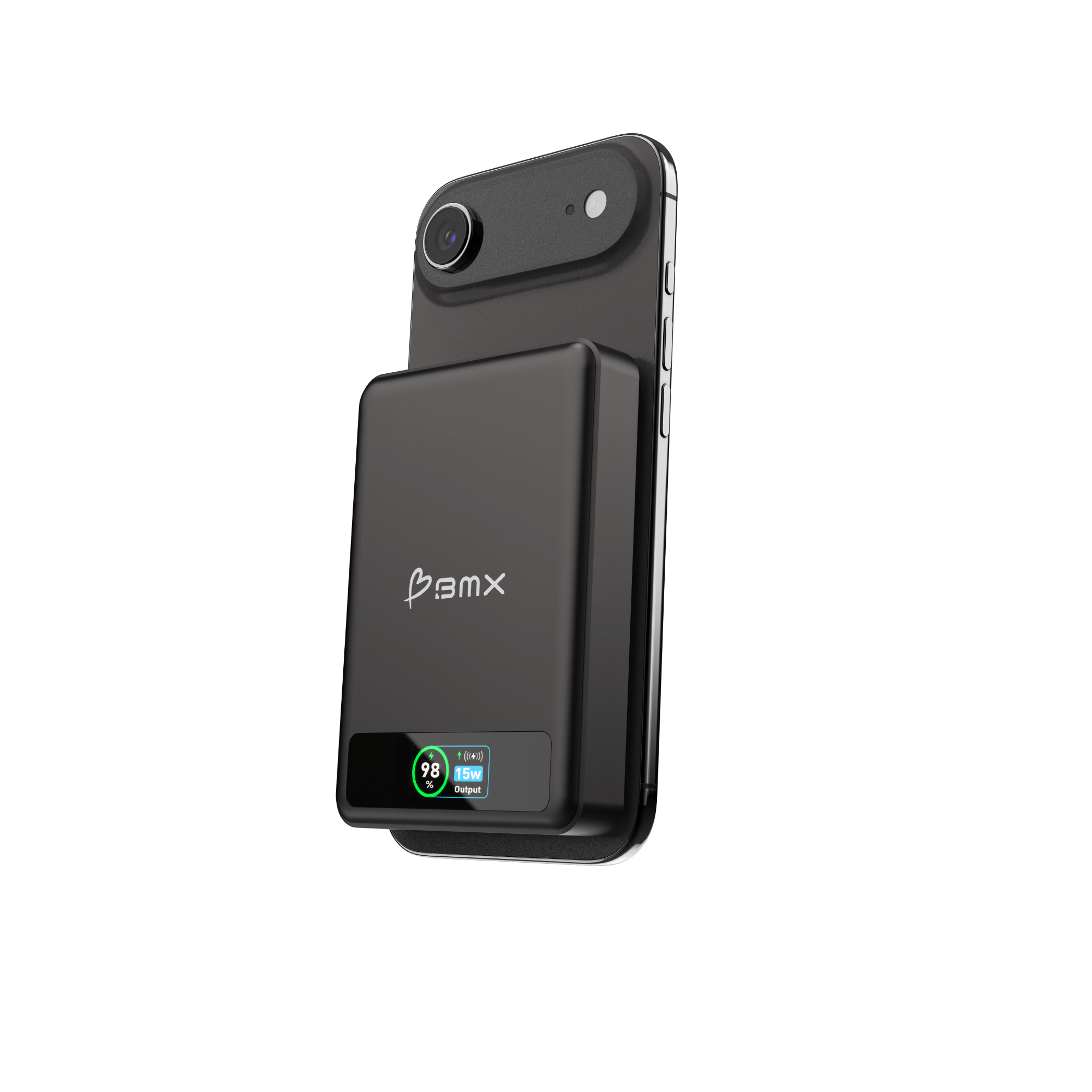
Same semi-solid-state safety as the Air, same $59.99 price, different priorities. The SolidSafe 5K is Qi2 certified at 15W wireless and adds a full-color LCD that shows exact battery percentage and live charging wattage. It also has a built-in USB-C lanyard cable that doubles as a carry strap. You never hunt for a cable. You always know your charge status.
MacSources rated it 92% (Excellent), noting: "A well-built, intelligently designed charging solution that's ideal for modern users who value both safety and performance." BabelTechReviews called it "a bold reimagining of what portable power should be." The Gadgeteer's take: "They nailed it. No, really."
The 5K charges via Qi2 at 15W wirelessly and 20W via USB-C. It supports pass-through charging, so you can recharge the bank while it charges your phone. There is an Airplane Mode button that disables wireless output for flights. The aluminum enclosure comes in four colors: black, blue, silver, and orange, matching the iPhone Pro lineup.
The trade-off versus the Air: it is 12.5mm thick, not 6.8mm. The Air disappears in your pocket. The 5K is a daily carry companion you interact with: check the screen, use the cable, grab it from the dock. Different tools for different people.

Best Qi2 Power Bank for All-Day Power: BMX SolidSafe 10K
If one phone charge is not enough, the SolidSafe 10K doubles the capacity to 10,000mAh. That is roughly two full phone charges. It is Qi2 certified at 15W wireless and adds a second USB-C port for 30W total wired output. Three devices can charge simultaneously: dual USB-C plus Qi2 wireless. The LCD display and built-in lanyard cable from the 5K carry over, as does the Airplane Mode button.
The safety argument is even stronger at 10,000mAh. More capacity means more stored energy. More stored energy in a lithium-ion battery means more thermal risk if something goes wrong. Semi-solid-state cells contain significantly less of the liquid that fuels thermal runaway, and that margin matters more as capacity scales up. At under 100Wh, it is still airline safe for carry-on.
Customer reviews confirm the real-world experience. One verified buyer wrote: "This has become my primary mobile charger replacing another well known MagSafe charger I've used for years. 5 stars!" Another noted the peace of mind of carrying a non-lithium-ion power bank after being burned (figuratively) by a previous brand.
Which other Qi2 power banks are worth considering?
The KUXIU S3 is the main Qi2.2 option right now. It delivers up to 25W wireless on compatible phones (Qi2.2 capable devices), 10,000mAh capacity, and 35W USB-C wired output. If maximum wireless speed is your priority, this is the bank to look at. KUXIU also markets it as semi-solid-state, though the testing transparency and third-party certification footprint is lower than BMX's. The enclosure is plastic rather than titanium or aluminum. Priced around $69. A legitimate option if you specifically need Qi2.2 25W wireless and do not need metal construction.
The Anker MagGo Nano 5K Slim is Anker's slimmest Qi2 bank at about 8.6mm with Qi2 15W and 20W USB-C. Well-built, widely available. The trade-off: conventional lithium-ion cells and a plastic enclosure. No semi-solid-state chemistry, no metal body. If slimness matters but battery chemistry does not, it is a solid pick at around $55, a similar price to the SolidSafe Air.
The Baseus PicoGo 10K is 10,000mAh with Qi2 15W and 27W USB-C for roughly half the price of the SolidSafe 10K, about $36. About 14.7mm thick. Same trade-off as every lithium-ion option: conventional battery chemistry, no metal enclosure. The budget pick for people who prioritize capacity and price over materials and chemistry.
How do you pick the right Qi2 power bank?
Need the broader shortlist? Compare Qi2 picks against capacity, safety, and carry style in the best power banks in 2026 roundup.
The decision comes down to four questions:
How much power do you need? If you just need a top-up to get through an evening or a long afternoon, 5,000mAh is enough. One full phone charge. If you need all-day power or charge multiple devices, go 10,000mAh.
Do you care what is inside the battery? Every Qi2 power bank on this list charges your phone. The difference is what happens over time and in edge cases. Semi-solid-state cells handle heat better, degrade more slowly, and contain significantly less of the flammable material that has caused every major power bank recall. If you charge overnight, carry it on flights, or just want the safest option available, the chemistry matters.
iPhone or Android? Both work identically with a Qi2 power bank. If you have an iPhone 12 or newer, a Pixel 10, or a Galaxy S25, the bank snaps on natively with magnets. For older Android phones, add a magnetic case or ring and you are done. Do not let Qi2 power bank marketing that leans heavily on "MagSafe" language confuse you: these banks are not iPhone-only.
What is your wireless speed priority? For most people, Qi2 at 15W is plenty. Wireless charging will never be as fast as a good USB-C cable no matter what. If you charge from near-empty often and want the fastest wireless available, Qi2.2 at 25W is the newer spec. Today, that mainly means KUXIU S3 or similar. If you usually top up from 30% to 80%, stay with Qi2 15W.
How do you keep a Qi2 power bank charged and ready?
The most common complaint about power banks is not the product itself. It is that people forget to charge them. You grab one on the way out the door and it is at 12%. The solution is a charging dock that keeps your banks topped up and in one place.
The BMX 3-Bay Charging Dock ($49.99) charges up to three SolidSafe power banks simultaneously. Drop them in when you get home, grab one on the way out. It turns charging from something you have to remember into something that just happens.
Frequently Asked Questions
What is the best Qi2 power bank in 2026?
The BMX SolidSafe Air 5K is the best Qi2 power bank in 2026 for most people. It is the thinnest Qi2 certified power bank available at 6.8mm, uses semi-solid-state battery cells with significantly less flammable liquid than conventional lithium-ion, and has a titanium enclosure. Macworld rated it 4.5/5 stars (89%) and Cult of Mac gave it a perfect 5/5. For 25W wireless, the KUXIU S3 is the main Qi2.2 alternative. For budget-minded buyers, the Anker MagGo Slim and Baseus PicoGo use conventional lithium-ion but work well.
What is the difference between Qi2 and Qi2.2?
Qi2 is the wireless charging standard released in 2023, delivering 15W magnetic wireless charging on compatible devices. Qi2.2 is the 2025 update that increases wireless charging to up to 25W on supported phones while keeping the same magnetic alignment. Both use the same magnet ring, so accessories and cases are cross-compatible. A Qi2.2 power bank will charge a standard Qi2 phone at 15W and a Qi2.2 capable phone at up to 25W.
Are Qi2 power banks compatible with iPhone?
Yes. Every iPhone from the iPhone 12 onward supports Qi2, because MagSafe is Apple's brand name for its Qi2 implementation. A Qi2 certified power bank snaps onto any iPhone 12, 13, 14, 15, 16, or 17 (including iPhone 17e and iPhone Air) with full magnetic alignment and delivers 15W wireless charging identical to an Apple-branded MagSafe accessory.
Do Qi2 power banks work with Android phones?
Yes. The Google Pixel 10, Pixel 10 Pro, and Pixel 10 Pro XL support Qi2 magnetic wireless charging natively. The Samsung Galaxy S25, S25+, and S25 Ultra also support Qi2 natively. A Qi2 power bank snaps onto any of these phones with no case required and charges at 15W. Older Android phones (Pixel 9 and earlier, Galaxy S24 and earlier) are Qi2 "Ready," meaning they support the wireless charging but need a magnetic case or ring adapter to get the magnetic snap.
Is Qi2 the same as MagSafe?
Qi2 is the open wireless charging standard managed by the Wireless Power Consortium, co-developed with Apple. MagSafe is Apple's brand name for its Qi2 implementation on iPhone. The physical magnet ring, alignment, and 15W charging speed are the same. When you buy a Qi2 certified power bank, it works as a MagSafe power bank on iPhone and also works on Qi2 Android phones like the Pixel 10 and Galaxy S25.
Can you bring a Qi2 power bank on a plane?
Yes. Any power bank under 100Wh is airline safe in carry-on luggage under current FAA rules. A 5,000mAh Qi2 power bank is roughly 18.5Wh. A 10,000mAh bank is roughly 37Wh. Both are well under the 100Wh carry-on limit. All power banks on this list are airline safe. Power banks are never permitted in checked baggage and must be carried in the cabin.
What is the safest Qi2 power bank?
The BMX SolidSafe line is built with semi-solid-state battery cells that contain significantly less flammable liquid electrolyte than conventional lithium-ion. No semi-solid-state power bank has ever been recalled, while over 1.4 million lithium-ion power banks have been recalled in the US between 2024 and 2026. The SolidSafe Air 5K adds CCC certification (China Compulsory Certification), one of the strictest battery safety standards in the world, which includes factory audits and not just lab testing.
How fast does a Qi2 power bank charge my phone?
Standard Qi2 charges at 15W wirelessly, which is the same speed as Apple's MagSafe accessories. Qi2.2 (the 2025 update) charges at up to 25W wirelessly on compatible phones. Wired charging via USB-C is typically faster: the SolidSafe Air and 5K deliver 20W USB-C, and the SolidSafe 10K delivers 30W total across its dual USB-C ports. If maximum speed matters most, use the cable. If convenience matters most, use Qi2 wireless.
SolidSafe Power Banks
The Qi2 Power Bank That Doesn't Run on Lithium-Ion
Semi-solid-state cells. Qi2 certified 15W. Titanium, aluminum, or 10K capacity. Works on iPhone, Pixel 10, and Galaxy S25 with the same magnetic snap.
See SolidSafe Power BanksRelated guides
- Best Power Bank for iPhone in 2026: Qi2, MagSafe, and USB-C Compared
- Best MagSafe Power Banks in 2026: Ranked by Safety, Slimness, and Materials
- Safest Power Banks in 2026: Ranked by Battery Type, Enclosure, and Test Results
- Qi vs Qi2: What's Different and Why Certification Matters
- Best Semi-Solid-State Power Banks in 2026: Ranked and Compared


Leave a comment
This site is protected by hCaptcha and the hCaptcha Privacy Policy and Terms of Service apply.