




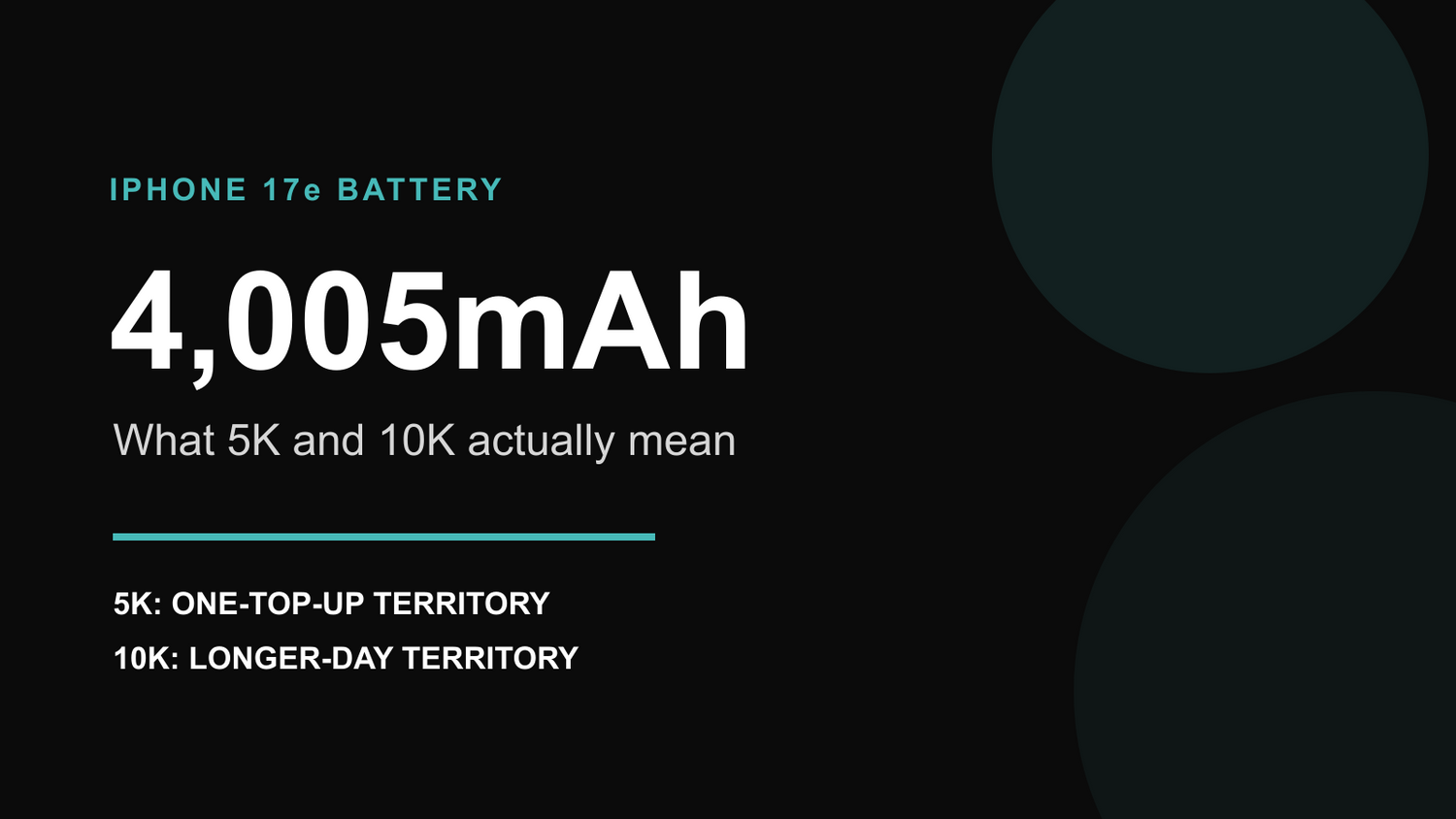
The iPhone 17e has a rated 4,005mAh battery. A 5,000mAh power bank is a one-top-up class choice, while 10,000mAh gives you more room for a longer day or another device. Exact results depend on transfer losses and how you use the phone while it charges.
You are not asking because you love battery specs. You are asking because you want to know one thing: will it get you through the day, and if it will not, how much help a power bank needs to give you.
mAh and Wh are not competing numbers
mAh is a capacity number. It tells you how much charge the battery can hold, but it does not tell you how much energy you can use unless you also know the voltage.
Wh is an energy number. It is what you get after you account for voltage, and it is the cleanest way to compare batteries across devices.
Quick answer
Apple's product information sheet lists 4,005mAh. Use 5K for one strong daily top-up. Choose 10K when you want roughly twice the reserve, need more than one refill, or may charge another device.
How to convert iPhone battery mAh to Wh
The conversion is straightforward:
Wh = (mAh ÷ 1000) × V
For phone batteries, the voltage is typically in the ~3.7V to 3.9V range. That is why you will see small differences between sources depending on which nominal voltage they use.
How many charges does that really mean
If you want the practical answer, use Wh and include losses. No power transfer is perfect. Between voltage conversion, heat, and charging overhead, a reasonable planning range is 70% to 85% usable energy.
That gives you an estimate like this:
Estimated full charges = (Power bank Wh × efficiency) ÷ iPhone Wh
That makes 5K one-top-up territory, not a guaranteed 1.25 full charges. A 10K bank offers roughly twice the reserve. These are planning ranges, not physical iPhone 17e test results.
If your goal is simple, one clean top-up for iPhone without carrying a brick, start with a 5K class power bank. See the SolidSafe™ Air 5K →
Why a 10,000mAh power bank does not give you 10,000mAh
This is the single most common misunderstanding: power bank mAh is measured at the cell voltage, but your iPhone charges at a different voltage. That conversion costs energy.
If you want the clean explanation with real examples and math, this post breaks it down step by step: Why a 10,000mAh Power Bank Does not Give You 10,000mAh →
Battery capacity is only half the story, charging setup matters
If you are using MagSafe or Qi2, your charging speed depends on alignment, heat, and the charger or power bank you pair it with. The fastest setup is not always the most convenient setup.
If you want the practical, non-fanboy guide to the whole setup, start here: iPhone Charging Guide: MagSafe, Qi2, USB-C, and the Best Setup →
Airline rule note, because people always ask
Airlines use Wh, not mAh. The common carry-on line is 100Wh per battery (with some airline exceptions and allowances). If you travel, it is worth thinking in Wh because it keeps your comparisons honest.
For the full rule breakdown and what is actually enforced, see: Power Bank Rules on Planes: The 2026 Update Every Traveler Needs →
A simple iPhone battery plan
If you want one clean top-up without thinking, a 5K power bank is usually the sweet spot. If you want to charge multiple devices, or you travel heavy, 10K buys you breathing room.


FAQ
What is iPhone 17e battery capacity in mAh?
Apple's European product information sheet lists a rated capacity of 4,005mAh for the iPhone 17e.
What is iPhone 17e battery capacity in Wh?
Wh is the cleanest way to compare batteries. If you only have an mAh number, estimate Wh with Wh = (mAh ÷ 1000) × V. For phones, V is typically around 3.7 to 3.9V.
How many times can a 10,000mAh power bank charge an iPhone 17e?
It depends on efficiency and phone use while charging. Treat 10K as roughly twice the reserve of 5K, not as a fixed decimal number of full charges.
Why do different sites show different iPhone battery mAh numbers?
Some sources round differently, or reference slightly different model variants. Others cite typical capacity vs rated minimum capacity. When in doubt, convert to Wh and sanity check the implied energy, not just the mAh.
Is mAh or Wh more important for travel?
Wh. Airline limits are in Wh, and Wh makes comparisons between devices and power banks cleaner.
Power you do not second-guess
SolidSafe™ power banks use semi-solid-state cells with significantly less liquid electrolyte than conventional lithium-ion, helping reduce fire risk. If you want iPhone backup power that feels normal to bring, start with the Air 5K.
Shop SolidSafe™

Leave a comment
This site is protected by hCaptcha and the hCaptcha Privacy Policy and Terms of Service apply.