

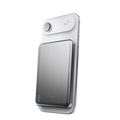
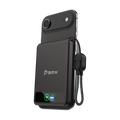
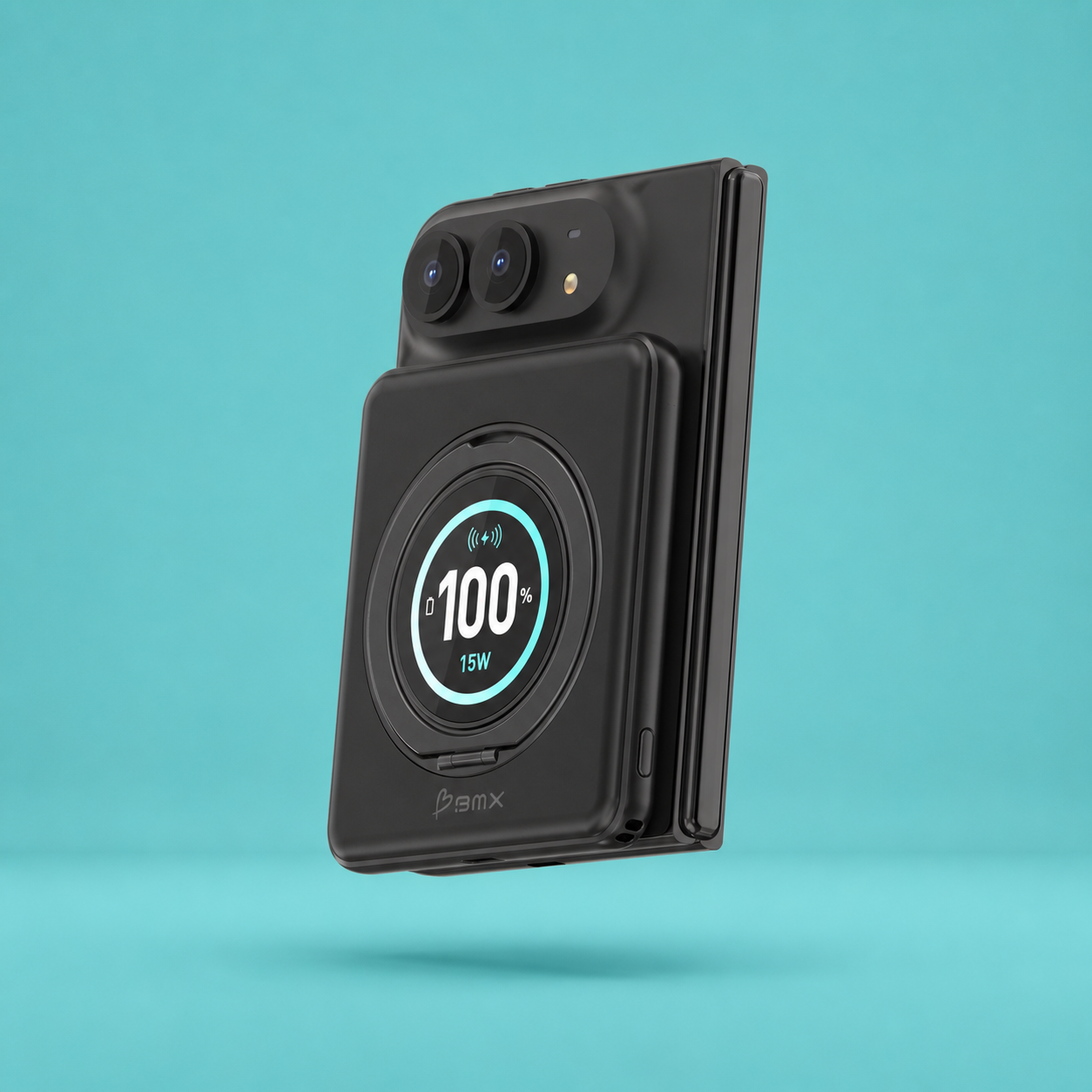

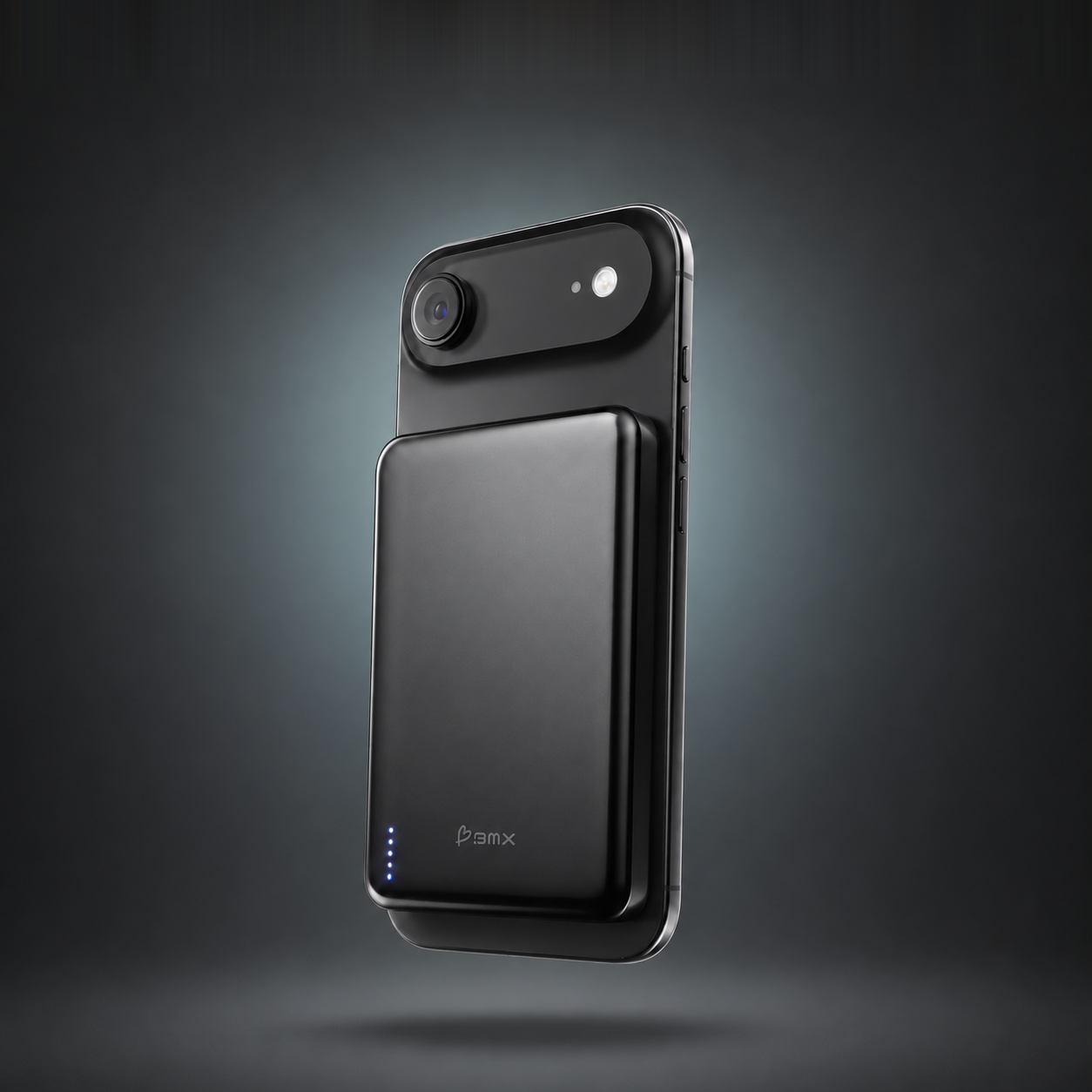

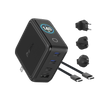
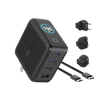
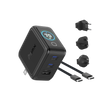
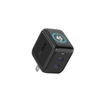


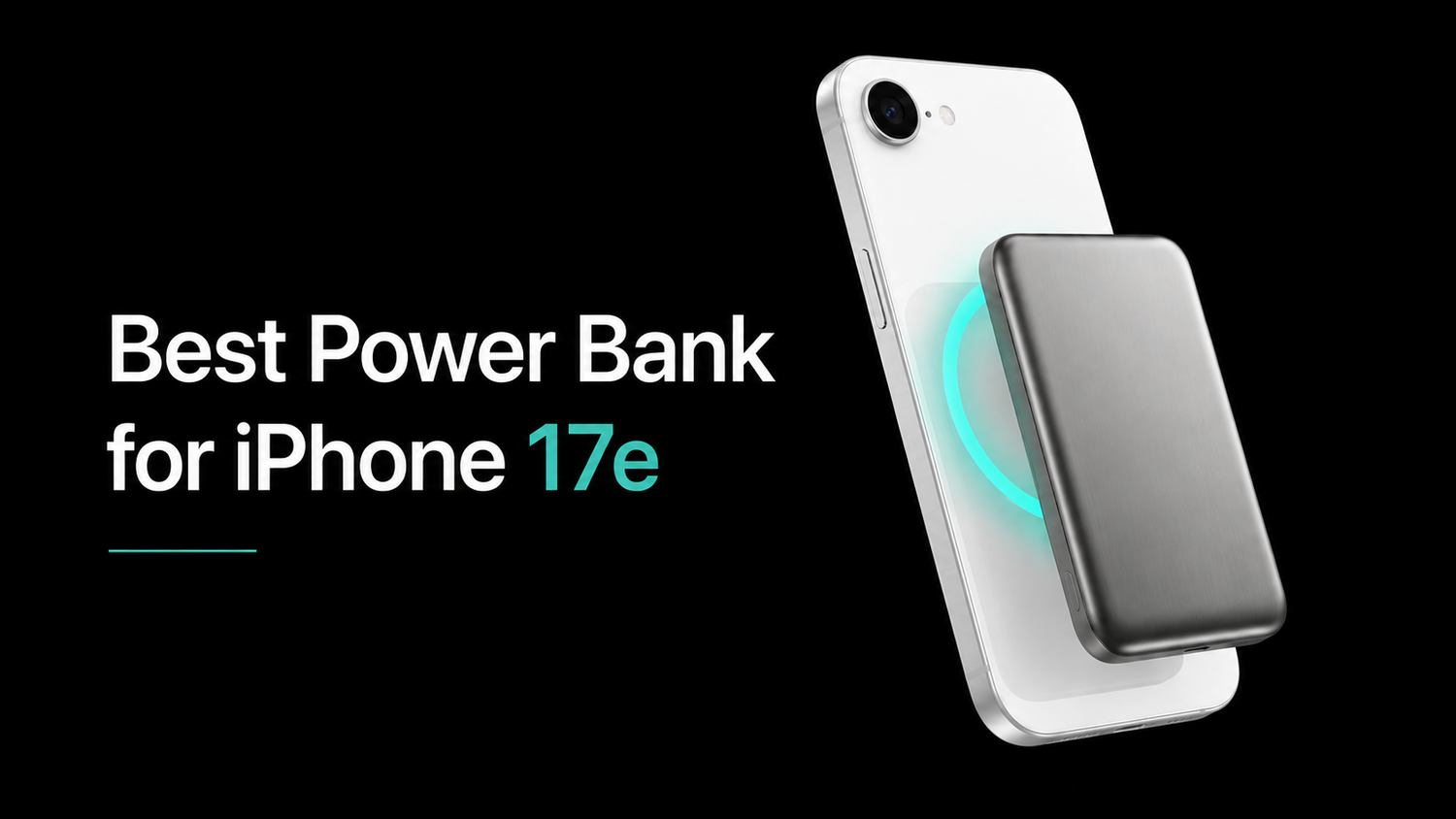
The best power bank for iPhone 17e in 2026 is the BMX SolidSafe Air 5K. It is Qi2 certified, delivers a full 15W wireless to match the 17e's MagSafe and Qi2 ceiling, weighs about 130 grams, and is 6.8mm thin. For longer days, the SolidSafe 10K gives you two full charges and 30W of dual USB-C output. For wired-only buyers who hate carrying cables, the SolidSafe 5K with its built-in USB-C cable is the simplest answer.
The iPhone 17e launched in March 2026 with a 4,005mAh battery, USB-C wired charging up to 20W (PD), and 15W wireless via MagSafe or Qi2. Those numbers set the buying criteria for a power bank that actually matches the phone's capability instead of overcharging for power your phone cannot accept.
This guide ranks three power banks for three different iPhone 17e use cases: daily carry, longer days, and cable-first simplicity. All three use BMX's semi-solid-state cells, which have significantly less liquid electrolyte than traditional lithium-ion.
What the iPhone 17e Actually Needs from a Power Bank
Before any product recommendations, get the spec match right. A power bank that delivers more than the iPhone 17e can accept is wasted spend. A power bank that delivers less is a worse experience than the cable that came in the box.
| iPhone 17e Spec | What it means for a power bank |
|---|---|
| Battery: 4,005mAh | 5,000mAh power bank = roughly one full charge. 10,000mAh = roughly two. |
| USB-C wired: 20W (PD) | A 20W USB-C port is the right ceiling. Higher wattage is wasted because the phone caps at 20W. |
| MagSafe wireless: 15W | Qi2-certified power banks deliver the full 15W. Generic magnetic Qi power banks usually cap at 5-7.5W. |
| Qi2 wireless: 15W | Same 15W ceiling as MagSafe. The iPhone 17e treats Qi2 and MagSafe identically for wireless speed. |
| Port: USB-C | Stick with USB-C cables. The iPhone 17e is part of Apple's full USB-C transition. |
Quick rule
Match the iPhone 17e at its real ceiling: 20W wired USB-C and 15W wireless via Qi2 or MagSafe. Paying for more is paying for capability your phone cannot use.
Our Picks for iPhone 17e
Three power banks, three use cases. All Qi2 certified where wireless is involved. All built on BMX's semi-solid-state cell chemistry.
1. Best Overall: BMX SolidSafe Air 5K
For daily carry. The obvious iPhone 17e match.
The SolidSafe Air 5K is the cleanest iPhone 17e pairing on the market. It is Qi2 certified at 15W, which is the exact ceiling the iPhone 17e accepts wirelessly. The body is titanium, 6.8mm thin, and weighs around 130 grams, so it travels with the phone instead of replacing it in your bag. Snap it onto the back of the iPhone 17e, drop both in a pocket, and walk out the door.
For a phone that ships at 4,005mAh, a 5,000mAh power bank gives you essentially one full top-up. That is the right ratio for daily carry: you are not lugging a backup battery, you are carrying about one extra charge.

2. Best for Longer Days: BMX SolidSafe 10K
For travel, all-day events, or charging a second device too.
If one full charge is not enough, the SolidSafe 10K doubles the capacity to roughly two full iPhone 17e charges. It also adds a second USB-C port, so you can charge the iPhone 17e plus AirPods or a watch from the same bank. Total USB-C output is 30W across the dual ports - more than the iPhone 17e needs alone, exactly right when you are charging two devices at the same time.
The 10K also has a small LCD on the front that shows real-time wattage per port and remaining battery. If you have ever wondered whether your power bank was actually charging fast or just slowly, the display ends the guessing.

3. Best for Cable-First Buyers: BMX SolidSafe 5K
When wireless is not the priority and a built-in cable is.
Some iPhone 17e owners want wired charging only. Wireless adds heat, the magnet on a case can interfere, or they just prefer the certainty of a cable. The SolidSafe 5K has a built-in USB-C cable that loops back into the body, so you carry one device instead of a power bank plus a cable. It is the simplest possible iPhone 17e travel kit: one bank, no cable to lose.
It also has Qi2 15W on top if you change your mind. The cable is the primary feature, but wireless is there as a fallback.

Why Chemistry Matters More Than Specs
Every other "best power bank for iPhone 17e" list compares wattage, capacity, and price. Those numbers are easy to compare. They are also the same numbers across most of the market. The thing that almost no buyer guide compares is what is actually inside the cell.
Traditional lithium-ion cells, the ones inside almost every power bank sold in 2026, use a liquid electrolyte. That liquid is flammable. It is the chemistry behind every major power bank recall in the last five years: a cell gets punctured, swells, or short-circuits, the liquid electrolyte ignites, and the result makes the news. The recall list is long enough that the CPSC has its own dedicated page for it.
The SolidSafe line uses semi-solid-state cells. The technical change is significant: there is significantly less liquid electrolyte than a traditional lithium-ion cell. The risk is reduced, not eliminated. No battery is risk-free. But the entire failure mechanism that drives lithium-ion recalls depends on that flammable liquid being present in volume, and semi-solid-state cuts that volume substantially.
Why this matters for an iPhone 17e specifically: the phone you charge from this power bank lives on your nightstand, goes in a bag with your laptop, sits in an overhead bin on flights, and gets carried in pockets every day. A 2W charging speed difference between power banks is invisible in daily use. The chemistry difference shows up the one time something actually goes wrong.

In internal testing, SolidSafe semi-solid-state cells were drilled, cut, and punctured while fully charged. No fire. No thermal runaway.
That is not a marketing video. The drill test is the simplest possible demonstration of the chemistry difference. A traditional lithium-ion cell drilled while fully charged is a fire. A semi-solid-state cell drilled while fully charged is a cell with a hole in it. That is the entire BMX SolidSafe argument in 15 seconds.
If you are comparing the Air 5K or 10K to a similarly-spec'd power bank from another brand on Amazon, the wattage and capacity will be close. The cells will not be. That is the trade-off that matters for a phone you carry every day and sleep next to every night.
Other Power Banks to Consider for iPhone 17e
If you are cross-shopping the iPhone 17e power bank category, these are the alternatives most commonly mentioned in 2026 buyer guides. Both are traditional lithium-ion. Neither matches the BMX picks on chemistry, but each has its own strengths worth noting.
Anker MagGo (Qi2 magnetic line). Anker's MagGo line covers Qi2 magnetic at 5K and 10K capacities. Wireless speed is 15W, which matches the iPhone 17e ceiling. The retail availability is broader than almost any competitor and entry-level pricing is typically lower than BMX. Trade-offs: the entry SKUs do not include a display, the cells are traditional lithium-ion, and Anker has had multiple high-profile recalls on adjacent product lines in the last two years.
Mophie Snap+ Powerstation Mini. Mophie's Apple-store retail presence and tight MagSafe integration are the appeal. The Snap+ Mini delivers 5,000mAh at 7.5W to 15W wireless depending on SKU, with USB-C wired output in the 15W to 18W range. It is the safest "buy at the Apple Store" option for shoppers who value the in-store trust. Trade-offs: it generally costs more per mAh than BMX or Anker, the wireless cap on some SKUs is below 15W, and the cells are traditional lithium-ion.
The differentiator across both alternatives versus the SolidSafe line is the same one: chemistry. Specs differ at the margin. Chemistry is the difference that shows up the one time something fails.
| Power bank | Capacity | Wireless | Cells |
|---|---|---|---|
| BMX SolidSafe Air 5K | 5,000mAh | Qi2 15W | Semi-solid-state |
| BMX SolidSafe 10K | 10,000mAh | Qi2 15W | Semi-solid-state |
| BMX SolidSafe 5K | 5,000mAh | Qi2 15W | Semi-solid-state |
| Anker MagGo (typical) | 5K to 10K | Qi2 15W | Lithium-ion |
| Mophie Snap+ Mini | ~5,000mAh | MagSafe 7.5W to 15W | Lithium-ion |
How to Choose Between Them
The honest decision tree for iPhone 17e owners:
- Carry a phone and want the thinnest, snap-on, magnetic option: Air 5K.
- Travel days, all-day events, charging phone plus a second device: 10K.
- Want a built-in cable so you never carry a separate USB-C: 5K.
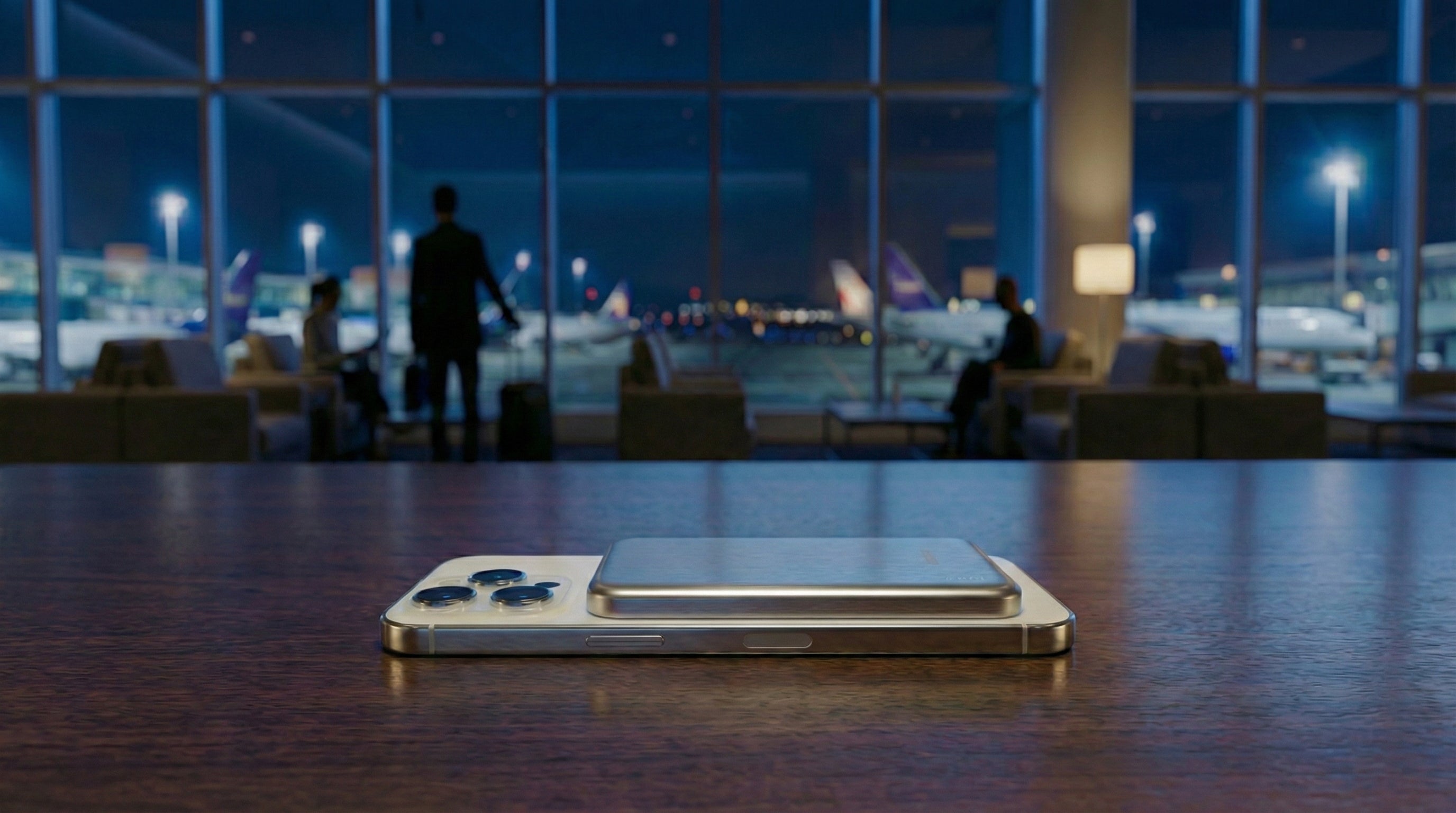
- Plan to take it on flights: All three are under the 100Wh airline limit. Air 5K and 5K are about 19Wh, 10K is about 38Wh.
What to Look For (Beyond the iPhone 17e)
Whatever power bank you end up with, these criteria are non-negotiable for an iPhone 17e:
Qi2 certification (if wireless matters)
The iPhone 17e maxes out at 15W wireless via MagSafe or Qi2. Power banks that say "magnetic wireless" without Qi2 certification usually deliver 5W to 7.5W. That is the slowest wireless option Apple supports and the longest charge time you can get. Look for the Qi2 mark on the box.
USB-C with at least 20W output
The iPhone 17e accepts up to 20W on USB-C PD. A 20W USB-C output is the right ceiling. A 30W or higher port is fine (the phone will just pull what it needs), but you are not getting any faster charging by paying more.
Safety certifications
UL, CE, FCC, and ideally CCC if you fly to or through mainland China. The Air 5K carries CCC certification, which became required for power banks on China's domestic flights in 2025.
Cell chemistry
Most power banks on the market use traditional lithium-ion cells. Semi-solid-state cells, like the ones in the SolidSafe line, have significantly less liquid electrolyte than traditional lithium-ion. The risk is reduced, not eliminated. For an iPhone 17e that lives next to your bed and travels with you, that chemistry difference matters more over time than the spec-sheet wattage does.
For the full charging-side reference on the iPhone 17e (cable types, charger wattages, MagSafe vs Qi2 behavior), read the dedicated charging guide. iPhone 17e Charging Guide →
Frequently Asked Questions
Does iPhone 17e work with MagSafe power banks?
Yes. The iPhone 17e supports MagSafe and Qi2 at 15W wireless. Any Qi2-certified magnetic power bank will deliver the full 15W. Magnetic but non-Qi2 power banks usually fall back to 5W to 7.5W.
What size power bank should I buy for iPhone 17e?
5,000mAh for daily carry (about one full charge). 10,000mAh for longer days or charging a second device too (about two full charges). Capacity above 10,000mAh is rarely needed for a phone with a 4,005mAh battery.
How fast does the iPhone 17e charge?
Up to 20W via USB-C wired (PD) and up to 15W via MagSafe or Qi2 wireless. A power bank that delivers more than these speeds will not charge the iPhone 17e any faster, because the phone caps the charge rate.
Can I take a power bank for iPhone 17e on a plane?
Yes, in carry-on only. All three picks in this guide are well under the 100Wh airline limit: the Air 5K and 5K are about 19Wh, the 10K is about 38Wh. Some international airlines (notably in mainland China) require CCC certification for domestic flights. The Air 5K carries CCC.
Do I need a USB-C cable to charge the iPhone 17e from a power bank?
Only if you are using wired charging. Wireless via Qi2 or MagSafe does not need a cable. The SolidSafe 5K has a built-in USB-C cable so you don't carry a separate one.
Will a higher-wattage power bank damage the iPhone 17e?
No. The iPhone 17e negotiates the charge rate it can accept and only draws what it needs. A 30W or 100W power bank will charge the iPhone 17e at the same 20W ceiling as a 20W power bank.
Is wireless charging bad for iPhone 17e battery health?
No, when done at the correct wattage. The iPhone 17e is designed for 15W wireless. Qi2-certified power banks deliver exactly that. Heat is the long-term battery-health enemy, so the bigger concern is using cheap magnetic power banks that misalign and generate excess heat.
Does the iPhone 17e support fast wireless charging from any Qi2 power bank?
Yes, any Qi2-certified power bank rated at 15W will deliver the iPhone 17e's full wireless ceiling. The magnetic alignment matters too. Power banks with the proper Qi2 magnet array snap into place and stay aligned, which keeps the wireless charging at its rated speed.
BMX SolidSafe Air 5K
The iPhone 17e match, in a 6.8mm titanium body.
Qi2 15W. 20W USB-C output. 5,000mAh semi-solid-state cells. Snaps to the back of your iPhone 17e and travels with it everywhere.
See the SolidSafe Air 5KRelated guides
- iPhone 17e Charging Guide: Battery, Speeds, MagSafe, and Qi2
- Best Power Bank for iPhone in 2026: Qi2, MagSafe, USB-C
- Best MagSafe Power Banks in 2026: Ranked by Safety, Slimness, and Materials
- Best Qi2 Power Banks in 2026: Ranked by Safety and Wireless Speed
- Safest Power Banks in 2026: Semi-Solid-State Buying Guide

Leave a comment
This site is protected by hCaptcha and the hCaptcha Privacy Policy and Terms of Service apply.