



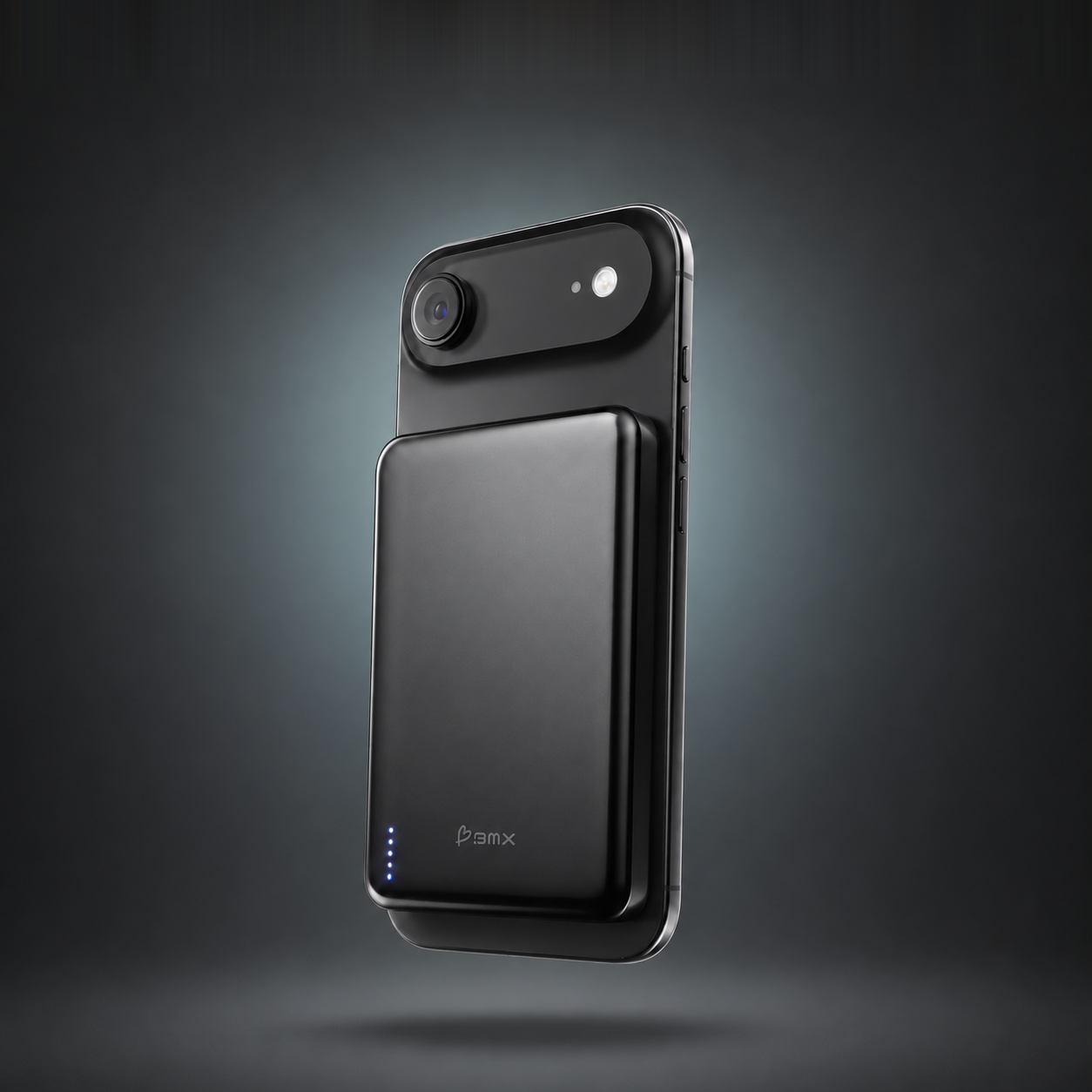

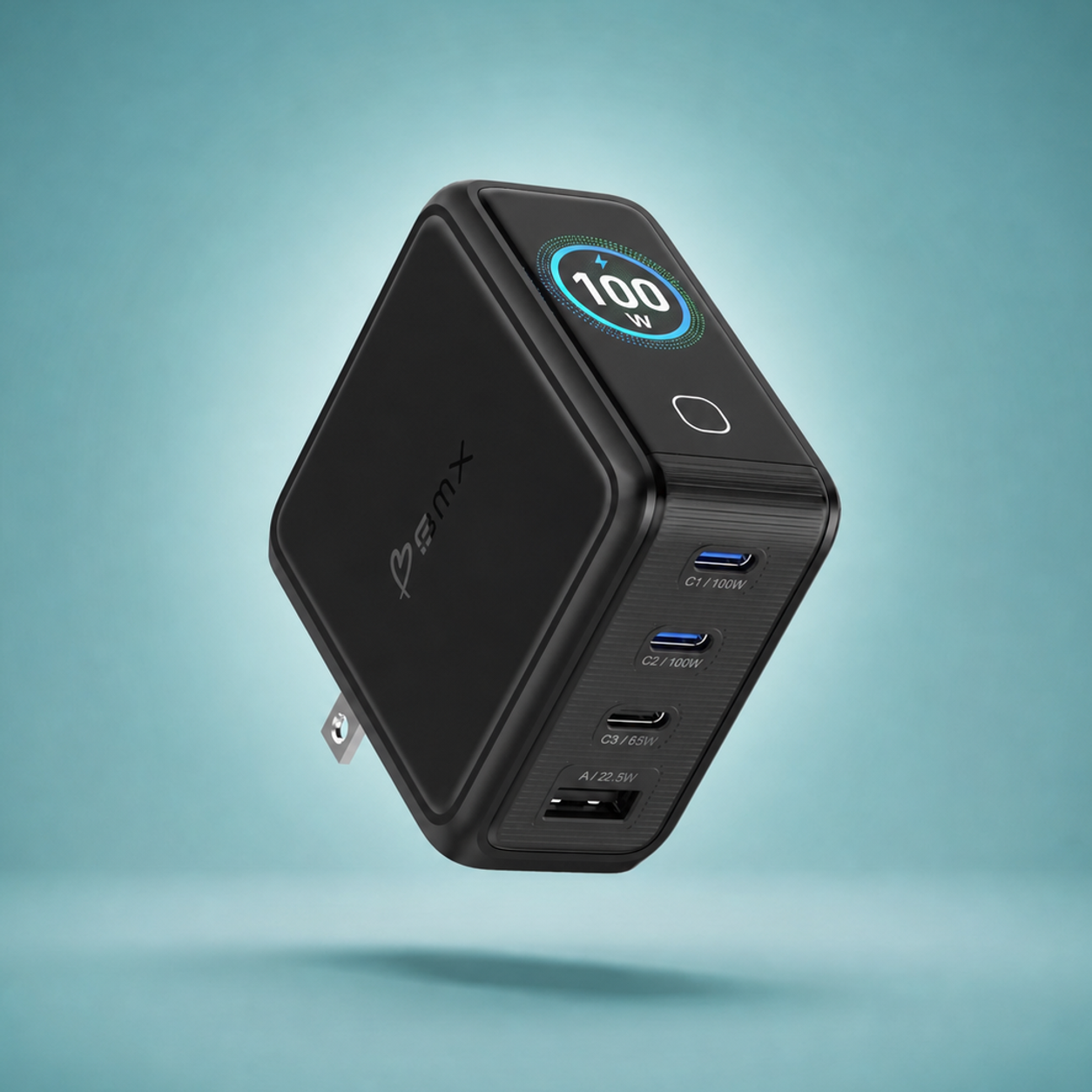
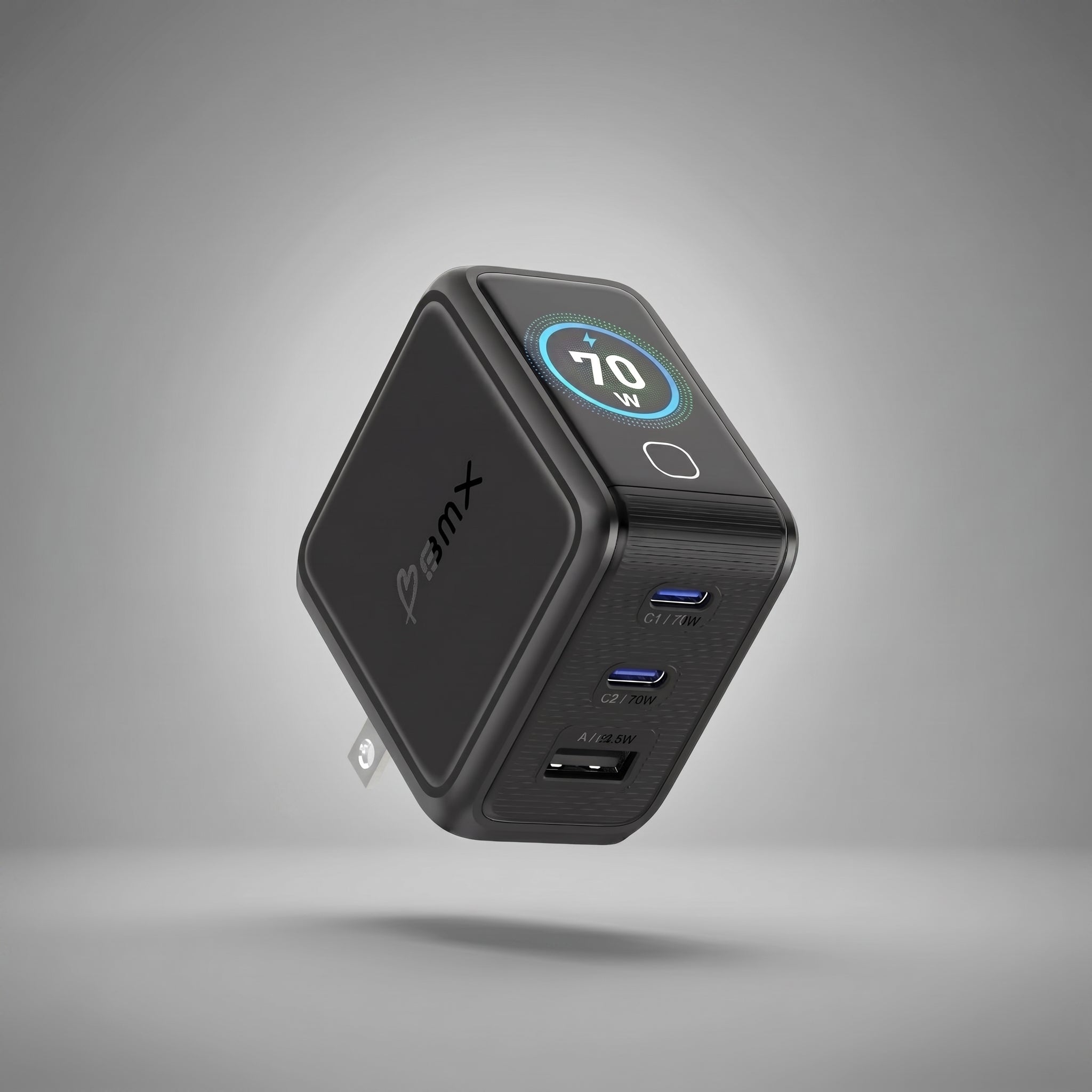
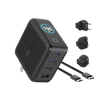


A GaN charger uses gallium nitride instead of silicon as its switching semiconductor. The result is a charger that's 30 to 50 percent smaller than a silicon equivalent, runs cooler at the same load, and converts more wall power into actual charging instead of waste heat. It does not make your phone or laptop charge faster than the device's built-in limit, and it costs more to manufacture. Worth it if you carry a charger every day, travel, or run multiple devices from one outlet.
You have seen the brick that ships with your laptop. Big, warm, mostly empty plastic. Most of that volume is silicon-era electronics that have not changed much in twenty years. The new generation of chargers does the same job in a third of the space. That technology is called GaN. This guide explains what GaN actually changes, what it does not change, and what to look for if you are about to replace an old brick in 2026.
At BMX we build mobile power gear for people who carry it daily, fly with it, and rely on it. That means we spend a lot of time studying what is real about charging technology and what is just marketing. This is the honest version.
What "GaN" Actually Means
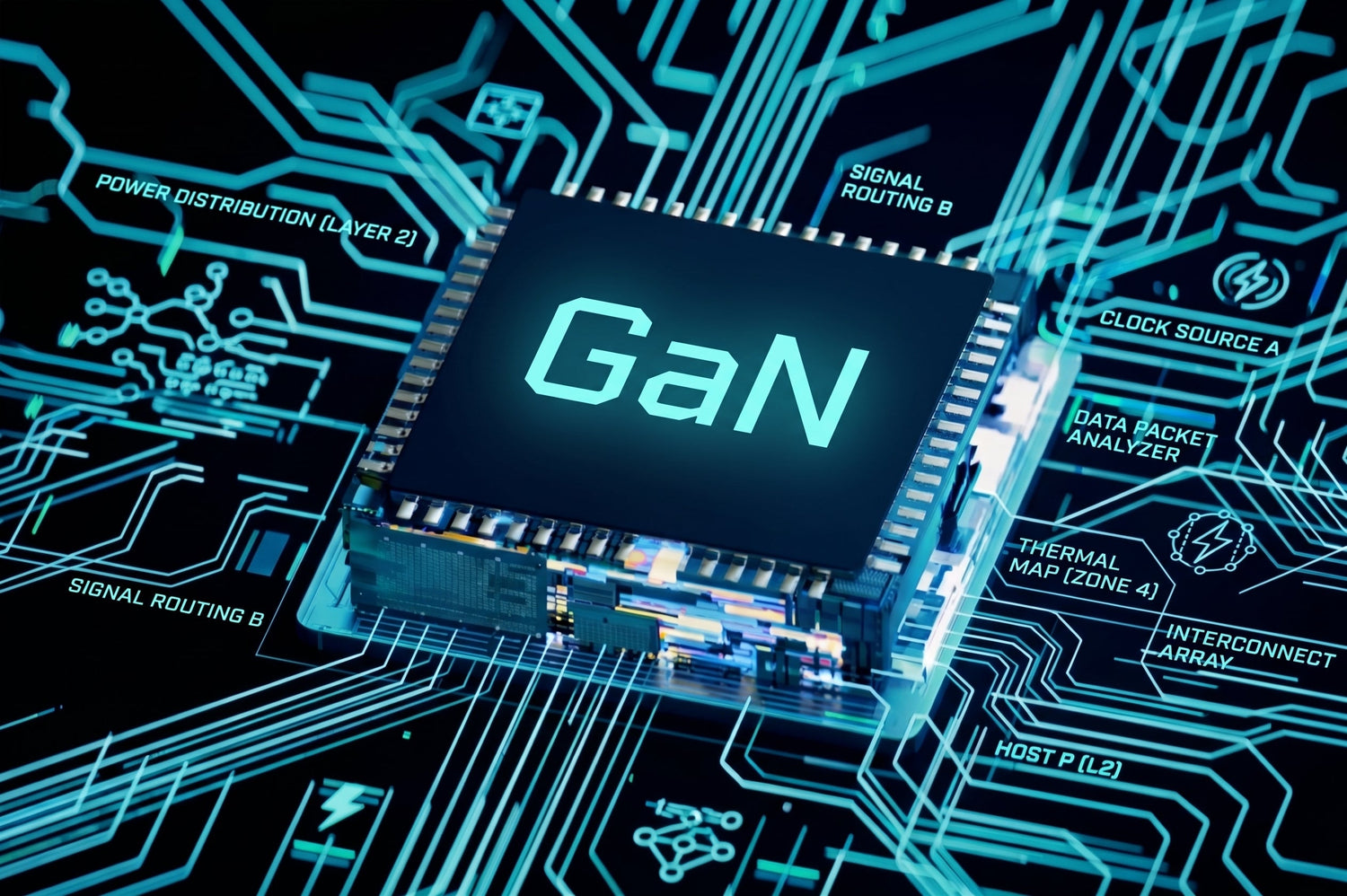
GaN is short for gallium nitride. It is a semiconductor compound used in place of silicon in the high-speed switching transistors that sit inside a power adapter. Silicon has dominated power electronics for decades because it is cheap and well-understood. GaN is harder and more expensive to manufacture, but it has better material properties for one specific job: switching electricity on and off very fast, at high voltage, with very little loss.
In plain English, GaN transistors can switch hundreds of thousands of times per second at higher voltages than silicon while wasting less energy as heat. That switching speed is what makes everything else about a GaN charger possible.
It is not new science. GaN has been used in radar, satellite communications, electric vehicle inverters, and 5G base stations for years. Putting it inside a consumer phone charger is the recent application, not the technology itself.
The Three Real Wins of GaN
Smaller
Faster switching frequency means smaller magnetic components (transformers and inductors). Smaller magnetics means a smaller charger overall. A 65W GaN charger is typically about the size of a stack of three credit cards. A 65W silicon equivalent is two to three times that volume. It is not magic, it is physics. The same trick made LED light bulbs smaller and solid-state amplifiers replace the old tube-and-transformer designs.
Cooler
GaN chargers typically convert more than 90 percent of input power into output power. Silicon chargers sit closer to 80 to 85 percent. The difference, somewhere between 5 and 10 percentage points, goes somewhere, and the answer is almost always heat. A GaN charger at 65W produces less waste heat than a silicon charger at 65W, so the case stays cooler.
One honest note: a GaN charger at 100W or higher, sustained, still gets warm. Marketing language like "runs cool" overpromises. A more accurate claim is "cooler than silicon at the same load." Warm to the touch at high sustained wattage is still normal behavior.
More efficient (which sometimes looks like faster)
Higher efficiency means more of the wall power becomes charging power. It also means the charger has more thermal headroom, which lets manufacturers push more wattage per port and support more devices simultaneously. When people say a GaN charger is "faster" what they usually mean is "supports a wider range of fast-charge protocols and can deliver high wattage to more ports at once" rather than "charges any single device faster than the silicon equivalent." That distinction matters, and we cover it next.
Efficiency and heat are not just charger problems. The cell chemistry inside the device you are charging matters just as much. BMX power banks use semi-solid-state cells, which manage heat differently than older lithium-ion. Read the semi-solid-state explainer →
What GaN Does Not Change
Your phone, laptop, and tablet have built-in charge speed limits set by the device manufacturer. The charger negotiates with the device over the USB-C cable and delivers whatever the device asks for, up to the charger's max. The device is almost always the bottleneck, not the brick.
Real-world device limits in 2026:
| Device | Max USB-C draw | What a 100W GaN delivers |
|---|---|---|
| iPhone 17 / 17 Pro | ~27W | ~27W |
| iPhone 17e | ~20W | ~20W |
| Pixel 10 / 10 Pro | ~37W PD | ~37W |
| Galaxy S25 / S25 Ultra | 45W (PPS only) | 45W if charger supports PPS, else ~25W |
| MacBook Air M3 | ~30W | ~30W |
| MacBook Pro 14" | ~96W (fast charge) | ~96W |
| MacBook Pro 16" | ~140W | ~100W (capped by charger), 140W needs 140W charger |
The takeaway: a 100W GaN charger plugged into an iPhone 17 will deliver about 27W. The same 100W GaN charger plugged into a MacBook Air will deliver about 30W. The phone is not charging "slowly" because the charger is wrong, it is charging at the speed the phone is built to accept.
Where GaN's wattage headroom does matter: laptops, gaming handhelds like the Steam Deck and ROG Ally, multi-device charging where the budget gets split, and PPS-capable Samsung phones that need a charger that speaks PPS to hit their 45W fast-charge mode.
And cables matter too. A GaN charger cannot push past a cable's rated capacity. A 60W USB-C cable will not pass 100W to your laptop, no matter how good the charger is. Look for cables marked "100W" or "5A" if you are charging a laptop.
The Multi-Port Truth Nobody Explains
This is the section most "what is GaN" articles skip. People search "100W charger only outputs 65W" and find marketing copy or no answer at all. Here is the honest version.
A 100W GaN charger labeled "100W" almost never delivers 100W to a single port and to other ports at the same time. The 100W is a total power budget shared across whatever is plugged in. This is called dynamic power splitting.
Example, two-port 100W GaN charger:
- Single device on one port: up to the full 100W to that device (assuming the device can pull that much).
- Two devices: laptop on port one gets up to 65W. Phone on port two gets the remaining 30 to 35W.
- Three devices: laptop usually takes priority, the remaining budget splits between the other two.
This is not a defect. It is how every multi-port GaN charger works. But the spec sticker on the box rarely explains it, which is why every Amazon listing for a 100W or 140W charger has at least a few one-star reviews complaining that they only saw 65W when two devices were plugged in.
Practical rule: when shopping a multi-port GaN charger, pick one whose total wattage covers your worst-case load. If you ever charge a 65W laptop plus a phone plus headphones at the same time, you need at least 100W total. If you sometimes charge a 96W MacBook Pro plus a phone, you need at least 140W. The total wattage rating is the right shopping number, not the per-port peak.
Quick rule
Total wattage is the real shopping number. Per-port peak is misleading when you have more than one device. Buy for the moments you charge multiple devices at once, not the moments you charge one.
What to Look for in a GaN Charger in 2026
Past the size and wattage on the box, here is what actually separates a good GaN charger from a generic one:
Total wattage that matches your real workload
45W covers a phone plus a tablet. 65W covers a phone plus a MacBook Air or iPad Pro. 100W covers a phone plus a Pixel or MacBook Pro 14". 140W is the modern "one brick for everything" answer, including 16" laptops and high-wattage Samsung fast charging.
USB-C Power Delivery (PD) 3.1 support
PD 3.1 unlocks the 28V output mode needed for sustained 100W and above. PD 3.0 chargers cap at 100W (20V at 5A). If you want headroom for 140W laptops or future devices, PD 3.1 is the spec to confirm.
PPS support
PPS stands for Programmable Power Supply. It is the only protocol that unlocks Samsung's Super Fast Charging 2.0 at 45W on the Galaxy S22 Ultra, S23 Ultra, S24 Ultra, S25, and S25 Ultra. If you own one of those phones and want the advertised 45W speed, the charger must specifically list PPS support. Most cheap GaN chargers skip it.
Real protection circuits
Look for certifications (UL, CE, FCC) on the box and overcurrent, over-temperature, and short-circuit protection in the spec sheet. GaN itself is a mature semiconductor, but cheap chargers cut corners on the protection components around it. Certifications are the cheapest filter against the worst products.
A wattage display (optional but increasingly common)
A small LCD or OLED screen on the charger that shows per-port wattage in real time answers three questions your hand cannot: is the cable throttling, is the device negotiating fast charge correctly, and is the warmth you feel normal load or a problem. People who go from a no-display charger to one with a display rarely go back.
Form factor
Folding prongs for travel. A grippy or matte finish so the charger does not slide off a desk. Weight balance, especially on 140W bricks, that does not pull the charger out of a loose wall outlet. These are not glamorous specs, but they show up in daily use.
When a GaN Charger Is Worth the Upgrade
Daily carry, yes. A smaller brick in a bag every day is a real quality-of-life win. The difference between a stock 65W brick and a 65W GaN brick is noticeable every time you pack.
Travel, yes. International travel especially benefits. One 100W or 140W GaN charger plus a wall adapter replaces three or four older bricks and a tangle of cables.
Home base or desk, less critical. The silicon brick stuffed behind a monitor is not visible. Upgrading to GaN at the desk is more about reclaiming outlets and powering multiple devices from one plug than about size.
One USB-C device, probably not. If you only charge a single phone, the stock charger that came with it is usually fine.
Replacing a working charger, check first. A working 30W brick that charges your phone fast enough is not a problem to solve. GaN matters when your current setup is actually slowing you down or when you carry multiple chargers because no single one covers everything.
Frequently Asked Questions
What does GaN stand for in a charger?
GaN stands for gallium nitride. It is a semiconductor compound used in place of silicon inside the charger's high-speed switching transistors. The result is a charger that runs at higher frequencies with less waste heat, which lets manufacturers make it smaller for the same wattage.
Are GaN chargers faster than regular chargers?
Not directly. The actual charging speed is set by the device, not the charger. A 100W GaN charger does not charge an iPhone 17 faster than a 30W charger because the iPhone caps around 27W either way. GaN's wattage headroom matters for laptops, multi-device setups, and PPS-capable Samsung phones at 45W.
Are GaN chargers safe?
Yes, when they are built with proper protection circuits. Look for UL or CE certification, overcurrent protection, over-temperature protection, and short-circuit protection. GaN itself has been used in radar, satellite communications, and electric vehicle inverters for years. The risk is not in the technology, it is in budget chargers that cut corners on the protection components around it.
Why is my 100W GaN charger only delivering 65W?
Dynamic power splitting. The 100W is a total budget shared across whatever ports are in use. With one device, you get the full available wattage to that port. With two or three devices, the total splits across them automatically. This is normal behavior on every multi-port GaN charger, not a defect.
Do GaN chargers get hot?
Less than silicon chargers at the same load, but yes, especially at 100W and above. Warm to the touch under sustained high-wattage load is normal. Hot enough that you cannot hold it is not normal and worth checking the cable, the wall outlet, and the charger itself.
Can I use a GaN charger with my old phone or non-USB-C devices?
Yes. GaN chargers are backward-compatible with older USB-A devices and older charging protocols when they include a USB-A port. The charger negotiates down to whatever the device supports. You will not get fast charging on a phone that does not support it, but the charger will not break the phone either.
How much do GaN chargers cost in 2026?
Entry-level 30 to 45W chargers run about $25 to $40. Mid-range 65 to 100W chargers run about $50 to $90. High-end 100W to 140W chargers with PPS and a display run about $90 to $150. The premium over silicon reflects manufacturing cost, not gouging. GaN wafers are harder and more expensive to produce.
Will a GaN charger work in another country?
Yes. Almost every GaN charger supports 100 to 240V input, which covers every consumer outlet voltage worldwide. You will need a physical plug adapter for the wall outlet shape, but you do not need a voltage converter. This is a major reason GaN chargers have become the default travel charger.
BMX Mobile Power
We build power gear that respects your time, your bag, and your bench.
Mobile power that actually fits the way you live. Smaller, safer, more honest. See what we have built so far in our power bank lineup.
See BMX SolidSafe Power BanksRelated guides
- USB-C Power Delivery Explained: How Your Phone Actually Charges
- Phone Charger Wattage Explained: 5W vs 20W vs 30W vs 45W
- Charging Speed Checklist: 7 Reasons Your Phone Is Not Fast Charging
- Semi-Solid-State Batteries Explained: What "Less Liquid" Actually Changes
- The Complete Guide to Power Bank Safety


Leave a comment
This site is protected by hCaptcha and the hCaptcha Privacy Policy and Terms of Service apply.