


Phone charger wattage measures how fast energy flows into your battery. A 5W charger takes over three hours to fill an iPhone. A 20W charger gets it to 50% in about 30 minutes. A 45W charger maxes out a Samsung Galaxy S25 Ultra. Your phone controls how much power it draws, so a higher-wattage charger will never damage it. That is the entire concept.
Every charger box has a wattage number on it. 5W. 20W. 30W. 45W. But nobody explains what those numbers actually mean for YOUR phone, or why your phone sometimes charges fast and sometimes crawls. The answer is not complicated, and you do not need to understand electrical engineering. You just need to know which wattage tier matches your phone and what slows charging down even when you have the "right" charger.
What Wattage Actually Means for Your Phone
Watts measure the rate at which energy moves. Higher watts means energy flows faster from the charger into your phone's battery. The formula is Volts x Amps = Watts, but you never need to calculate that. Think of it like a faucet: 5W is a trickle. 20W is a strong stream. 45W is full blast.
Here is the part that charger companies rarely explain: your phone decides how much power it accepts, not the charger. A 45W charger plugged into an iPhone 16 delivers about 27W, because that is the iPhone's maximum. The other 18W just sits there, unused. No damage. No overheating. No wasted electricity. The charger and phone negotiate automatically through USB-C Power Delivery, settling on the fastest safe speed in milliseconds before any power flows. For the full technical breakdown of that negotiation, see our guide to USB-C Power Delivery explained.
This is why you can safely buy a charger or power bank rated higher than your phone needs. Your phone will only take what it can handle.
Quick answer
A higher-wattage charger will not hurt your phone. Your phone controls the draw. A 30W charger plugged into a phone that maxes out at 20W will only deliver 20W. You cannot "overcharge" a modern phone with a higher-wattage charger or power bank.
The Phone Wattage Tiers: 5W to 45W
Not every jump in wattage makes an equal difference. Going from 5W to 20W is life-changing. Going from 20W to 30W saves you a few minutes. Here is what each tier actually does for phone charging.
5W -- The overnight trickle. This is the old Apple USB-A wall brick that shipped with iPhones for years. It charges an iPhone from dead to full in roughly 3.5 hours. Still fine for nighttime charging on a bedside table. Painful for any other situation. If your power bank or charger only delivers 5W, it is almost certainly outdated.
7.5W -- Old wireless charging. The original Qi wireless standard before MagSafe and Qi2 existed. Slightly faster than 5W, but still slow. If you own a wireless charging pad from before 2020, this is probably what it delivers. Modern Qi2 pads have doubled this speed.
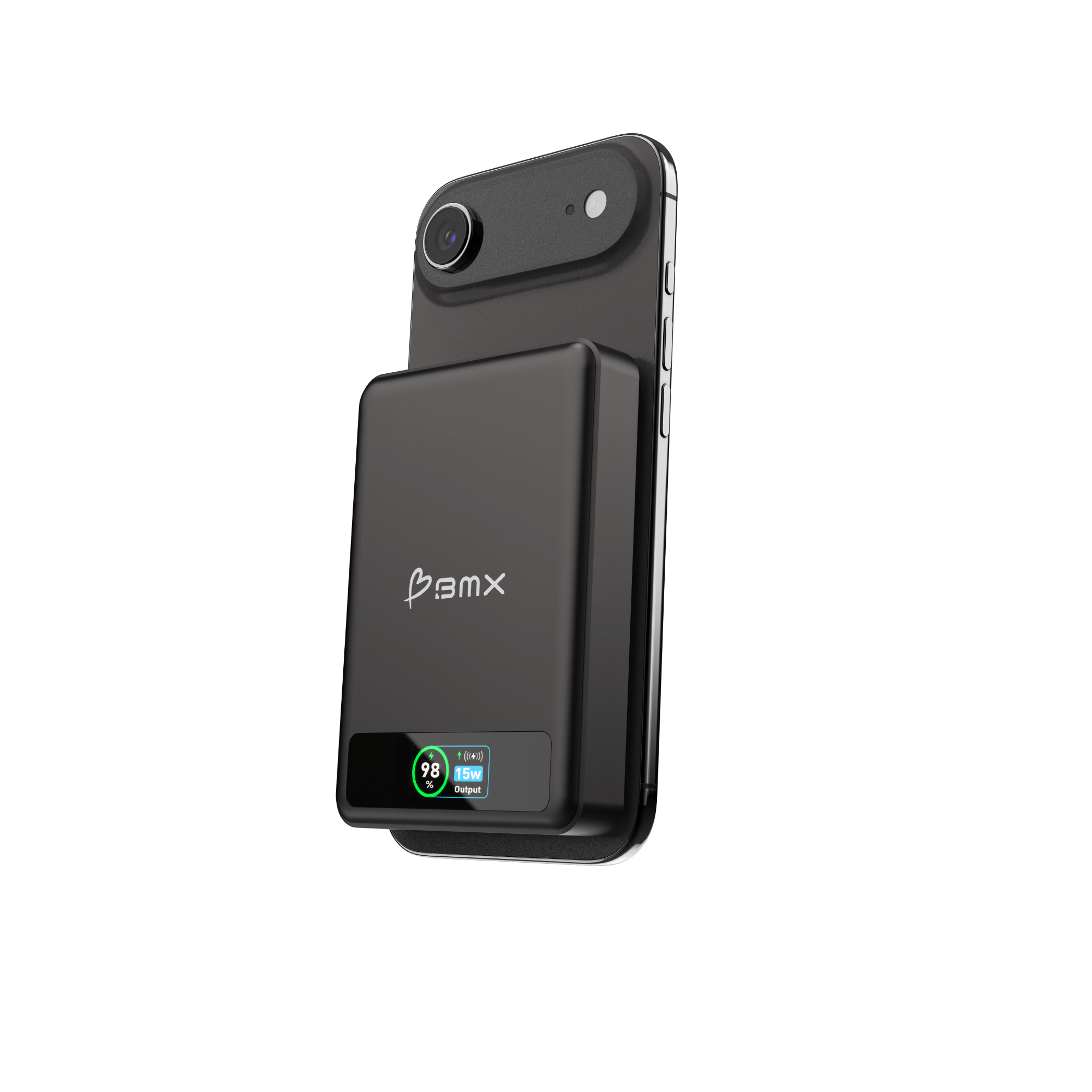
15W -- Modern wireless (Qi2 and MagSafe). The current standard for magnetic wireless charging on iPhones (MagSafe) and the growing number of Android phones with Qi2 support. Gets an iPhone 16 from 0% to about 50% in roughly 45 minutes. This is the speed you get from a BMX SolidSafe power bank snapping magnetically onto the back of your phone. For most people, 15W wireless is "fast enough" for desk charging, car mounts, and grab-and-go power banks.
20W -- The fast-charging baseline. Apple calls this "fast charging" for iPhone, and it is the minimum wattage you need to unlock that speed tier. Gets an iPhone 16 from 0% to 50% in about 30 minutes via USB-C. This is the sweet spot for phone charging: dramatically faster than 5W, and you get most of the speed benefit you will ever notice. Every BMX SolidSafe power bank delivers 20W through its USB-C port.
25-27W -- iPhone's actual ceiling. Apple does not officially publish the iPhone's maximum wired charging speed, but independent testing consistently shows the iPhone 16 Pro Max peaks around 27W during the 0-50% window. A 20W charger gets you most of the way there. A 30W charger lets the iPhone draw its full 27W instead of being capped at 20W. The real-world time difference between 20W and 27W is roughly 3-5 minutes over a 30-minute charge. Noticeable if you time it. Forgettable in daily life.
30W -- Samsung Galaxy A series and all-phone coverage. This is the charging cap for many mid-range Samsung phones and provides headroom for every iPhone, Pixel, and budget Android on the market. A single 30W charger or power bank covers every phone sold today. If you share chargers with family or friends who have different phone brands, 30W is the "covers everyone" tier.
45W -- Samsung Galaxy S and Ultra max speed. The Samsung Galaxy S25 Ultra, S24 Ultra, and S25+ can draw up to 45W through USB-C with PPS (Programmable Power Supply). This is the only phone tier where the jump from 30W to 45W makes a measurable difference: the S25 Ultra hits 65% in about 30 minutes at 45W versus roughly 50% at 25W. If you own a Galaxy S-series flagship and charge speed matters to you, 45W is worth it. For everyone else, it is overkill.
The BMX SolidSafe 10K delivers 20W through USB-C and 15W through Qi2, which covers fast charging for every iPhone, Pixel, and most Samsung devices. The LCD display shows your exact charging speed in real time, so you can see whether your phone is pulling 15W wirelessly or 20W wired. See the SolidSafe 10K →
What Your Specific Phone Actually Draws
The wattage printed on your charger is its maximum output. Your phone has its own maximum input. The actual charging speed is whichever number is lower. Here is what the most popular phones actually accept:
| Phone | Max Wired | Max Wireless | Charger You Need |
|---|---|---|---|
| iPhone 16 Pro Max | ~27W | 15W (MagSafe/Qi2) | 20W minimum, 30W ideal |
| iPhone 16 / 16 Plus | ~25W | 15W (MagSafe/Qi2) | 20W minimum, 30W ideal |
| iPhone 15 / 14 / SE 4 | ~20W | 15W (MagSafe/Qi2) | 20W is perfect |
| Samsung Galaxy S25 Ultra | 45W (PPS) | 15W (Qi2) | 45W for max, 25W still fast |
| Samsung Galaxy S25 / S25+ | 25-45W (PPS) | 15W (Qi2) | 25W minimum, 45W for max |
| Google Pixel 10 / 10 Pro | ~27W | 15W (Qi2) | 20W minimum, 30W ideal |
| Google Pixel 9 / 9 Pro | ~27W | 12W (Qi only) | 20W minimum, 30W ideal |
| Samsung Galaxy A55 / A35 | 25W | N/A | 25W is max speed |
Why Samsung needs PPS, not just PD
Samsung Galaxy S-series phones require PPS (Programmable Power Supply) to hit their maximum 45W speed. A charger that only supports USB-C PD (Power Delivery) will cap Samsung at about 15-25W, even if the charger is rated for 45W. Always check that a Samsung charger explicitly supports PPS. iPhones and Pixels use standard PD and do not need PPS.
Why Your Phone Does Not Always Charge at Max Speed
You bought a 30W charger. Your phone supports 27W. But the charging indicator says 15W. What happened? Nothing is broken. Your phone is being smart about protecting its own battery. There are four main reasons your phone throttles its charging speed, even when the charger has the power available.
1. Battery percentage. Fast charging is fastest between 0% and about 50-60%. After that, every phone slows down deliberately. This is called the charging curve, and it protects the battery from degradation. An iPhone charges at near-max speed from 0% to about 50%, then gradually slows from 50% to 80%, then crawls from 80% to 100%. A "30-minute fast charge" always measures the 0-50% window, not 0-100%. Getting the last 20% takes almost as long as the first 80%.
2. Heat. Lithium-ion batteries charge best between 20-35 degrees Celsius (68-95 degrees Fahrenheit). If your phone gets warm from use, direct sunlight, or even just sitting in a hot car, it will throttle charging speed to protect the battery. This is why wireless charging is sometimes slower than wired: the coils generate heat, and the phone backs off to stay cool. If you have ever noticed your phone charging slowly on a summer day, heat is almost certainly the reason.
3. Battery health. As batteries age, they lose capacity and the phone's software adjusts charging speed to extend the remaining lifespan. An iPhone with 85% battery health will charge slightly slower than one at 100%. This is intentional. Some phones (including iPhones with iOS 18+) also have "optimized charging" features that learn your schedule and deliberately slow charge overnight so the battery spends less time at 100%, which reduces long-term wear.
4. Cable quality. Not all USB-C cables support the same power. A cheap cable without proper wiring may cap your charging speed at 10-15W even with a 30W charger. For fast charging, you need a cable that supports the wattage your phone draws. The cable that came with your phone is almost always fine. Replacement cables should explicitly state USB-C PD support and the wattage they handle. If your phone is charging slowly and the charger is good, try a different cable before buying a new charger.
Wired vs. Wireless: Why the Wattage Gap Matters
Wired USB-C charging maxes out at 20-45W for phones. Wireless Qi2 and MagSafe max out at 15W. That is a big gap, and it affects how you think about wattage depending on how you charge.
Wired is faster. Period. If you need your phone charged as fast as possible before you walk out the door, plug in a USB-C cable. A 20W wired charge gets most phones to 50% in about 30 minutes. A 15W wireless charge takes about 45 minutes to hit the same level.
Wireless is more convenient. You snap on a MagSafe or Qi2 power bank and keep using your phone. No cable. No fumbling. The trade-off is speed. For most daily situations (desk charging, car mounts, topping up while you work), the 15W wireless speed is more than enough. You plug in for speed. You snap on for convenience.
Both wattage tiers matter. A power bank like the BMX SolidSafe 5K gives you both: 20W through USB-C when you need speed, 15W through Qi2 when you want convenience. Understanding the wattage difference helps you pick the right charging method for the moment. For the complete breakdown of MagSafe, Qi2, and USB-C charging on iPhones, see our iPhone charging guide.
Power Bank Wattage: Output vs. Input
Power banks have two wattage numbers that matter: output and input. They measure different things, and mixing them up is one of the most common mistakes in product listings.
Output wattage is how fast the power bank charges YOUR phone. This is the number that directly affects your experience. A power bank with 20W USB-C output fast-charges your phone at the same speed as a 20W wall charger. A power bank with 5W output does not fast-charge anything. When shopping for a power bank, output wattage is the number to check first.
Input wattage is how fast the power bank recharges itself from a wall charger. Higher input means less waiting between uses. A power bank with 27W input refills about twice as fast as one with 15W input. The BMX SolidSafe 10K accepts 27W input, so a full recharge from a 30W wall charger takes roughly 2.5 hours. At 15W input, the same recharge would take 4+ hours.
Both numbers matter, but output matters more. A power bank with great input speed but weak output speed recharges itself fast and then slowly trickle-charges your phone. That is backwards. Check output first, input second.
And remember: the mAh number on the label does not equal the real capacity you get. Voltage conversion between the power bank's internal cells and the USB output costs energy, typically reducing usable capacity to about 60-65% of the rated number.
How to Pick the Right Wattage for Your Phone
Forget memorizing every spec. Here is the decision tree:
iPhone user (any model): 20W USB-C is your sweet spot. It unlocks Apple's "fast charging" tier and gets you 0-50% in about 30 minutes. Going to 30W gives a small improvement. Going beyond 30W does nothing for your iPhone. For wireless, any Qi2 or MagSafe power bank or pad at 15W maxes out your wireless speed. For a deeper look at how all these methods compare on iPhones specifically, see our iPhone charging guide.
Samsung Galaxy S-series user: 45W with PPS unlocks your phone's full speed. But 25W with standard PD still charges fast. The speed difference is most noticeable in the 0-50% window. If you do not own a PPS charger, a 25W PD charger gets you about 80% of the speed at half the cost. Also note: Samsung's 45W speed only kicks in with a PPS-compatible charger and cable. Standard PD chargers cap Samsung phones at a lower speed even if the charger is rated for 45W.
Google Pixel user: 20W minimum, 30W ideal. Pixels max out around 27W wired and 15W wireless (Qi2 on Pixel 10, Qi on Pixel 9 and older). See our Pixel 10 wireless charging guide for the full breakdown.
If you share chargers with family or friends: 30W covers every phone on the market. It maxes out iPhones, comes close on Pixels, and fast-charges Samsungs (though not at their 45W maximum). One 30W charger or power bank handles everyone.
The Bottom Line
Phone charging wattage is simpler than the industry makes it look. Your phone controls the speed, not the charger. 20W is fast charging for almost every phone. 45W only matters for Samsung Galaxy S flagships. Higher than your phone's maximum does zero harm and zero good. And when your phone charges slowly despite having the "right" charger, the culprit is usually heat, battery percentage above 50%, or a bad cable.
For most people, a 20W USB-C charger or power bank and a 15W Qi2 wireless option covers every phone situation. That is the whole formula.
SolidSafe Power Banks
20W Wired. 15W Wireless. See Your Speed.
Every BMX SolidSafe power bank shows your exact charging speed on the LCD display. Fast-charge any phone via USB-C. Snap on magnetically via Qi2. Semi-solid-state battery cells for safety you can see on the inside, speed you can see on the screen.
See SolidSafe Power BanksFrequently Asked Questions
What does 20W mean for phone charging speed?
20W means your charger delivers energy fast enough to take an iPhone 16 from 0% to 50% in about 30 minutes via USB-C. It is the baseline for what Apple calls "fast charging" on iPhones. For most phones, 20W is the sweet spot where speed improves dramatically compared to 5W without generating excessive heat. A 20W power bank like the BMX SolidSafe 5K fast-charges your phone at the same speed as a 20W wall charger.
Will a 45W charger damage my iPhone?
No. Your iPhone controls how much power it draws through USB-C Power Delivery negotiation. A 45W charger plugged into an iPhone delivers about 25-27W, because that is the iPhone's maximum. The charger will not force extra power into your phone. It works exactly the same as plugging a nightlight into a 20-amp wall outlet: the outlet has the capacity, but the device only takes what it needs.
Why is my phone charging slowly even with a fast charger?
Four common reasons: your battery is above 50% (phones deliberately slow down past this point to protect battery health), the phone is warm from use or sunlight (heat triggers throttling), the cable does not support full power (cheap cables can cap speed at 10-15W), or the phone's battery health has degraded over time. Try charging from a lower battery percentage, in a cooler environment, with the cable that came with your phone.
Is 30W faster than 20W for iPhone?
Slightly. The iPhone 16 Pro Max peaks around 27W, so a 30W charger lets it draw its full speed. A 20W charger caps it at 20W. The real-world difference is about 3-5 minutes over a 30-minute charge. Noticeable if you time it, but forgettable in daily life. If you already own a 20W charger, upgrading to 30W for phone charging alone is not worth the cost.
Does Samsung really need 45W to fast charge?
Samsung Galaxy S-series phones (S25, S24, etc.) support 45W, but they also fast-charge at 25W. The 45W speed is about 15-20% faster in the 0-50% window. After 50%, both speeds converge as the phone throttles. So 45W is noticeably faster, not dramatically faster. Also, Samsung's 45W only works with PPS-compatible chargers, not standard PD chargers.
How many watts is a good power bank for phones?
Look for 20W USB-C output as the minimum. That is enough to fast-charge any modern smartphone. If you want wireless charging, look for 15W Qi2 support. The BMX SolidSafe line delivers both: 20W USB-C and 15W Qi2, covering wired and wireless fast charging for every iPhone, Pixel, and most Samsung devices.
What is the difference between PD and PPS for phone charging?
PD (Power Delivery) is the standard USB-C fast-charging protocol. It works with iPhones, Pixels, and Samsung phones. PPS (Programmable Power Supply) is an extension of PD that allows finer voltage control. Samsung Galaxy S-series phones require PPS to hit their maximum 45W charging speed. Without PPS, Samsung phones charge at 15-25W even from a high-wattage charger. iPhones and Pixels do not need PPS, they use standard PD.
Related guides
Disclosure: This post contains links to BMX products. We are the manufacturer of SolidSafe power banks. All charging speeds and wattage specifications cited are based on manufacturer specs and independent testing where noted. Device-specific charging speeds may vary based on battery health, temperature, and software version.


Leave a comment
This site is protected by hCaptcha and the hCaptcha Privacy Policy and Terms of Service apply.