










A protection circuit in a power bank is the small board that watches voltage, current, and temperature and cuts power the moment something goes wrong. Most modern power banks stack 7 of these protections together. They are the last line of defense, not the first, which is why the chemistry inside the cells still matters.
If you have ever read a power bank product page, you have seen the bullet list: overcharge protection, short-circuit protection, over-temperature protection, and so on. Every brand says it. Almost no brand explains it. This post does. We will cover what each layer of a power bank protection circuit actually does, how it differs from the battery management system (BMS), where these protections quietly fail in the real world, and why the chemistry under the protections is the part that decides how serious the failure gets when it happens.
What is a protection circuit in a power bank?
A protection circuit, also called a Protection Circuit Module (PCM), is a small printed circuit board sitting between the battery cells and everything else: the USB ports, the wireless coil, the power button, the charging input. It is the gate. Power flows through it on the way in and on the way out, and the moment it sees something it does not like, it shuts the gate.
It is not the battery. It is the bodyguard. The cells store energy. The protection circuit decides whether that energy is allowed to leave or arrive. When you plug in a wall charger, the protection circuit is the part that checks the voltage and current before letting the cells charge. When you plug in your phone, it is the part that decides how much current to deliver and when to stop.
People often use "protection circuit" and "battery management system" interchangeably. They overlap, but they are not the same. The protection circuit is the hardware and the safety logic. The BMS is the broader system that includes the protection circuit plus the smarts that balance cells, manage charging curves, report state of charge, and talk to the LCD on the front. In a small consumer power bank like a SolidSafe Air or 5K, both functions live on the same board. In bigger packs they can be separate.
Quick answer
Protection circuits monitor voltage, current, and temperature in real time and shut the cell off the moment a value crosses a safe threshold. Modern power banks typically run 7 layers: overcurrent, overvoltage, undervoltage, short circuit, over-temperature, under-temperature, and overcharge protection. They are necessary, but they are not the same thing as a safe battery.
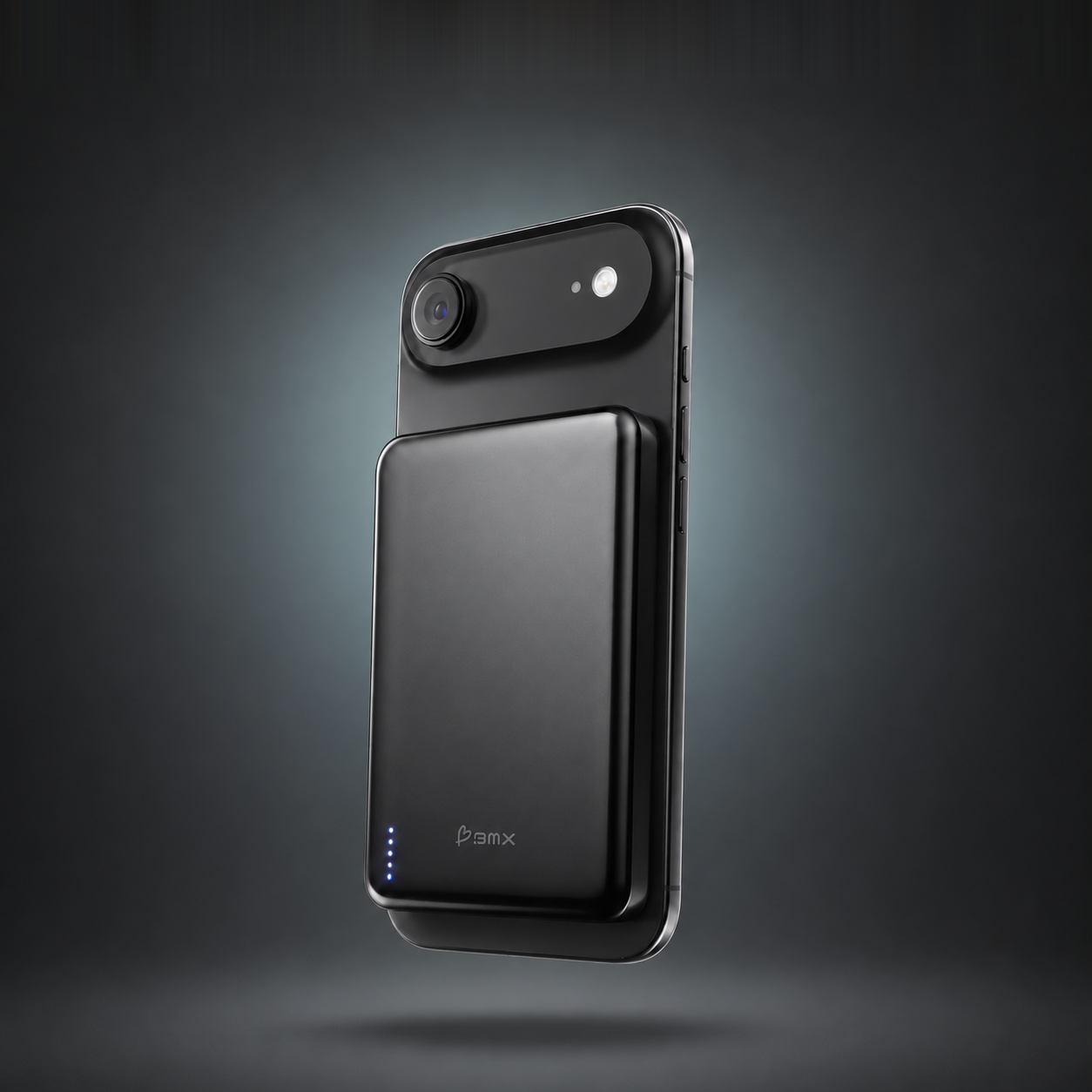
Every BMX SolidSafe power bank ships with the same multi-layer protection circuit stack you will read about below, plus semi-solid-state cells that reduce free-flowing liquid electrolyte underneath them. See the SolidSafe Air →
The 7 layers of protection inside a modern power bank
Most decent consumer power banks, BMX included, run a similar stack of protections. Here is what each one does, in plain English.
1. Overcurrent protection. Limits how many amps can flow into or out of the cells. If a phone tries to pull more than the power bank can safely deliver, or if a faulty cable creates a current spike, the circuit clamps it down. You see this when a high-draw device suddenly stops fast charging and drops to a slower rate. That is overcurrent protection doing its job, not your power bank breaking.
2. Overvoltage protection. The cells inside a power bank are designed to charge up to a specific voltage, usually 4.2 volts per lithium cell or slightly higher for some semi-solid-state chemistries. Push past that, even by a little, and the cell starts to plate metallic lithium on the inside, which is one of the failure modes that leads to thermal events. Overvoltage protection cuts the charge off the moment the voltage gets too high.
3. Undervoltage protection. Run a lithium cell down too far and you damage it permanently. Once it drops below about 2.5 volts, the chemistry stops working properly and recharging it can be unsafe. Undervoltage protection shuts the bank off long before that point. This is the protection layer that creates the small "reserve" you can sometimes feel when a power bank says it is at zero but recharges almost instantly.
4. Short circuit protection. If the positive and negative terminals get connected by something that should not be there, like a piece of metal in your bag or a damaged cable with crossed wires, the current spikes to dangerous levels in milliseconds. Short circuit protection has to react in the same window. The circuit detects the spike and trips the gate before the cells have time to dump their energy through the short.
5. Over-temperature protection. A small thermistor sitting on or near the cells reports the internal temperature back to the protection circuit. If it crosses a programmed limit, usually around 60 to 70 degrees Celsius, charging and output stop until it cools down. This is why your power bank slows or stops in hot cars and at the bottom of a sun-baked beach bag.
6. Under-temperature protection. Charging a lithium battery below freezing damages it through a process called lithium plating, which can cause internal shorts later. Good protection circuits will refuse to charge if the cells are too cold. This one matters less for daily users in temperate climates and more for backpackers, ski trips, and winter travel.
7. Overcharge protection. Once the cells are full, the protection circuit cuts the charging current. Modern lithium cells should never sit at 100 percent under continuous charge for long periods, and overcharge protection is what stops them from doing so. This is also the reason "trickle charging" your power bank overnight is generally fine in modern designs: the protection circuit has already stopped the actual charge hours before you wake up.
A few power banks add an eighth layer: input reverse-polarity protection, which guards against a cable being plugged in backward (rare with USB-C, common enough in older designs to still be worth including). And the better designs also do real-time cell balancing, making sure the cells inside a multi-cell pack stay at the same voltage as each other so no single cell gets overstressed.

Why protection circuits alone are not enough
Here is the part most product pages skip: a protection circuit is a smart bouncer in front of a flammable nightclub. It can keep most trouble outside. It cannot redesign the building.
Conventional lithium-ion cells use a free-flowing liquid electrolyte to move ions between the anode and cathode. That liquid is what makes lithium-ion both efficient and dangerous. When a cell is punctured, crushed, exposed to high heat, or overcharged through a defect the protection circuit did not catch, the liquid electrolyte can vaporize, react, and feed a thermal runaway event. The protection circuit can prevent the trigger. The chemistry decides what happens after the trigger fires.
This is why the same generic "7-layer protection" claim shows up on every recalled power bank you have ever read about in the news. The circuit was usually fine. The cell underneath it was not. Counterfeit cells, contaminated cells, manufacturing defects from a bad batch, or simple age-related degradation can all defeat a layer of protection from the inside. When the cell fails before the circuit can react, the liquid electrolyte is what the heat and pressure escape through.
Semi-solid-state cells, the chemistry inside every BMX SolidSafe power bank, change that picture. They contain significantly less liquid electrolyte, which reduces (not eliminates) the volatile fuel that makes a thermal event more dangerous. The protection circuit still does its job. But if the protection circuit ever misses, the chemistry underneath has less to give. Risk is reduced, not eliminated. That is the honest framing.

| Layer | Standard lithium-ion | Semi-solid-state (SolidSafe) |
|---|---|---|
| Protection circuit (BMS) | Yes, multi-layer | Yes, multi-layer |
| Liquid electrolyte content | High, free-flowing | Significantly reduced |
| If protection circuit misses | Cell can vent, heat, ignite | Less volatile fuel available |
| Behavior under puncture | High risk of thermal event | Drilled in BMX testing without fire |
| Reliance on circuit | Heavy: chemistry needs the gate | Layered: circuit plus calmer chemistry |
How protection circuits actually fail in the real world
Protection circuits are not magic. They are components, and components have failure modes. The most common ones, in roughly the order they show up in CPSC and FAA incident reports:
Counterfeit or low-spec components. Cheap power banks sometimes ship with protection circuits built around clones of the major safety ICs, sourced through unofficial channels. They look right under a scope. They behave correctly under normal load. They miss the edge cases the genuine ICs were designed to catch. This is one of the dominant factors behind the wave of power bank recalls reported across 2024 and 2025.
Manufacturing defects. A solder joint cracks under repeated thermal cycling. A capacitor shifts position during reflow. A thermistor is mounted with too much thermal paste, so it reports a delayed temperature reading and the over-temperature cutoff fires too late. None of this shows up on day one. It shows up six months in.
Cell-side failure that bypasses the gate. If a cell develops an internal short (from a metallic burr, a dendrite, or contamination), the failure can happen inside the cell itself. The protection circuit is watching the leads. The fault is happening downstream of where it can intervene.
Age and abuse. Every charge cycle ages the cell slightly. Heat ages it faster. Drops and crushes age it faster still. After enough years and enough miles, the headroom that the protection circuit was designed to operate within shrinks. The circuit does not get worse. The cell underneath gets harder to protect.
This is not an indictment of protection circuits. It is the boring engineering reality of why "we have 7 protections" is a starting point, not an end state. The cells, the build quality, and the chemistry all matter as much as the circuit doing the watching.
Signs your power bank's protections may be doing less than they should:
- It runs noticeably hotter than it used to during normal charging.
- It cuts out under loads it used to handle without complaint.
- It charges to "full" in dramatically less time than when it was new (often a sign cell capacity has degraded).
- It looks swollen, deformed, or feels different in the hand. Stop using it immediately.
- It smells. Any chemical smell from a power bank is a hard stop. Bag it, take it to a battery recycler, do not put it back in your bag.
What BMX builds in
Every SolidSafe power bank, the Air 5K, the 5K, and the 10K, ships with the multi-layer protection circuit stack described above: overcurrent, overvoltage, undervoltage, short circuit, over-temperature, under-temperature, and overcharge protection. The 5K and 10K add a full color LCD that surfaces what the protection circuit is seeing in real time, so you can read the actual current and voltage instead of guessing.
The Air uses a CCC-certified design that meets China's strict 3C requirement for power banks on domestic flights, an extra layer of regulatory scrutiny on top of the protection electronics. All three SolidSafe banks sit under the 100Wh airline limit so you can fly with them anywhere.
The chemistry layer is the part most brands cannot match. SolidSafe cells are semi-solid-state, with significantly less free-flowing liquid electrolyte than conventional lithium-ion. In internal testing, SolidSafe cells were drilled, cut, and punctured while fully charged with no fire and no thermal runaway. The protection circuit is one safety layer. The semi-solid-state chemistry underneath is the one that decides what happens if the circuit ever has to be wrong.
SolidSafe Power Banks
Protection circuits matter. So does what is underneath them.
Multi-layer protection circuits, semi-solid-state cells with significantly less liquid electrolyte, and a track record of being drilled on camera without catching fire. That is what BMX builds.
See SolidSafe Power BanksFrequently Asked Questions
What does a protection circuit do in a power bank?
A protection circuit watches voltage, current, and temperature in real time and cuts power to the cells the moment any of those values cross a safe threshold. Modern power banks like the BMX SolidSafe lineup typically run seven protection layers: overcurrent, overvoltage, undervoltage, short circuit, over-temperature, under-temperature, and overcharge. It is the safety gate between the cells and everything you plug in.
What is the difference between a BMS and a protection circuit?
A protection circuit (or PCM) is the hardware and safety logic that prevents unsafe voltage, current, and temperature conditions. A battery management system (BMS) is the broader system that includes the protection circuit plus features like cell balancing, charge curve management, state-of-charge reporting, and the LCD readout. In a small consumer power bank like a SolidSafe Air, both functions sit on the same board. In larger packs they can be separate.
Are protection circuits enough to make a power bank safe?
No. Protection circuits are the last line of defense, not the first. They prevent the most common triggers (overcharge, short circuit, overheating) from reaching the cells. But if a cell fails internally, or if the circuit itself is built around counterfeit components, the chemistry inside the cell decides what happens next. Conventional lithium-ion contains a free-flowing liquid electrolyte that can feed a thermal event. Semi-solid-state cells, like the ones inside BMX SolidSafe power banks, contain significantly less liquid electrolyte and reduce that risk.
Can a power bank still catch fire if it has protection circuits?
Yes, and most recalled power banks did have protection circuits. The circuits prevent specific failure modes from outside the cell, but they cannot prevent every failure that starts inside the cell, like an internal short caused by a manufacturing defect, contamination, or age. They also cannot do anything if the circuit itself was built with counterfeit parts. This is why chemistry, build quality, and the brand's actual track record all matter alongside the spec sheet.
What is overcurrent protection in a power bank?
Overcurrent protection limits how many amps can flow through the power bank at any moment. If a connected device tries to pull more current than the bank is rated for, or a faulty cable creates a current spike, the protection circuit clamps it down. You see this when a fast-charging phone suddenly drops to a slower rate under heat or load. That is the protection working as designed, not a defect.
Do all power banks have protection circuits?
Reputable consumer power banks do. The cheapest no-name banks sold through gray market channels sometimes ship with stripped-down or counterfeit protection ICs that pass surface-level testing but miss edge cases. This is one of the main reasons CPSC and FAA recall lists are heavy with off-brand power banks. If a power bank is dramatically cheaper than the established brands and the spec sheet is vague, assume the protection circuit is part of the corner being cut.
How can I tell if a power bank's protection circuits are failing?
Watch for the bank running hotter than it used to during normal charging, cutting out under loads it used to handle, charging to full much faster than it did when new, swelling or deforming, or any chemical smell. Any of those is a reason to stop using the bank, recycle it through a battery drop-off program, and replace it. Visible swelling or smell is a hard stop and should not go back in a bag.
Related guides
- Why Power Banks Get Hot: Normal Heat vs Red Flags and What to Do
- Why Do Power Banks Catch Fire? The Chemistry Behind Battery Fire
- Semi-Solid-State Batteries Explained: What "Less Liquid" Actually Changes
- Thermal Runaway Explained: What It Is and Why Airlines Care
- Can You Charge a Power Bank Overnight? What's Safe, What's Not



Leave a comment
This site is protected by hCaptcha and the hCaptcha Privacy Policy and Terms of Service apply.