


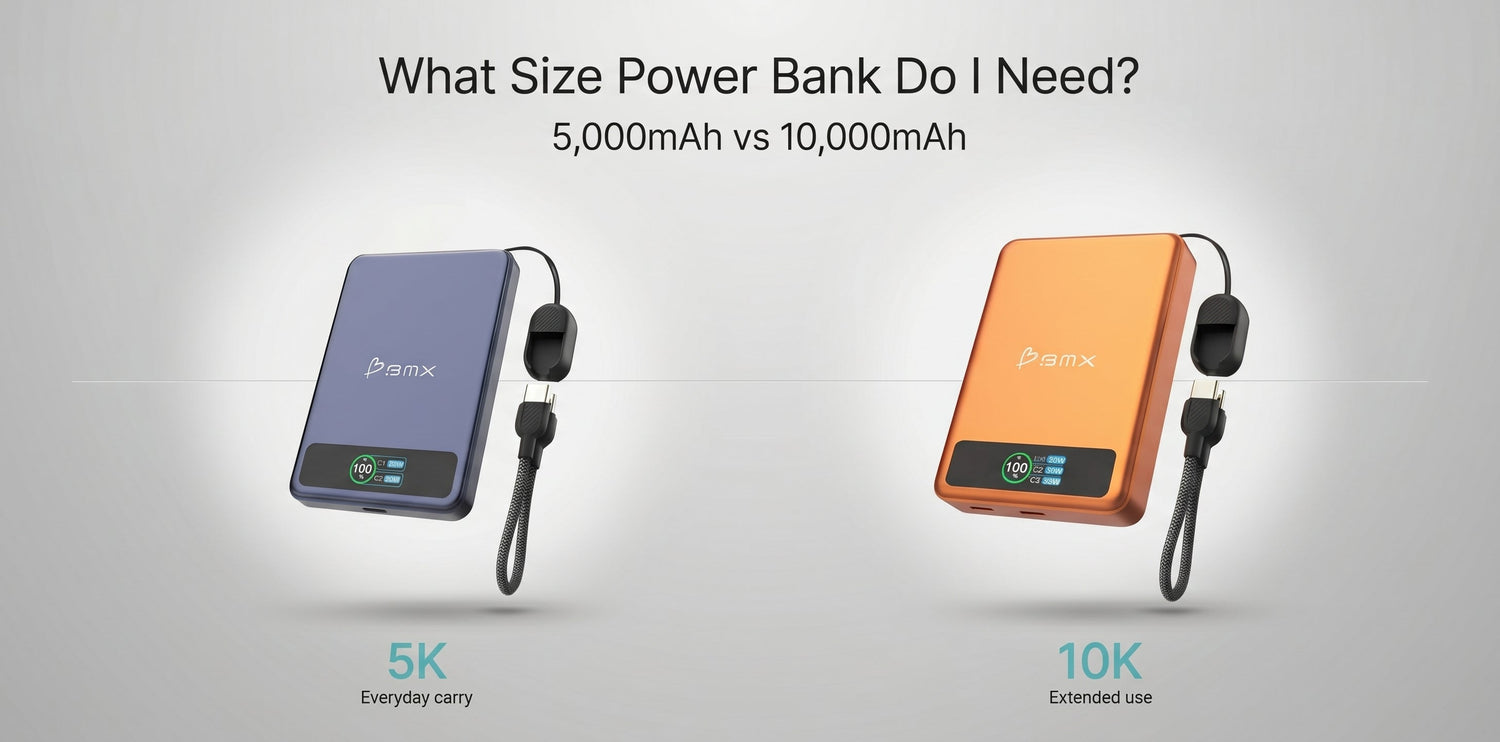
A 5,000mAh power bank gives most phones one full charge plus a small reserve. A 10,000mAh power bank gives you roughly two full charges, or enough headroom to charge a phone, earbuds, and a watch through a long day without running dry. Pick 5K if you need a same-day top-up. Pick 10K if you need all-day, multi-device, or travel-day runway.
Capacity is the one decision most people get wrong when they buy a power bank. They either buy too small, run out halfway through the afternoon, and blame the product. Or they buy too big, carry a brick they never drain, and resent the weight. The right answer is not "whichever number is bigger." It is "which one matches how you actually use your phone."
This guide breaks down the real difference between a 5,000mAh and 10,000mAh power bank, who each one is for, and how to pick without overbuying.
The short answer: how you use your phone decides the size
There are two clean use cases. Once you know which one you are, the decision is already made.
Pick a 5,000mAh power bank if your day usually ends within reach of an outlet and you just need a cushion. You forgot to charge overnight. The meeting ran long. The flight delayed. You want one clean top-up from 20% back to full, not a full-day power station. A 5K is small enough to live in a pocket or a mini bag and disappear until you need it.
Pick a 10,000mAh power bank if your day includes long stretches away from power. You travel. You shoot video. You run navigation plus music plus hotspot for an entire flight or road trip. You charge more than just your phone. Your Pro Max, Galaxy Ultra, or Pixel Pro XL has a bigger battery than the average phone and soaks up more power. A 10K buys you a full day of heavy use or two clean phone charges before you think about refilling it.
Quick rule
5,000mAh = one full phone charge with a small reserve. 10,000mAh = about two full phone charges, or one heavy-use day. If you are ever unsure, go up one size. The cost of running out is always higher than the cost of carrying a few extra ounces.
What mAh actually means for your phone
mAh (milliamp-hours) is how much charge a battery can deliver. Higher number, more energy stored. But there is a translation step people skip: the mAh printed on a power bank is the internal cell capacity, not the amount that transfers to your phone.
Roughly 60% to 70% of a power bank's rated capacity actually makes it to your device. The rest is lost to voltage conversion (5V for USB, 3.7V inside the cell) and heat. This is not a defect. It is physics, and every power bank on the market works this way.
That means a 5,000mAh power bank delivers about 3,000 to 3,500mAh to your phone. Your iPhone 16 has a 3,561mAh battery. Your iPhone 16 Pro Max has a 4,685mAh battery. Your Samsung Galaxy S25 Ultra has a 5,000mAh battery. So a 5,000mAh power bank gets a standard iPhone back to roughly 100%, but only gets a Pro Max or Ultra back to about 70%.
A 10,000mAh power bank delivers about 6,000 to 7,000mAh. That is one full charge on any flagship phone plus another 40% to 60% left over, or two full charges on most standard phones. It is also enough to charge a phone plus a set of earbuds plus an Apple Watch without thinking about it.
One more thing people conflate with size: charging speed. Charging speed is set by wattage, not by mAh. A 5,000mAh bank rated at 20W will charge your phone at the same speed as a 10,000mAh bank rated at 20W. Capacity tells you how many charges you get. Wattage tells you how fast each charge happens. They are two different specs and two different decisions.
If the math helps you zero in on a size, the SolidSafe line gives you 5,000mAh and 10,000mAh options, both built on semi-solid-state battery chemistry instead of standard lithium-ion. See the SolidSafe lineup →
When 5,000mAh is the right call
The 5K is a top-up, not a power station. It is for the person whose day usually lands near an outlet at some point, but who wants a buffer for the hours in between. Commutes. Errands. A night out. A work day where the meeting ran over and the phone is at 18%.
A 5,000mAh power bank is small enough to carry without thinking. Slim ones slide into a pocket or a mini bag like a deck of cards. If you have ever left a bigger power bank at home because it was too bulky to bother with, a 5K solves that. The bank you actually bring is the one that saves you.
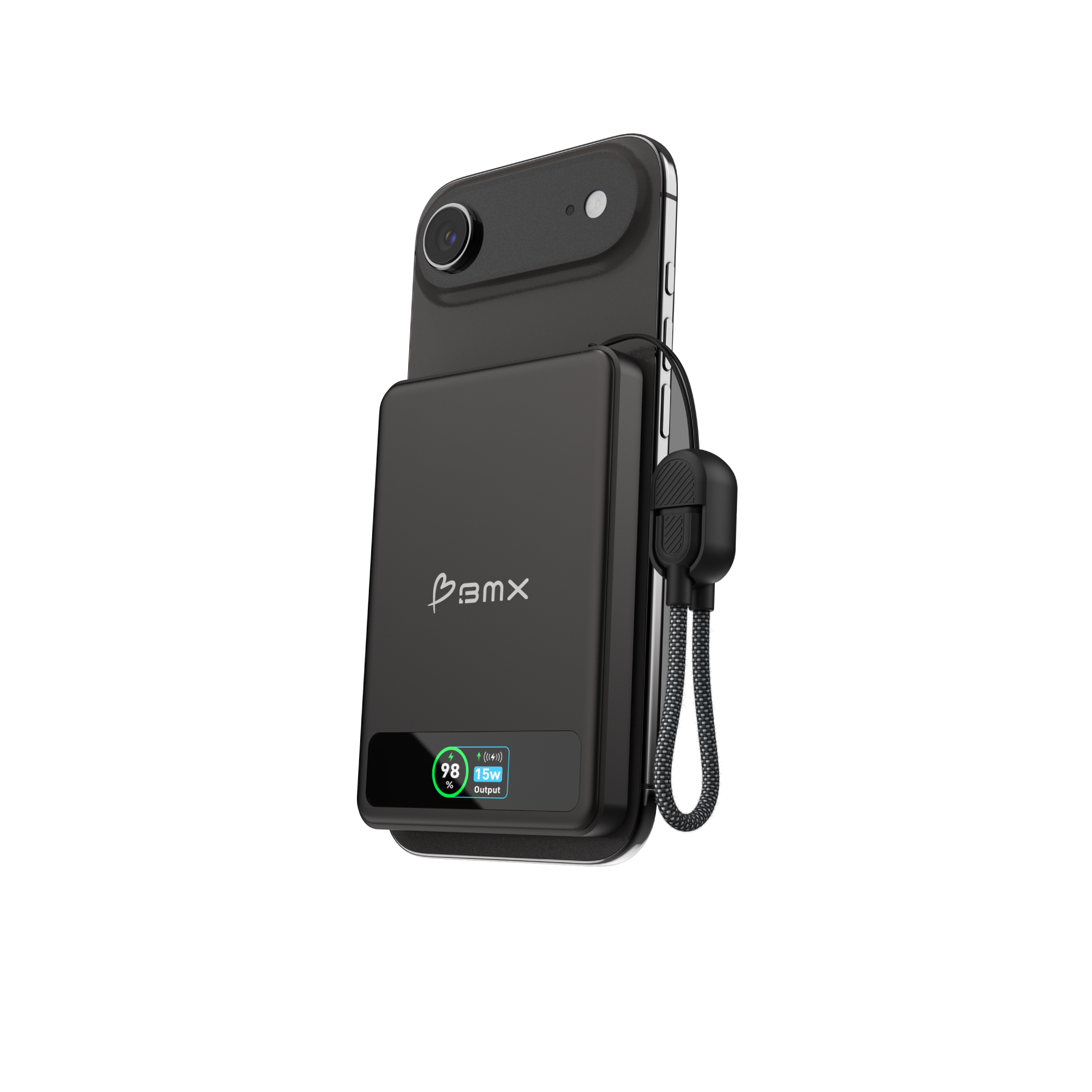
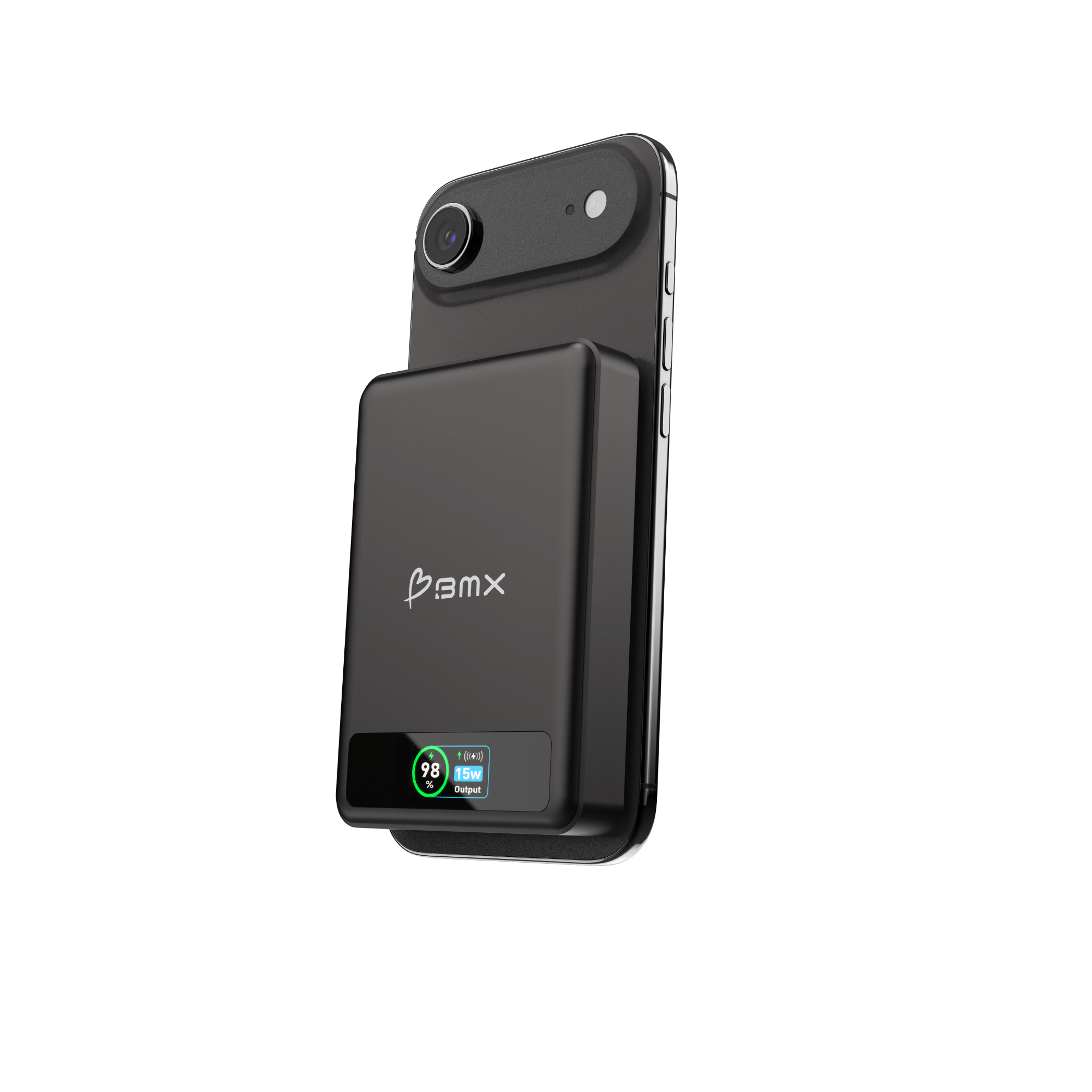
Within the 5K tier, there are two very different flavors of "small." One is the ultra-thin approach: the SolidSafe Air is 6.8mm of titanium with snap-on MagSafe-compatible wireless, no built-in cable, and LED dot indicators instead of a screen. It is designed to disappear in a pocket or on the back of a phone. The other is the full-feature approach: the SolidSafe 5K keeps a full color LCD and a built-in USB-C lanyard cable, adding a couple of millimeters of thickness in exchange for information and convenience. Both are legitimate 5K choices, and the right one depends on whether you want to forget your power bank exists or whether you want to see exactly what it is doing at all times.
Who a 5K is not for: anyone charging multiple devices, anyone whose flagship phone battery is over 4,500mAh, anyone who travels all day, and anyone running navigation plus streaming plus hotspot on the regular. For those users, the 5K will leave you short.
When 10,000mAh is the right call
The 10K is a day-long power source. It handles more than one device, more than one charge, and more than one person if you are the one who carries power for the group.
Ten thousand milliamp-hours gives you roughly two full charges on a standard phone, or one heavy-use day on a Pro Max with enough left to top up earbuds. If you are the person running navigation plus music plus hotspot plus occasional video calls on a flight, the 10K covers you without rationing.
The capacity is not the only upgrade. A 10K usually has more output headroom, so it charges your phone faster when you plug in. It is also more likely to have two or more ports, which means you can charge your phone and your earbuds at the same time instead of alternating. On a 10K, you can realistically top up AirPods or Galaxy Buds 20 or more times between refills, so the small stuff around your phone gets covered for free.
The SolidSafe 10K, for example, has dual USB-C plus Qi2 wireless, so you can charge three devices at once. It also accepts 27W input, which means it refills quickly, which matters more on a bigger bank since there is more capacity to fill.
Who a 10K is not for: someone who wants invisible, ultra-light everyday carry. A 10K weighs noticeably more than a 5K, roughly twice as much in most designs, and takes up more pocket real estate. If you are going to resent carrying it, it will end up in a drawer and you will still run out.
5,000mAh vs 10,000mAh, side by side
Here is how the two sizes map onto real use cases.
| Your day | 5,000mAh | 10,000mAh |
|---|---|---|
| One top-up, near outlets all day | Yes | Overkill |
| All-day phone use, navigation, streaming | Tight | Yes |
| Flight or long road trip | Cuts it close | Yes |
| Charging phone plus earbuds plus watch | Not enough | Yes |
| Going out at night, errands, quick trips | Yes | Too bulky |
| Flagship phone with large battery (Pro Max, Ultra) | One partial charge | One full plus reserve |
| Slipping into a pocket or mini bag | Yes | Tight fit |
And here is what the specs look like across the three SolidSafe power banks, including the two 5,000mAh options (the ultra-thin Air and the full-featured 5K) plus the 10K:
| Spec | SolidSafe Air 5K | SolidSafe 5K | SolidSafe 10K |
|---|---|---|---|
| Capacity | 5,000mAh | 5,000mAh | 10,000mAh |
| Phone charges (typical) | About one full | About one full | About two full |
| Thickness / build | 6.8mm titanium | Thicker, aluminum | Thicker, aluminum |
| Display | LED dots | Full color LCD | Full color LCD |
| Built-in cable | No | Yes (lanyard) | Yes (lanyard) |
| USB-C ports | 1 | 1 | 2 (dual) |
| USB-C output | 20W | 20W | 30W total |
| USB-C input (refill) | 15W | 15W | 27W |
| Qi2 wireless | 15W | 15W | 15W |
| Devices at once | 2 | 2 | 3 |
| Battery chemistry | Semi-solid-state | Semi-solid-state | Semi-solid-state |
| Price | $59.99 | $59.99 | $79.99 |

Why not just buy the biggest one?
It is tempting to skip the decision and buy a 20K or bigger. More capacity is always better, right? Not really.
There are three costs to buying bigger than you need. First, weight. A 10K is about twice as heavy as a 5K, and a 20K is about twice as heavy as a 10K. Carry weight compounds. The power bank that feels fine in your hand feels different when it is in your jacket pocket for eight hours or in a bag you are already overpacking.
Second, size. Bigger batteries are thicker batteries. They stop fitting in pockets and mini bags. The 5K and 10K both slip into a jacket pocket. A 20K often does not.
Third, and most overlooked: airline rules. The FAA and most international aviation authorities cap power banks at 100Wh for carry-on. A 20,000mAh power bank sits around 74Wh, still inside the limit. Anything above 27,000mAh starts bumping into the 100Wh ceiling, depending on cell voltage. And any power bank you can fly with has to go in the cabin, never checked luggage. If you travel, overbuying capacity is not free. It is one decision closer to an airline rule you did not know existed.
The right rule is "one size up from what you think you need, not two." If a 5K feels like it might be tight, go to a 10K. Do not jump to a 20K unless you have a specific reason, like charging a laptop or running a handheld gaming console.
The chemistry matters more than the capacity
Here is the thing no spec sheet tells you. The size of the battery is less important than what is inside it.
Since March, more than 1.7 million lithium-ion power banks have been recalled in the United States for fire risk. Airlines are banning power banks outright or restricting them to specific seat pockets where they can be seen. The root cause is not bad manufacturing. It is the chemistry. Conventional lithium-ion cells are filled with flammable liquid electrolyte, which is what catches fire when a battery overheats, gets punctured, or short circuits.
Semi-solid-state chemistry reduces the amount of flammable liquid inside the cell to a fraction of what standard lithium-ion carries. Less liquid means less fuel for a thermal runaway reaction. It is why SolidSafe power banks can be drilled through while fully charged without catching fire, and why every SolidSafe bank, from the 5K to the 10K, uses the same semi-solid-state chemistry regardless of size.
This is also why capacity matters more than people realize. A 10K carries twice the stored energy of a 5K. If something goes wrong, a 10K has twice as much potential energy to release. That is true whether the cells are lithium-ion or semi-solid-state. But the chemistry determines how much of that energy becomes a fire. When you are picking a size, you are also picking how much risk you are carrying around in your bag. Semi-solid-state is why the SolidSafe line exists. The bigger the battery, the more the chemistry matters.
Frequently asked questions
Is 5,000mAh enough for a phone?
Yes, for most phones and most days. A 5,000mAh power bank delivers roughly 3,000 to 3,500mAh to your phone after conversion losses, which is enough to get a standard iPhone from empty to full, or a flagship Pro Max or Galaxy Ultra to about 70%. Not enough for a full day of heavy use or multi-device charging.
How many phone charges does a 10,000mAh power bank give?
About two full charges on a standard phone, or one and a half charges on a flagship with a large battery. After voltage conversion, a 10,000mAh power bank delivers roughly 6,000 to 7,000mAh to your devices. Enough for a full heavy-use day or multi-device charging.
Do I need 10,000mAh or 20,000mAh?
10,000mAh covers almost every consumer phone use case: full-day travel, multi-device charging, flagship phones with large batteries. Go to 20,000mAh only if you are charging a laptop, a handheld gaming console, or running multiple days without access to an outlet. Otherwise the extra weight and thickness is not worth it.
What size power bank can I take on a plane?
FAA and most international aviation rules cap power banks at 100 watt-hours (Wh) for carry-on. A 5,000mAh bank is around 18Wh and a 10,000mAh bank is around 37Wh, both comfortably under. Even a 20,000mAh bank (about 74Wh) is allowed. Above roughly 27,000mAh you start running into the limit. Power banks must go in carry-on, never checked luggage.
Why does a 10,000mAh power bank not give me 10,000mAh?
Because the mAh rating is the internal cell capacity at 3.7 volts, not the output at 5 volts (USB). Voltage conversion plus heat and efficiency losses mean about 60% to 70% of the rated capacity actually makes it to your phone. This is true for every power bank on the market and is a function of physics, not a defect.
What is the difference between a 5K and a 10K power bank?
A 5K (5,000mAh) gives you about one full phone charge. A 10K (10,000mAh) gives you about two full phone charges plus enough headroom to charge earbuds or a watch. 10K power banks also tend to have more ports and faster output and input speeds. The 10K is larger and heavier in exchange.
Can I charge an iPhone 16 Pro Max with a 5,000mAh power bank?
Partially. The iPhone 16 Pro Max has a 4,685mAh battery. After conversion losses, a 5,000mAh power bank delivers roughly 3,200mAh to your phone, which takes a Pro Max from empty to about 70%. If you want a full charge on a Pro Max or Galaxy Ultra, go with a 10,000mAh bank.
Is 5,000mAh enough for iPhone 15 or iPhone 16?
Yes, for the standard models. The iPhone 15 has a 3,349mAh battery and the iPhone 16 has a 3,561mAh battery. A 5,000mAh power bank delivers roughly 3,000 to 3,500mAh after conversion, which is enough to take either phone from empty to 100% once. For the Pro Max models (4,422mAh and 4,685mAh), a 5,000mAh bank will get you to about 70 to 80%. If you need a full charge on the Pro Max, step up to a 10,000mAh.
Does a higher mAh power bank charge faster?
No. Charging speed is set by wattage, not by mAh. A 5,000mAh power bank rated at 20W will charge your phone at the same speed as a 10,000mAh power bank rated at 20W. The mAh number tells you how many charges you get before the bank itself needs refilling. The watt number tells you how fast each charge happens. If you want faster charging, look for higher wattage output (20W, 27W, 30W, or more), not higher capacity.
SolidSafe Power Banks
Pick the size that matches how you actually use your phone.
The SolidSafe Air 5K for invisible everyday carry. The SolidSafe 5K for a top-up you can see and control. The SolidSafe 10K for all-day, multi-device, travel-day power. All three built on semi-solid-state chemistry to reduce fire risk.
See SolidSafe Power Banks


Leave a comment
This site is protected by hCaptcha and the hCaptcha Privacy Policy and Terms of Service apply.