


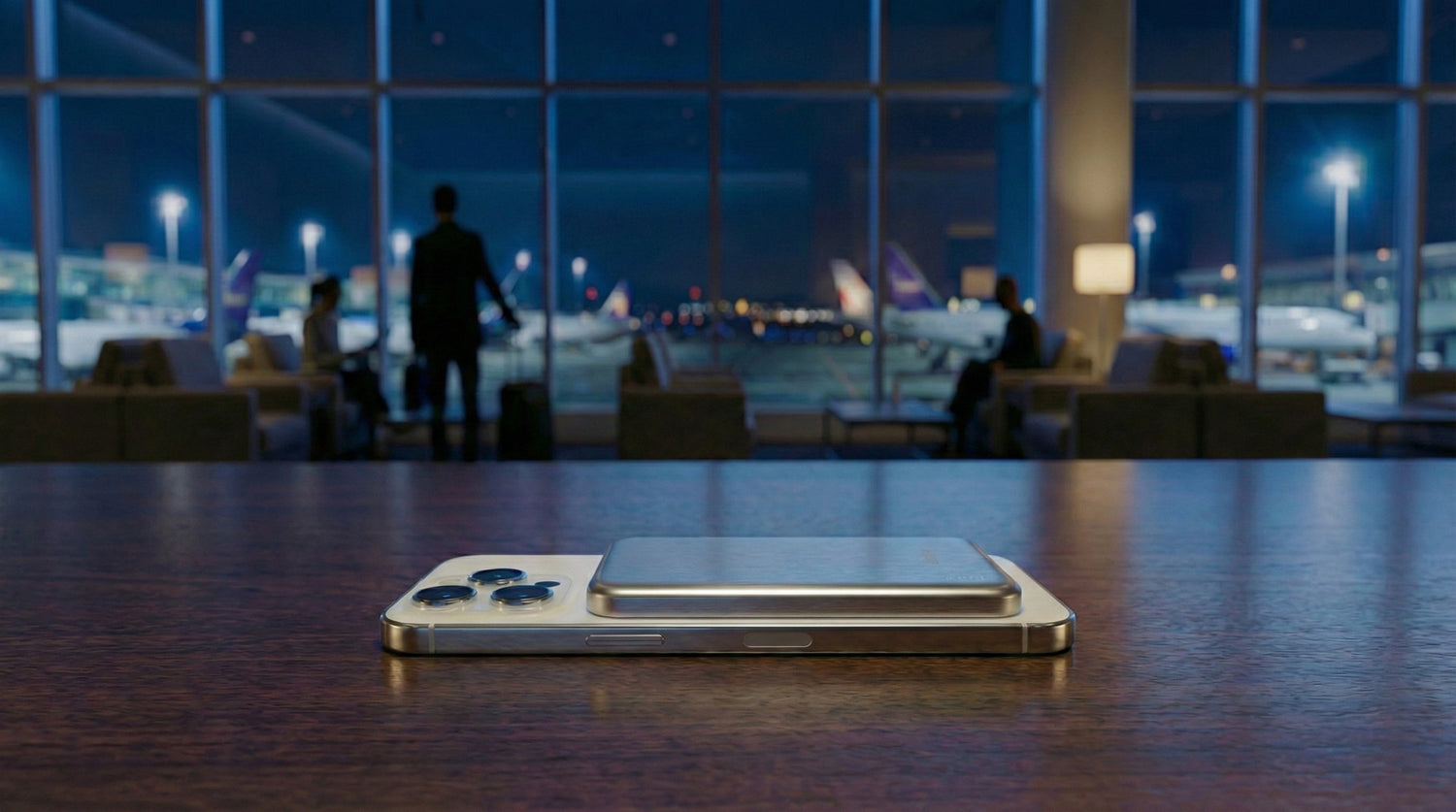
An airline friendly power bank in 2026 is a lithium-cell pack rated under 100 watt-hours (Wh), with the rating clearly printed on the case, packed in your carry-on, and ideally built on chemistry that reduces fire risk. No agency tests or certifies power banks as "airline approved." The rules are about watt-hours, packaging, and where the battery rides, not a sticker on the box.
Walk through any airport store or scroll any product page and you will see "TSA friendly," "airline approved," "flight ready," "safe for carry-on." These phrases are mostly marketing. The Transportation Security Administration does not run an approval program for power banks. The FAA does not stamp batteries. There is no TSA logo a manufacturer can earn.
What actually decides whether your power bank makes it through security and onto the plane is a short list of physical facts: the watt-hour rating, the chemistry inside, the way the terminals are protected, and the bag you put it in. This guide walks through each one so you stop worrying about the buzzwords and start packing the right battery.
"Airline Friendly" Isn't a Real Certification
There is no government body or trade group that issues an "airline friendly" or "TSA approved" badge for power banks. The TSA's own guidance page on power banks says the same thing in plain language: lithium-ion batteries with a capacity at or under 100 watt-hours are permitted in carry-on baggage, and anything from 100 Wh up to 160 Wh needs airline approval. Above 160 Wh, you cannot bring it on a passenger flight at all.
That means "airline friendly" is shorthand for "this power bank meets the 100 Wh carry-on limit," not a certification anyone awarded. A brand that prints "TSA approved" on the box is using the phrase the way customers search for it, not the way regulators define it. When evaluating any power bank for travel, ignore the badge language and look at the printed Wh figure on the device. That is the only number a screening officer cares about.
The Watt-Hour Number Is the Only Number That Matters
Power banks sell themselves on milliamp-hours (mAh) because the number is bigger and easier to compare on a shelf. Airlines and the FAA do not measure in mAh. They measure in watt-hours (Wh), because Wh is the actual energy a battery can release. mAh by itself ignores voltage, and energy is the variable that determines how dangerous a thermal event would be.
The conversion is straightforward: Wh equals mAh divided by 1,000, multiplied by the cell's nominal voltage. Most lithium-ion power banks use cells at 3.7 V nominal. So a 10,000 mAh power bank stores about 37 Wh of energy, well under the 100 Wh limit. A 27,000 mAh pack lands right at the line.
Quick math
Wh = (mAh / 1,000) x 3.7 V. A 5,000 mAh power bank is about 18.5 Wh. A 10,000 mAh is about 37 Wh. A 20,000 mAh is about 74 Wh. A 27,027 mAh is exactly 100 Wh. Most travelers never come close to the limit, but they also rarely look at the Wh number.
| Power Bank Capacity | Watt-Hours (at 3.7 V) | Airline Status |
|---|---|---|
| 5,000 mAh | 18.5 Wh | Allowed in carry-on |
| 10,000 mAh | 37 Wh | Allowed in carry-on |
| 20,000 mAh | 74 Wh | Allowed in carry-on |
| 27,000 mAh | 99.9 Wh | At the limit, allowed |
| 30,000 mAh | 111 Wh | Requires airline approval (100-160 Wh) |
| 45,000+ mAh | 160+ Wh | Not allowed on passenger flights |
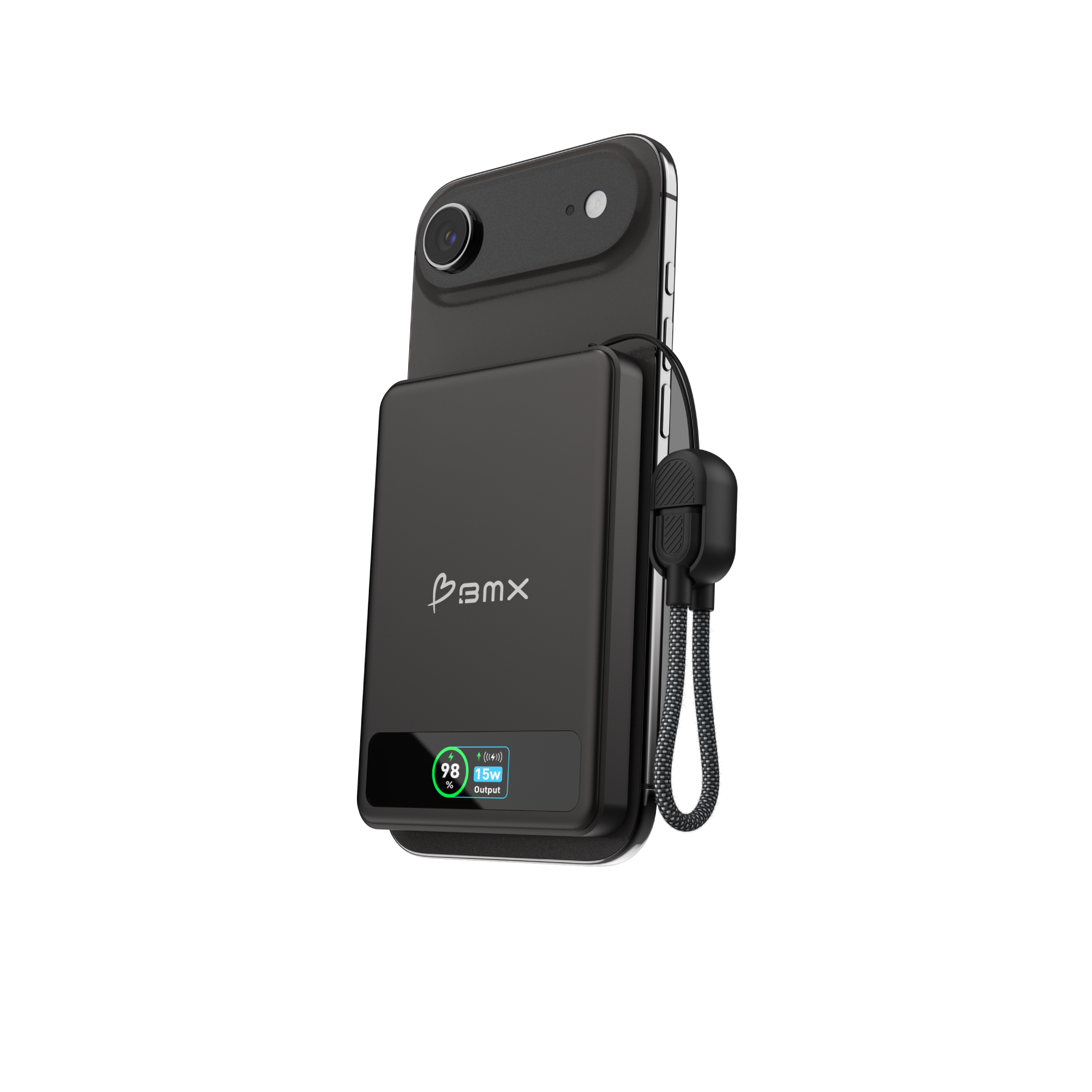
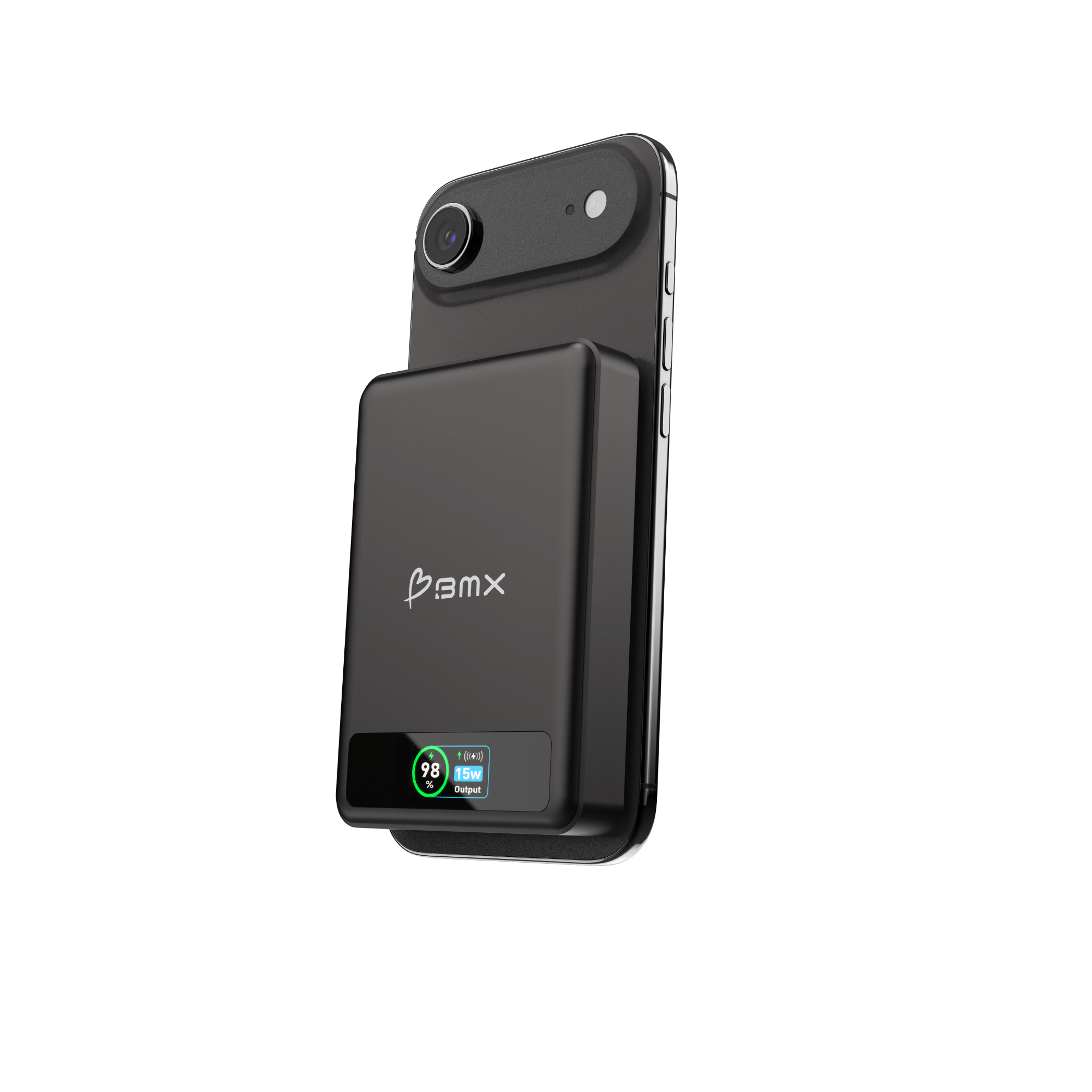
The BMX SolidSafe Air 5K is 18.5 Wh on a 6.8mm titanium body, well under the carry-on limit and one of the few semi-solid-state power banks on the US market with CCC certification for China-route compliance. See the SolidSafe Air 5K →
Why Packaging Matters as Much as Capacity
Most "airline friendly" buying guides stop at the watt-hour number. The FAA does not. The federal hazardous materials regulations for lithium batteries (49 CFR 175.10) require that batteries be carried in a way that prevents short circuits, accidental activation, and physical damage. For loose spare batteries the rule is explicit: terminals must be protected, by original packaging, a battery case, tape over the contacts, or by placing each battery in its own plastic bag.
Sealed-housing power banks already meet this rule because the lithium cells are enclosed and the USB ports are not exposed terminals. That is one reason finished power banks usually pass screening while loose 18650 cells in a bag often get pulled. But two practical things still trip travelers up: the unit needs to be turned off or unable to turn itself on inside a bag, and there should be no metal items (coins, keys, hair clips) crammed into the same pocket that could press buttons or scrape connectors.
Carry-On Only Is a Hard Rule, Not a Suggestion
Lithium-ion power banks are not allowed in checked baggage. This is consistent across the FAA, IATA, the European Aviation Safety Agency, and the Civil Aviation Administration of China. It is also the rule with the least flexibility. If a power bank is found in a checked bag, the airline can refuse to load the bag, hold it for retrieval, or fine the passenger depending on jurisdiction.
The reason is simple: the cargo hold is unpressurized at the cell level, hard to monitor, and difficult to reach if a battery starts to vent or smoke. The cabin is where flight crew can see, isolate, and contain an event. If your power bank starts behaving strangely, an attendant can grab it and drop it in a thermal containment bag. They cannot do that to a bag in the hold.
This rule also covers anything with a non-removable battery: a laptop, a tablet, a vape, a wireless headphone case. The cabin is the only legal place for those too.
Where Chemistry Comes Into the Conversation
The Wh limit and the carry-on rule exist for one reason: lithium-ion batteries can enter thermal runaway, where the cell heats itself faster than it can shed heat, vents flammable electrolyte, and ignites. That is what airline crews train for. The FAA has logged hundreds of in-flight lithium battery incidents involving personal electronics and power banks since 2006.
That risk does not vanish with a higher-capacity number on the label or a sticker that says "airline approved." The risk is set by the chemistry inside. A power bank built on conventional lithium-ion with a free-flowing liquid electrolyte carries the standard fire risk if the cell is punctured, overheated, or damaged. A power bank built with semi-solid-state cells contains significantly less liquid electrolyte, which reduces the risk of an exothermic vent and fire if the cell is compromised. It is a chemistry difference, not a magic claim.
The BMX SolidSafe line is built on semi-solid-state cells. In internal testing, SolidSafe cells were drilled, cut, and punctured while fully charged with no fire and no thermal runaway. The chemistry is what makes the result possible, not the housing.

SolidSafe cell drilled while charged. No fire, no thermal runaway.
Semi-solid-state does not mean zero risk. It means reduced risk. The honest framing matters because every other piece of marketing copy in this category claims more than the chemistry can deliver, and that overclaim is what got the lithium-ion category in trouble with airlines in the first place.
Airline-Safe SolidSafe Lineup

Different Countries, Different Rules
The 100 Wh carry-on threshold is the global default because both the International Civil Aviation Organization and IATA use it. Most major aviation authorities follow that line, but several jurisdictions add wrinkles travelers miss.
China (CAAC): As of June 2025, power banks on China domestic flights must carry the CCC ("3C") certification mark, the country's compulsory product safety certification. Power banks without a visible CCC mark on the unit are being confiscated at security on domestic legs, regardless of Wh capacity. The BMX SolidSafe Air 5K is CCC certified for travel to and within China. Many US-market power banks are not.
India (DGCA): Power banks are not allowed in checked baggage at all. The 100 Wh and 100-160 Wh thresholds match the global standard, but enforcement is stricter and some Indian carriers cap the number of spare lithium devices per passenger.
European Union (EASA): Follows IATA 100 / 160 Wh thresholds. No special chemistry approval, but several EU carriers, including Lufthansa and Air France, require that power banks not be in use during the flight and must be visible (not buried in a closed overhead bag) for emergency access.
Singapore, Hong Kong, Thailand, Australia: All follow ICAO and IATA standards. Recent incidents on Asian and Pacific routes have led to stricter spot checks but no rule changes.
When in doubt, check the specific airline's dangerous goods page before you fly. The most important detail for international travel is that the Wh number is printed on the case, and that the chemistry inside is not compromised.
How to Read a Power Bank Label Like a Safety Inspector
Pull a power bank out of a drawer and turn it over. There is usually a small block of printed text on the back or bottom. Here is what to look for and what to ignore.
Look for, in this order:
- The Wh rating, printed plainly. If the unit only lists mAh, do the math yourself.
- The cell chemistry, sometimes listed as "Li-ion," "Li-Po," "LiFePO4," or "semi-solid-state."
- Certification marks: UL or ETL listing for US, CE for EU, CCC for China, PSE for Japan, KC for Korea.
- The voltage of the internal cells (3.7 V nominal is the standard, some packs run higher).
Ignore: "TSA Approved" badges, "FAA Friendly" stamps, "Flight Safe" logos. These are not real certifications. A power bank with all the right specs but none of those badges is just as airline-safe as one plastered with them. A power bank covered in marketing badges but without a clearly printed Wh rating is the riskier choice at the screening checkpoint.
A 60-Second Pre-Flight Check
Before you walk out the door:
- Confirm the printed Wh on each power bank is at or below 100. If between 100 and 160, get airline approval in writing in advance.
- Move every power bank from your checked bag to your carry-on. This includes spares.
- Power the unit fully off, not in standby. Many modern power banks turn themselves on if a USB-C cable wiggles.
- Stash it in a dedicated pouch or sleeve, not loose against keys, coins, or metal pens.
- For China-bound legs, confirm a visible CCC mark on the case.
- If you are traveling internationally with more than one power bank, photograph the labels with phone-camera-readable Wh numbers in case you are asked.
SolidSafe Power Banks
Power that clears the rules, not just the slogans.
BMX SolidSafe power banks are semi-solid-state, under 100 Wh, and built with chemistry that reduces fire risk instead of marketing copy that claims it away.
See SolidSafe Power BanksFrequently Asked Questions
What does "airline friendly power bank" actually mean?
It means a power bank that meets the FAA and IATA rules for carry-on lithium batteries: rated at 100 Wh or less, carried in the cabin (never checked), with the Wh number clearly printed on the unit. There is no official "airline friendly" certification. The term is a marketing shorthand for "meets the rules."
Is there a "TSA approved" power bank certification?
No. The TSA does not run a power bank certification program. It enforces the FAA's 100 Wh carry-on limit and bans lithium-ion batteries from checked baggage. A power bank that prints "TSA approved" on the box is using the phrase as marketing, not citing a real credential. The watt-hour rating on the device is what matters at the checkpoint.
How many watt-hours can I bring on a plane?
Up to 100 Wh in your carry-on without any approval. From 100 Wh to 160 Wh you can bring up to two units, but you need explicit airline approval in advance. Anything over 160 Wh is not allowed on a passenger flight. A typical 10,000 mAh power bank is about 37 Wh, well inside the limit.
Can I pack a power bank in checked luggage?
No. The FAA, IATA, EASA, and CAAC all prohibit lithium-ion power banks in checked baggage. They must travel in the cabin so flight crew can isolate a thermal event quickly. If a power bank is found in a checked bag during screening, the airline may pull the bag, charge a handling fee, or refuse to load it.
Does semi-solid-state chemistry change the airline rules?
Not on the regulatory side. Semi-solid-state power banks under 100 Wh follow the same carry-on rules as any other lithium pack. What chemistry changes is risk, not eligibility. A semi-solid-state cell contains significantly less liquid electrolyte than a conventional lithium-ion cell, which reduces the chance of a vented fire if the cell is punctured or damaged. The Wh number still determines whether security lets it through.
Why are airlines suddenly cracking down on power banks?
The FAA has logged a rising number of in-flight lithium battery incidents involving power banks since 2022, and a few high-profile cabin fires on Asia-Pacific carriers in 2024 and 2025 accelerated rule changes. The recent CCC requirement in China is the most visible example: as of June 2025, power banks on domestic Chinese flights must carry the CCC ("3C") certification mark or they are confiscated.
How do I check the Wh of a power bank that only lists mAh?
Use the formula Wh = (mAh / 1,000) x V, where V is the nominal cell voltage. Most lithium-ion power banks use 3.7 V cells, so a 10,000 mAh pack is roughly 37 Wh. Some higher-output power banks use stacked cells at 7.4 V or 11.1 V nominal, in which case the printed Wh on the case is the only honest number. Always trust the Wh figure over the mAh figure for airline math.
Which BMX power bank is best for international flights?
For travelers who want the slimmest profile and CCC certification for China-route compliance, the BMX SolidSafe Air 5K at 18.5 Wh is the lead pick. For longer trips that need more capacity, the SolidSafe 10K at 37 Wh covers all-day power plus wireless, USB-C, and a color LCD, all well inside the 100 Wh limit. Both are semi-solid-state and built to reduce, not eliminate, fire risk.
Related guides
- Safest Power Bank for Air Travel in 2026
- Power Bank Rules on Planes: The 2026 Update
- mAh vs Wh: How the Airline Limit Actually Works
- CCC Certification: What It Is and Why It Matters for China Flights
- Power Bank Wh Calculator: Is Mine Allowed on a Plane?
- SolidSafe Air 5K product page
- All SolidSafe power banks

Leave a comment
This site is protected by hCaptcha and the hCaptcha Privacy Policy and Terms of Service apply.